New vinyl LPs from Leonard Cohen and Hawkwind out now!
Order now from http://www.1960s.london
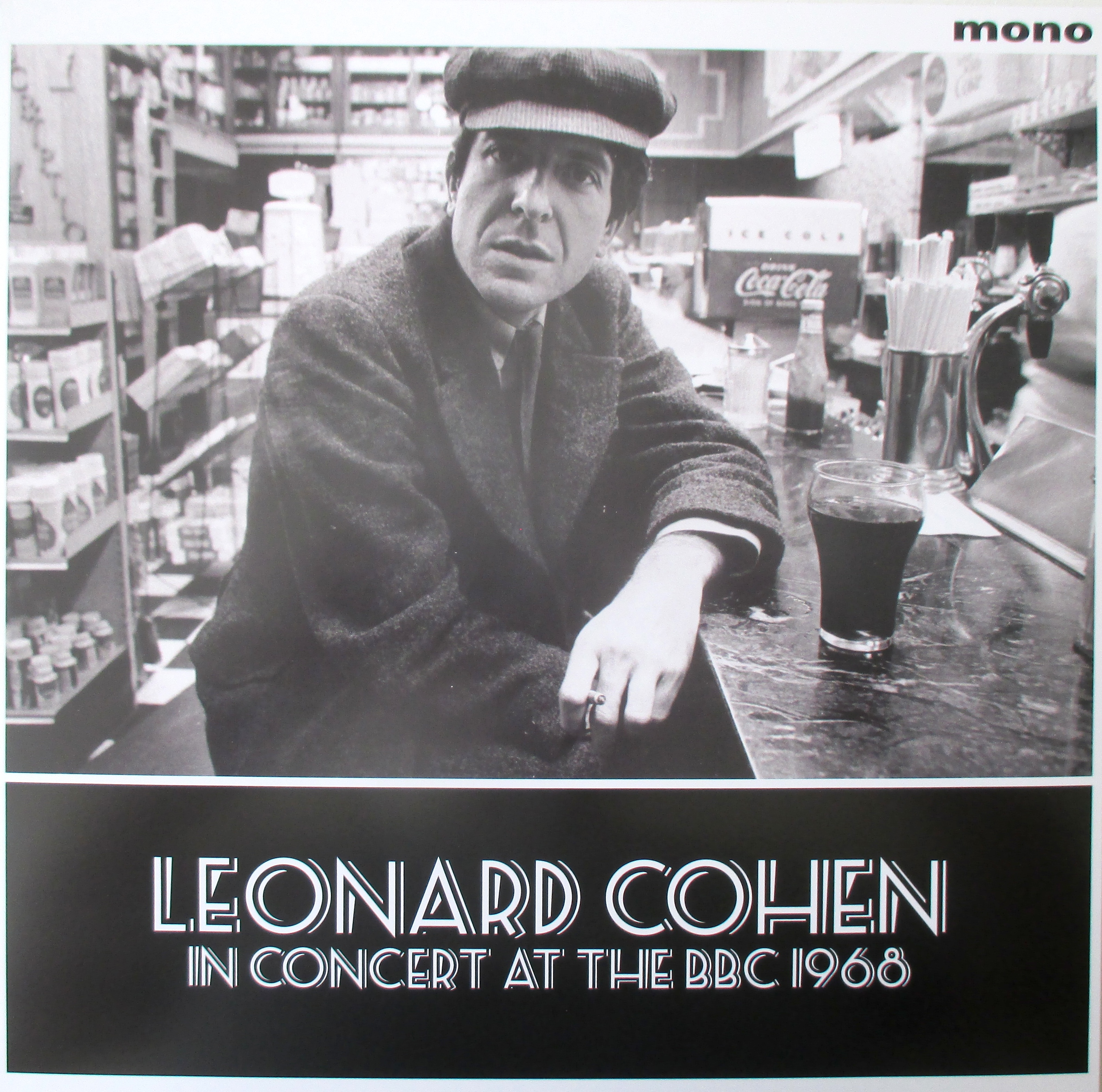
Leonard Cohen – Live On The BBC 1968
Tracklisting
Side One
- You Know Who I am
- Bird On The Wire
- The Stranger Song
- So Long, Marianne
- Sisters Of Mercy
Side Two
- Master Song
- There’s No Reason Why You Should Remember Me
- Teachers
- Dress Rehearsal Rag
- Suzanne
- Hey, That’s No Way To Say Goodbye
All songs written by Leonard Cohen
Recording Details
All tracks recorded at the Paris Theatre, Lower Regent Street, London on Wednesday 20th March and broadcast on BBC2 television as ‘Leonard Cohen Sings Leonard Cohen’ on Saturday 31st August (Side One Tracks 1-4, Side Two Track 2) and Saturday 7th September (Side One, Track 5 and Side Two Tracks 2-6)
Personnnel
Leonard Cohen – vocals, acoustic guitar
Dave Cousins – banjo, guitar
Danny Thompson – double bass
Ted Taylor – organ
Maggie Stredder, Marian Davies, Gloria George – backing vocals
Recording Quality
Excellent throughout
Sleevenotes
“Like Joni Mitchell, or Laura Nyro or Neil Young or Jackson Browne, Leonard Cohen wrote of struggling with a susceptibility to romantic bondage. But Cohen presented a unique combat strategy, since he had no special eagerness to win the battle, and knew how to make the most out of defeat.” Janet Maslin, Rolling Stone (1976)
By the time Leonard Cohen arrived in London to record a BBC television special for producer Stanley Dorfman he had achieved much acclaim for his debut LP Songs Of Leonard Cohen, released by Columbia in December the preceding year. It was actually Cohen’s second appearance for the BBC as he had already been a guest on Once More With Julie Felix. Before his recording career Cohen had published poetry and two novels, The Favourite Game (1963) and Beautiful Losers (1966). Both books got excellent reviews but neither sold enough copies for Cohen to make a living as a writer. This prompted his move into songwriting, initially writing for others and then writing and performing his own material. Cohen became a recording artist after he wrote the song Suzanne. At the time Cohen was living in his native Montreal, but had met Judy Collins during a visit to New York. “I phoned Judy Collins and I played Suzanne to her on the phone and she said ‘Oh I want to record that’ . So I went down to New York and gave her the chords and that gave me the opportunity to play for John Hammond.” Hammond signed Cohen to Columbia records.
Of the eleven songs featured here, seven are taken from Cohen’s debut LP: The Stranger Song, So Long, Marianne, Sisters Of Mercy, Master Song, Teachers, Suzanne and Hey, That’s No Way to Say Goodbye whilst You Know Who I Am and Bird On A Wire come from its follow up (Songs From A Room, 1969). Dress Rehearsal Rag would be released on Songs Of Love And Hate (1971), although it had been attempted during the Songs From A Room sessions. There’s No Reason Why You Should Remember Me is an ‘improvisation’ which would not appear on a Cohen studio LP.
The musical director for this performance was Dave Cousins, who would subsequently find fame leading The Strawbs. At the time he was producing London News, a weekly radio show covering the world-wide music scene for Danmarks Radio that was recorded in the BBC Radio One studios in Broadcasting House. He remembers “I listened to every new album release to compile the tracks for the show, and one such was Leonard Cohen’s first album, it was strange, hypnotic and I listened over and over. Somehow I had also become the go-to folk session player in London but I must admit to being a little apprehensive when booked for the recording of the Cohen television special.
On the morning of Tuesday 19th March I met Leonard (‘call me Len’) for the rehearsal. For each song I asked him whether he wanted me to play guitar or banjo, and he said ‘whatever you think suits it best’. In the afternoon we ran through the songs again with the Ladybirds as backing vocalists, Ted Taylor on organ and Danny Thompson on bass. The following morning, we met up again for the full camera rehearsal. In the afternoon, the stage manager called a two-hour break before the audience was allowed in for the recording. In the corridor I met Leonard wearing a dressing gown, but no trousers. ‘Where are your trousers, Len?’ I asked. ‘They’re in Wardrobe being pressed’ he said, ‘I’ve only got one pair of trousers.’.”
Cousins’ musical backing carefully framed Cohen’s vocals, being supportive without distracting from the words and melodies. Len revealed his dry sense of humour when introducing the songs, whether it was relating an encounter with two girls who claimed to have introduced the mini-skirt to Edmonton (Sisters of Mercy) or explaining a narrow escape with his long-term Norwegian muse (So Long, Marianne). The set finishes with two of Cohen’s best known songs. Suzanne is another ode to a different muse, the ballet dancer Suzanne Verdal. It is followed by a delicate Hey, That’s No Way To Say Goodbye, another song for Suzanne.
Judy Collins claims that the first time she met Leonard Cohen he said ”I can’t sing, and I can’t play the guitar. I don’t know if this is a song.” One listen to Leonard Cohen Sings Leonard Cohen proves him wrong.
Sleevenotes: Shel C. O’Dell
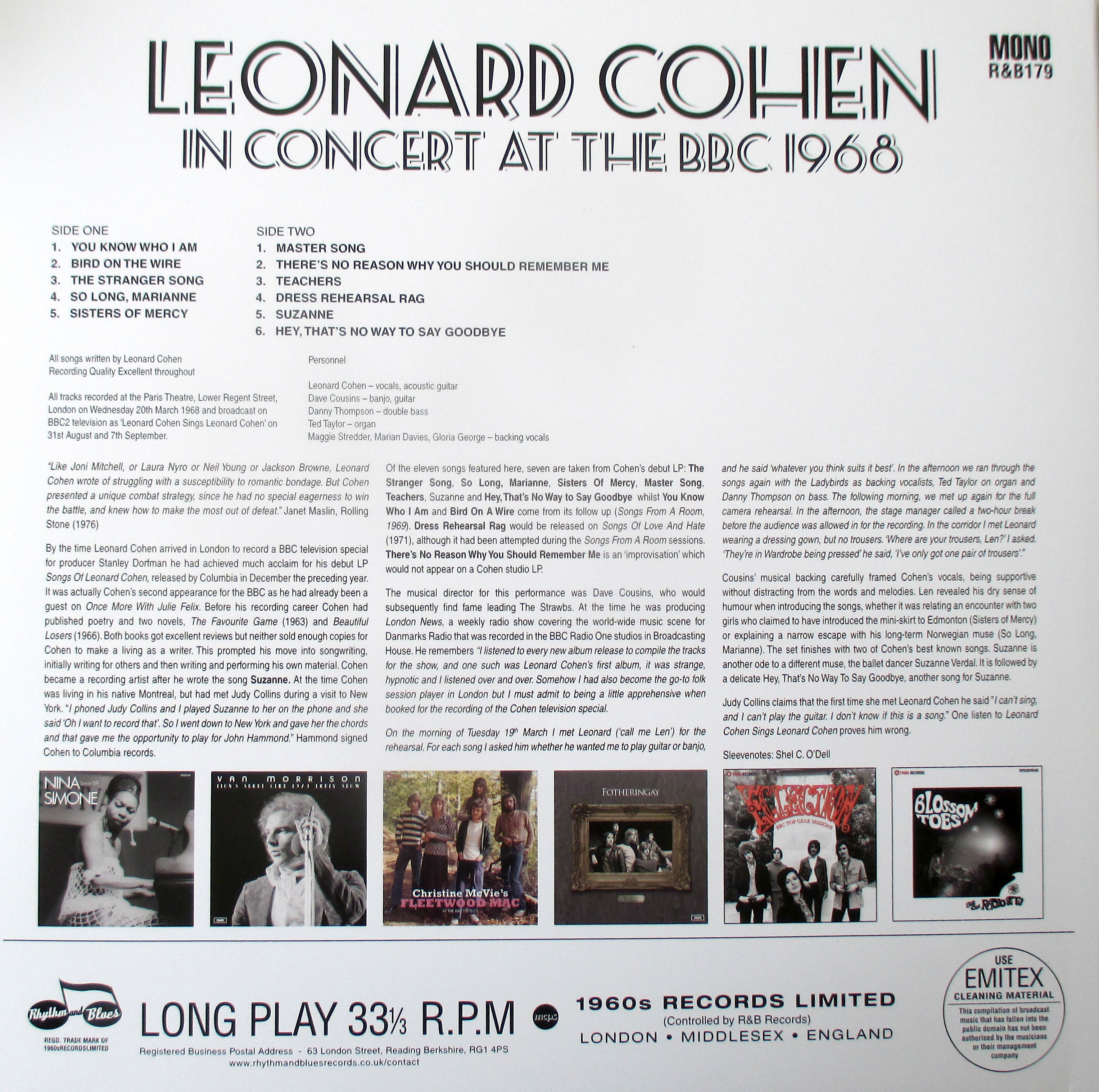
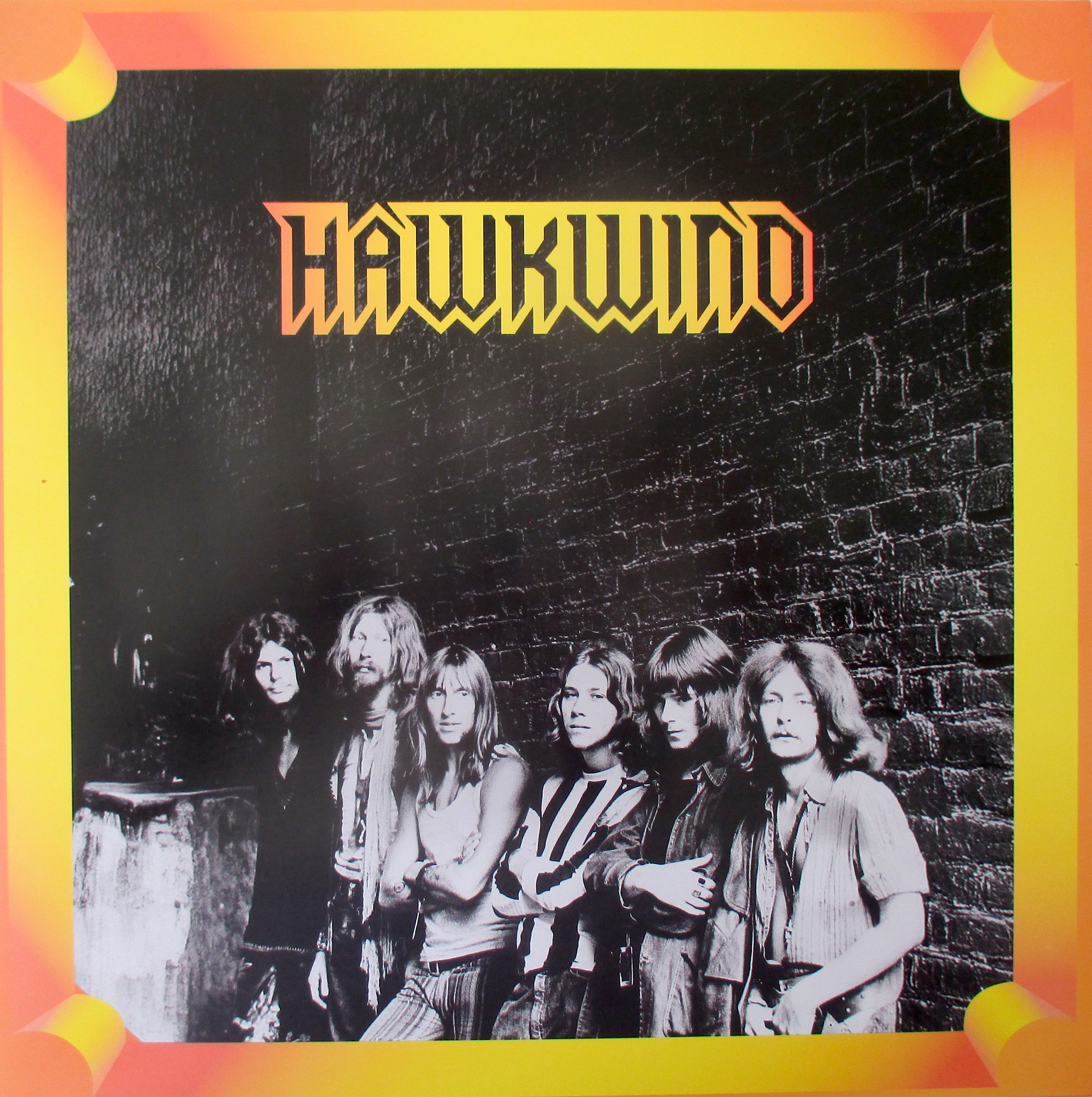
Hawkwind
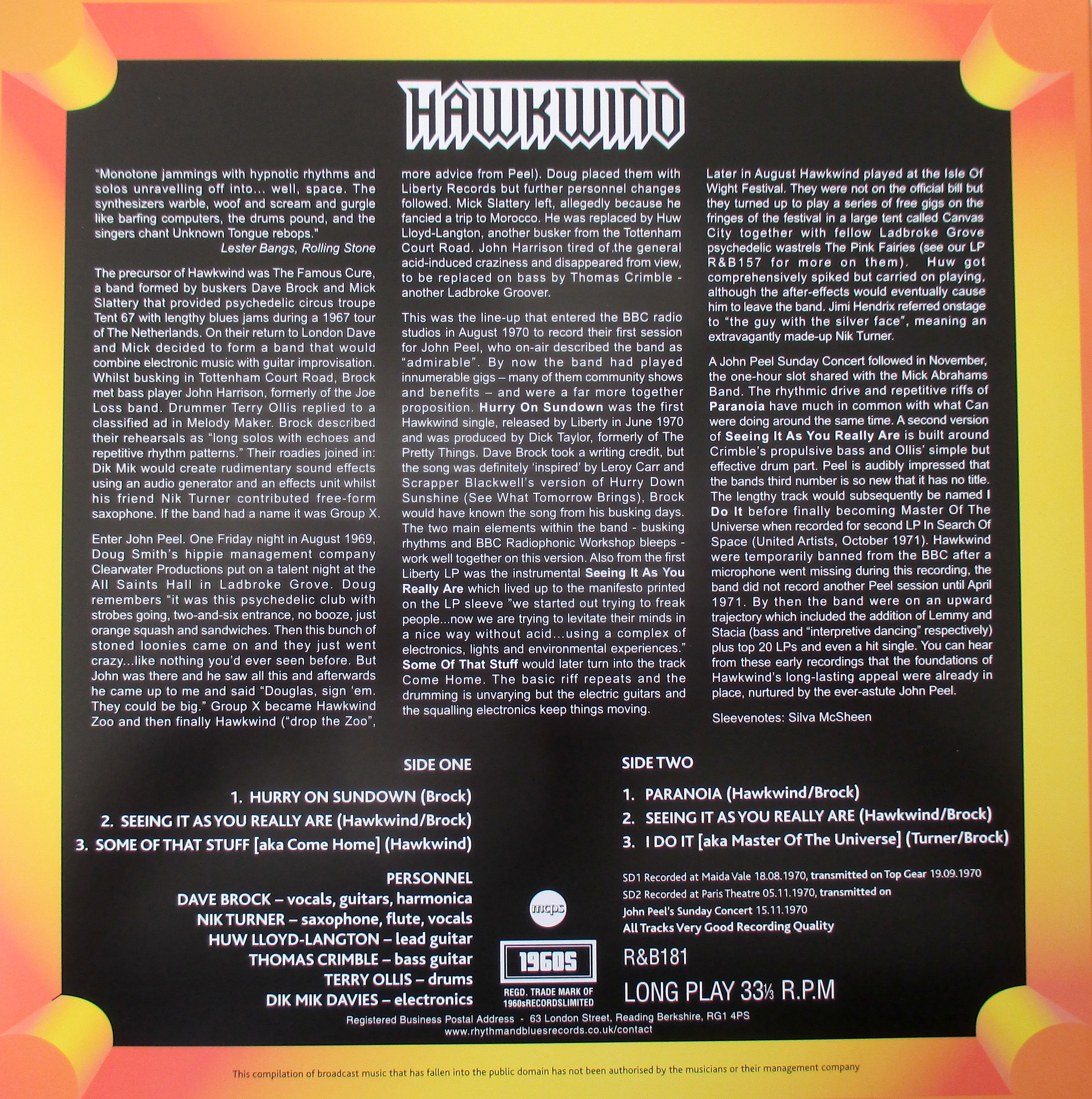
At the BBC 1970
Tracklisting
Side One
- Hurry On Sundown (Brock)
- Seeing It As You Really Are (Hawkwind/Brock)
- Some Of That Stuff aka Come Home (Hawkwind)
Side Two
- Paranoia (Hawkwind/Brock)
- Seeing It As You Really Are (Hawkwind/Brock)
- I Do It aka Master Of The Universe (Turner / Brock)
Recording Details
Side One recorded for BBC radio Top Gear on August 18th and transmitted on September 19th
Side Two recorded for BBC radio John Peel’s Sunday Concert on November 5th and transmitted on November 15th
Personnel
Dave Brock – vocals, guitars, harmonica
Nik Turner – saxophone, flute, vocals
Huw Lloyd-Langton – lead guitar
Thomas Crimble – bass guitar
Terry Ollis – drums
Dik Mik Davies – electronics
Recording Quality
All tracks are Very Good
Sleevenotes
“Monotone jammings with hypnotic rhythms and solos unravelling off into… well, space. The synthesizers warble, woof and scream and gurgle like barfing computers, the drums pound, and the singers chant Unknown Tongue rebops.”
Lester Bangs, Rolling Stone
The precursor of Hawkwind was The Famous Cure, a band formed by buskers Dave Brock and Mick Slattery that provided psychedelic circus troupe Tent 67 with lengthy blues jams during a 1967 tour of The Netherlands. On their return to London Dave and Mick decided to form a band that would combine electronic music with guitar improvisation. Whilst busking in Tottenham Court Road, Brock met bass player John Harrison, formerly of the Joe Loss band. Drummer Terry Ollis replied to a classified ad in Melody Maker. Brock described their rehearsals as “long solos with echoes and repetitive rhythm patterns.” Their roadies joined in: Dik Mik would create rudimentary sound effects using an audio generator and an effects unit whilst his friend Nik Turner contributed free-form saxophone. If the band had a name it was Group X.
Enter John Peel. One Friday night in August 1969 Doug Smith’s hippie management company Clearwater Productions put on a talent night at the All Saints Hall in Ladbroke Grove. Doug remembers “it was this psychedelic club with strobes going, two-and-six entrance, no booze, just orange squash and sandwiches. Then this bunch of stoned loonies came on and they just went crazy…like nothing you’d ever seen before. But John was there and he saw all this and afterwards he came up to me and said “Douglas, sign ‘em. They could be big.” Group X became Hawkwind Zoo and then finally Hawkwind (“drop the Zoo”, more advice from Peel). Doug placed them with Liberty Records but further personnel changes followed. Mick Slattery left, allegedly because he fancied a trip to Morocco. He was replaced by Huw Lloyd-Langton, another busker from the Tottenham Court Road. John Harrison tired of the general acid-induced craziness and disappeared from view, to be replaced on bass by Thomas Crimble – another Ladbroke Groover.
This was the line-up that entered the BBC radio studios in August 1970 to record their first session for John Peel, who on-air described the band as “admirable”. By now the band had played innumerable gigs – many of them community shows and benefits – and were a far more together proposition. Hurry On Sundown was the first Hawkwind single, released by Liberty in June 1970 and produced by Dick Taylor, formerly of The Pretty Things. Dave Brock took a writing credit, but the song was definitely ‘inspired’ by Leroy Carr and Scrapper Blackwell’s version of Hurry Down Sunshine (See What Tomorrow Brings), Brock would have known the song from his busking days. The two main elements within the band – busking rhythms and BBC Radiophonic Workshop bleeps – work well together on this version. Also from the first Liberty LP was the instrumental Seeing It As You Really Are which lived up to the manifesto printed on the LP sleeve ”we started out trying to freak people…now we are trying to levitate their minds in a nice way without acid…using a complex of electronics, lights and environmental experiences.” Some Of That Stuff would later turn into the track Come Home. The basic riff repeats and the drumming is unvarying but the electric guitars and the squalling electronics keep things moving.
Later in August Hawkwind played at the Isle Of Wight Festival. They were not on the official bill but they turned up to play a series of free gigs on the fringes of the festival in a large tent called Canvas City together with fellow Ladbroke Grove psychedelic wastrels The Pink Fairies (see our LP R&B157 for more on them). Huw got comprehensively spiked but carried on playing, although the after-effects would eventually cause him to leave the band. Jimi Hendrix referred onstage to “the guy with the silver face”, meaning an extravagantly made-up Nik Turner.
A John Peel Sunday Concert followed in November, the one-hour slot shared with the Mick Abrahams Band. The rhythmic drive and repetitive riffs of Paranoia have much in common with what Can were doing around the same time. A second version of Seeing It As You Really Are is built around Crimble’s propulsive bass and Ollis’ simple but effective drum part. Peel is audibly impressed that the bands third number is so new that it has no title. The lengthy track would subsequently be named I Do It before finally becoming Master Of The Universe when recorded for second LP In Search Of Space (United Artists, October 1971). Hawkwind were temporarily banned from the BBC after a microphone went missing during this recording, the band did not record another Peel session until April 1971. By then the band were on an upward trajectory which included the addition of Lemmy and Stacia (bass and “interpretive dancing” respectively) plus top 20 LPs and even a hit single. You can hear from these early recordings that the foundations of Hawkwind’s long-lasting appeal were already in place, nurtured by the ever-astute John Peel.
Sleevenotes: Silva McSheen