
Rolling Stones Album By Album #1 – England’s Newest Hitmakers!
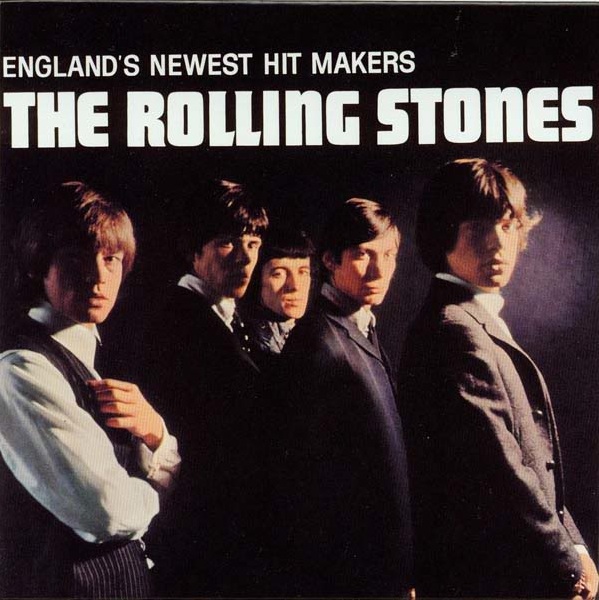
Back in 2012 I was commissioned by a publisher to write an album-by-album assessment of the Stones most interesting LPs for a short-lived Rolling Stones app. I ended up profiling 14 LPs, up to and including Voodoo Lounge.
Going through some old files recently I came across my original text, which follows for your interest and (I hope) entertainment. They were written not for hardcore fans but for people maybe new to the band so they knew what to look out for.
The other 13 LP reviews will follow in reverse chronological order ie oldest first
——-
The Rolling Stones (England’s Newest Hit Makers)
‘Believe me, it is fantastic! I will go as far to say that if it doesn’t take over from the Beatles at the top of the LP chart I will eat my chocolate-flavoured record player’. Richard Green, New Musical Express, 1964.
By the end of 1963, The Rolling Stones had seen two singles in the UK top 40. In the summer, Come On had reached a respectable #21 on the charts, and their follow-up, the Lennon and McCartney penned I Wanna Be Your Man had stalled just outside the top 10 at #12. At the end of the year, The Rolling Stones were voted sixth in the best British group category in the New Musical Express.
I’d bet not one member of the band ever dreamt of The Rolling Stones becoming the most successful rock & roll band ever, playing to the largest crowds imaginable, setting new grossing records for revenues made. Or that Mick and Keith would write the soundtrack to so many peoples lives, or more unbelievable, that the cocky lead singer would one day be knighted for his services to music by The Prince of Wales.
Recording a new album in the early 60’s was normally a quick and fairly easy process for working bands like The Rolling Stones who would laydown what was essentially their live act.
Clocking up hundreds of gigs, quite often playing two shows a day, the bands set would be well arranged, tight, and everyone would know what each other played on the track. The Beatles debut album Please Please Me was recorded in 15 minutes short of ten hours. The Stones took a little longer with their debut, recording leisurely over five days at Regent Sound Studios in London.
Only one original composition to the album: Tell Me (You’re Coming Back) was credited to the new song-writing team of Jagger and Richards. Two songs are credited to ‘Nanker Phelge’ – a pseudonym the band used for group compositions from 1963 to 1965. American producer Phil Spector and Gene Pitney both contributed to the recording sessions, and are referred to as ‘Uncle Phil and Uncle Gene’.
The Stones take us through a collection of their favourite tracks by their heroes, Chuck Berry, Willie Dixon, Slim Harpo, Rufus Thomas, Jimmy Reed. At this stage in their career, the Stones had toured with some big names from America – Bo Diddly and The Every Brothers, but it wouldn’t be until June 1964 until the Stones took their first steps on American soil.
Unheard of at the time, the Stones took the brave step of releasing the album without their name on the front, just a picture of Mick, Keith, Brian, Bill and Charlie, wearing their beast gear, turned to look at the camera. However, the US version did display the bands name on the front cover.
When released in 1964, the Stones’ debut climbed its way to the top of the UK charts enjoying one week short of a year in the top 40. The American edition of the LP, with a slightly different track list, came out on London Records on 30 May 1964, with the added title England’s Newest Hit Makers.
Not bad for a bunch of young guys who liked playing blues and R&B covers. They might have a future.
Route 66
What has now become a rock & roll classic, associated with road trips and freewheelin’ everywhere, Route 66 was written in 1946 by American jazz pianist and songwriter Bobby Troup.
Troup first saw success in 1941 when Sammy Kaye and his Orchestra covered his song Daddy, which became a regional #1 hit and was also covered by Glenn Miller and His Orchestra and The Andrews Sisters in the same year. Another of Troup’s songs Snootie Little Cutie was later recorded by Frank Sinatra.
Five years later Nat King Cole scored a hit with his version of (Get Your Kicks On) Route 66, whose song’s lyrics follow the path of the US Route 66 highway, which used to run a long distance across America, going from Chicago, Illinois, to Los Angeles, California.
Troup came up with the idea for the song while driving west from Pennsylvania to Los Angeles, California, and many of the cities he passed through, St Louis; Joplin, Missouri; Oklahoma City, Oklahoma; Amarillo, Texas; Gallup, New Mexico; Flagstaff, Arizona; Winona, Arizona; Kingman, Arizona; Barstow, California; and San Bernardino, California. For young men living in a cold damp and fogy England, hearing these exotic towns and cities in this far away land must have been the stuff dreams are made of.
Of course the Stones version is much closer to Chuck Berry’s 1961 hit, complete with Jagger handclaps and Keith doing his best Berry licks, playing a neat solo that guitarist has been working around ever since. Charlie brings the journey to an end with a nice cymbal crash.
I Just Want to Make Love to You
This Willie Dixon song was turned into a hit by Muddy Waters in 1954, with the help of an all star blues line-up of Little Walter blowing harmonica, Jimmy Rogers on guitar and Otis Spann on piano.
During the peak of Chess Records, 1950–1965, Dixon’s songs were recorded by countless musicians, his most famous compositions include Little Red Rooster, Hoochie Coochie Man, Spoonful, Back Door Man, I Ain’t Superstitious, and Bring It On Home.
Known as ‘the father of modern Chicago blues’, Muddy Waters was a major influence on many aspiring British blues bands in the 1960s and had previously run his own juke joint, complete with gambling, and moonshine, where he would also perform. Waters was a major influence on the career of the Stones, Brian Jones came up with the name ‘the Rollin’ Stones’ while on the phone with a venue owner, who asked ‘What are you called?’ Jones saw a copy of The Best Of Muddy Waters lying on the floor – and track one was Rollin’ Stone Blues. They also recorded a version of his song Soon Forgotten during their first ever recording session at Curly Clayton Sound Studios in October 1962.
Waters’ version is a slow, stomping blues shuffle, The Stones play the song at breakneck speed, with the rhythm dramatically changed from the original. Jaggers vocal so loud, its distorted effect adds to the rough blues feel, with a rushed harmonica solo aided by fast fills and breaks from Richards.
The song got more exposure in the US when it was placed on the B-side of their 1964 hit Tell Me.
Honest I Do
Jimmy Reed is another American blues artists to have the honour of having one of his songs on the Stones’ debut album, with Honest I Do.
Reed was born in Dunleith, Mississippi, in 1925, moving to Chicago, Illinois, in 1943 before being drafted into the US Navy during World War II. In the 50’s he signed with Vee-Jay Records who released You Don’t Have To Go, which became his first hit record. Another major hit for Reed was the 1959, Babe What You Want Me To Do which was much covered by acts including Elvis Presley who played the song during his 1968 Comeback Special.
Early Stones set lists included many of Reed’s songs, including tracks like Ain’t That Lovin’ You Baby, The Sun Is Shining (also played at the Stones’ 1969 Altamont concert), Bright Lights, Big City and Shame, Shame, Shame.
Reed’s original version is a laid back 12 bar with a soulful vocal. The Stones’ take is a little more up-tempo, and in the days before electronic guitar tuners, is a little out of tune! Keith Richards has said that some of the tracks on this first album were unfinished demos, and Honest I Do might just be one of these.
Mona (I Need You Baby)
On Mona, the Stones do their best Bo Diddley impression, with Brian Jones leading the track on guitar in true Bo Diddley mode, Jagger’s voice sounds raw, singing and shouting, which sits nicely on top of the guitar.
Bo was born Ellas Otha Bates in McComb, Mississippi, on December 30, 1928, he became known as The Originator due to his key role in the transition from the blues to rock, influencing a host of acts, including Buddy Holly, Jimi Hendrix, The Who, The Yardbirds, Eric Clapton, Elvis Presley, and The Beatles to name but a few. In 1963, Bo headlined a UK concert tour with the Everly Brothers and Little Richard. The Rolling Stones, still barely known outside London at that time, appeared as a supporting act on the same bill.
Like the Stones did later in their career, Diddley appeared on The Ed Sullivan Show, where he infuriated the host. The show had requested that he sing the Merle Travis-penned Tennessee Ernie Ford hit Sixteen Tons, but when he appeared on stage, he sang Bo Diddley instead resulting in his being banned from further appearances.
Bruce Springsteen, and Tom Petty and the Heartbreakers have also both taken Mona out for live concerts.
Now I’ve Got a Witness (Like Uncle Phil and Uncle Gene)
This track sees the Stones running through a 12 bar instrumental version of Can I Get a Witness.
The American singer Gene Pitney, (who gets a mention as Uncle Gene), had become a friend of the Stones’ with his version of the Jagger/Richards song That Girl Belongs To Yesterday scoring the singer a hit in 1964, and the first tune composed by the Rolling Stones to become a Top 10 hit in the UK.
This was credited to Nanker Phelge, a pseudonym Jagger and Richards used. ‘Nanker’ was a wacky face they would make to amuse each other, ‘Phelge’ was a Edith Grove flatmate, Jimmy Phelge whom Keith Richards considered ‘The most disgusting person ever.’
Organ is played by Ian Stewart, Mick bangs away on tambourine, Bill and Charlie provide the bass and drums, Keith plays guitar and Brian Jones blows the harmonica.
Little By Little
Talking about Little By Little, Andrew Oldham stated in 1964, ‘After we had done Not Fade Away, Phil (Spector) and Mick disappeared. Nobody noticed they had gone until about five minutes later when they returned, looking very pleased with themselves. They sat down, told us to be quiet, and played the number they had just written in the outside corridor. It was very good, so we decided to use it as the B-side. Mick took hold of his harmonica, Phil found the maracas again, and Gene Pitney’.
Kicking off with harmonica, the song is a pastiche of Shame, Shame, Shame by Jimmy Reed. A mean guitar solo precedes a long instrumental break, the rhythm guitar showing hints of the stabbing and pushes that became Keith Richards signature style.
Little By Little was issued as the B-side to Stones version of Not Fade Away a hit in 1964. piano. It was a fantastic scene!
I’m a King Bee
I’m A King Bee by Slim Harpo, was released in 1957 as the B-side to his debut single, I Got Love If You Want It, but went on to become better known than the A-side. The American blues musician was an ace harmonica player, his name ‘Slim Harpo’ being derived from ‘harp’ the popular nickname for the harmonica in blues circles.
Born James Moore in Lobdell, Louisiana, he enjoyed a string of popular R&B singles which many British bands as well as the Stones covered The Pretty Things, The Yardbirds, Pink Floyd and Them all tipping their hat to Harpo.
The Stones’ version is very similar to the original, using the same tempo, sliding bass, with added guitar fills and includes a slide-guitar break by Brian Jones.
Muddy Waters, The Doors, Tom Petty, Rod Stewart, Captain Beefheart, and Grateful Dead have all covered I’m A King Bee. In the 1970s, Led Zeppelin sometimes performed I’m A King Bee as part of the live Whole Lotta Love medley.
Carol
Carol was first released by Chuck Berry on Chess Records in 1958. Born October 18, 1926, in St. Louis, Missouri, while still a high school student, Berry served a prison sentence for armed robbery between 1944 and 1947. His break came when he travelled to Chicago in May 1955, and met Muddy Waters, who suggested he contact Leonard Chess of Chess Records, a string of hits followed and he helped shape the face of rock & roll music.
The Stones burst out on their debut album with a fast and furious version, one would imagine very similar to early live versions at the Crawdaddy Club. Again Richards shines impersonating his favourite guitarist, playing all the riffs and fills note for note with great ease.
A live version of Carol featured on their 1970 album Get Yer Ya-Ya’s Out!, with Keith Richards on lead guitar it shows the Stones off in fine form.
Tell Me (You’re Coming Back)
Recalling their first album, Keith Richards said, ‘Our first album reflected what we used to play at the Crawdaddy – a regular diet of Jimmy Reed, Bo Diddley, Muddy Waters, with some Slim Harpo. The album was basically the cream of the set! We cut the album in a room full of egg boxes, using a two-track Grundig. The only concession to professionalism was that the tape recorder was hanging on the wall instead of sitting on a tabletop… We would sit around in playback and go, Sounds good or Stop it, let’s do it again and then Yeah, that’s it. It was either a yes or a no. We were using a two-track or four-track machine and there’s not a lot you can do with that. To overdub you had to do what they call ping-ponging between the tracks, which was not a great thing because you actually lost generations of sound quality.’
Can I Get a Witness
Recalling these early recording sessions, Andrew Oldham said, ‘We did the first album in about 10 days. We’d decide to do a tune, but Mick wouldn’t know the words, so Mick would run around to Denmark Street, (London) to Carlin Music to pick up the words to something like Can I Get A Witness? He’d come back 25 minutes later and we’d start.’
The Holland–Dozier–Holland song Can I Get A Witness had given a young Marvin Gaye a hit in 1963. The team of Holland–Dozier–Holland made up of Lamont Dozier and brothers Brian Holland and Eddie Holland wrote and produced 25 #1 hit singles, including, (Love Is Like a) Heat Wave for Martha and the Vandellas, How Sweet It Is (To Be Loved by You) for Marvin Gaye, along with singles for the Four Tops and The Supremes, including 10 out of The Supremes’ 12 US #1 singles, such as Baby Love, Stop! In the Name of Love, and You Keep Me Hangin’ On.
The Stones’ version of Witness has Jagger in fine voice, driven along by the bouncy piano. Charlie Watts lays down a tight soulful rhythm.
Scottish singer Lulu, Dusty Springfield, and Steampacket (which featured a very young Rod Stewart) all recorded cover versions of the song.
You Can Make It If You Try
You Can Make It If You Try finds the Stones having a go at gospel. Ted Jarrett who wrote the song was born in Nashville, Tennessee, and later became a disc jockey for WSOK in Nashville.
You Can Make It If You Try became a hit for Gene Allison, early in 1958, hitting #3 on the R&B charts in the US. The Stones’ rendition comes complete with ‘gospel’ backing vocals; Charlie shuffles and pushes the song along making this version not quite the smooth and soulful version that Allison delivered.
Ian Stewart plays the organ, with Jagger, Richards, Jones and Wyman doing their best to sound like a gospel church choir.
Walking The Dog
This Rufus Thomas song closes the debut album from the Stones and is different than most Stones’ recordings, as Walking The Dog features co-lead vocals on the chorus by Brian Jones (most early Stones songs feature either Keith Richards or Bill Wyman on backing vocals). Jones’ voice gives the track a hard edge, different to what became the trademark Jagger and Richards’s vocal backing.
Thomas recorded on Sun Records in the 50’s, moving to Stax Records in the 60’s, releasing over 30 singles, often backed by Booker T. and the MG’s. The Stones walk their way through the song, aided by hand-claps and Jagger half-singing and half talking in a style he would develop on later recordings.
Plenty of other artists have covered the song, including Aerosmith, The Flamin’ Groovies, Roger Daltrey, Green Day, and the Grateful Dead.
Talking about the Stones debut Brian Jones said in 1964, ‘I’m knocked out by the LP. I didn’t expect so much from it. I know you expect an artist to talk like that about his own record, but I have tried to listen to it impartially. I hope people will accept it as a good LP by the Rolling Stones and a good R&B record as well… It is very good. That’s not just from my point of view because I happen to be on it, but because it reflects the Rolling Stones, which is what we intended to do’.

