
Order now from http://www.1960s.london

Mott The Hoople
TV and Radio 1970 – 1971
Side One
- Thunderbuck Ram (Ralphs)
- Original Mixed-Up Kid (Hunter)
- Whisky Women (Ralphs)
- The Moon Upstairs (Hunter, Ralphs)
- Darkness, Darkness (Young)
- At The Crossroads ( Sahm)
- Keep A-Knockin’ (Penniman) /
- What’d I Say (Charles)
Side Two
- Like A Rolling Stone (Dylan)
- You Really Got Me (Davies)
- Angel Of Eighth Avenue (Hunter)
- Wrong Side Of The River (Ralphs)
- When My Mind’s Gone (Hunter)
Recording Details
Side One
Track 1 recorded for BBC radio Top Gear on February 3rd 1970 and transmitted on February 21st 1970
Tracks 2 & 3 recorded for BBC radio Sounds Of The Seventies on March 8th 1971 and transmitted on March 16th 1971
Tracks 4 & 5 recorded for BBC radio Sounds Of The Seventies onOctober 25th 1971 and transmitted on November 4th 1971
Track 6 recorded for Beat Club, ARD TV, Bremen and broadcast on March 28th 1970
Tracks 7 & 8 recorded for Get To Know, ABC TV, Australia and broadcast on January 20th 1971
Side Two
Track 1 recorded for BBC radio Top Gear on July 6th 1971 and transmitted on July 24th 1971
Track 2 recorded for Beat Club, ARD TV, Bremen and broadcast on March 28th 1970
Track 3 recorded for BBC radio Top Gear on July 6th 1971 and transmitted on July 24th 1971
Tracks 4 & 5 recorded for BBC Radio John Peel Sunday Concert on April 23rd 1970 and transmitted on 3rd May 1970
Personnel
Ian Hunter: vocals, piano
Mick Ralphs: guitar, vocals
Pete Overend Watts: bass
Dale “Buffin” Griffin: drums
Verden “Phally” Allen: organ
Sound Quality
All except the final two tracks are Very Good. The two Sunday Concert tracks are of lesser quality but still totally listenable.
Sleevenotes
“I’ll give you a little information about the band I’m mixed up in. Buffin is the baby of the band: he’s a drummer, a fucking great one. Mick Ralphs is your original loner. He’ll run for miles to escape friendship when it’s the one thing he needs. He’s totally committed to the group. Phally – a product of Wales, come from a tiny village outside Swansea. When he’s down, he’s down, when he’s up he’s within reason. Pete still gets to rehearsals two hours late and we have them a quarter of a mile from his place in Hampstead. He’s solid as a rock – when I think of Pete I think of kindness, gentleness, eccentricity – a complete upper in every way.”
Ian Hunter, Diary Of A Rock’n’Roll Star
The period 1970 – 71 found Mott The Hoople playing innumerable live gigs, pausing only to record three well-received LPs for Island Records. The performances here document the band’s live set, featuring several songs not released on the band’s studio LPs plus some deep cuts only rarely performed live.
Thunderbuck Ram provides a suitably raunchy beginning. According to Pete Watts “It was a song with no title. We found the name scrawled on a toilet wall in the Pied Bull, our rehearsal base in Islington and it seemed perfect for the track. I think it was the name of a group.” This version is largely instrumental and the band manage the quiet / loud transitions with precision, Allen’s organ duetting with Ralphs’ guitar. Original Mixed-Up Kid features the band’s sensitive side and includes a quote from Byron. Ralphs is back in charge for Whiskey Woman, a tale of loose women encountered backstage at the Whiskey A Go Go in Los Angeles. The Moon Upstairs was a punk precursor, a fast-paced rocker opening with chopped guitar chords and featuring the lyric “We’re not leading you, we’re bleeding you but you’re too fucking slow”. In deference to delicate BBC sensibilities, Hunter swallows the f-word. Darkness, Darkness was written by Jesse Colin Young for The Youngbloods and is another Ralphs showcase. At The Crossroads was originally written by Doug Sahm for The Sir Douglas Quintet and is performed here for German TV Beat Club. It shows the band at their hairiest. Classic rockers like Keep-A Knockin’ (Little Richard) and What’d I Say(Ray Charles) frequently closed Mott sets: the frantic versions here were recorded for Australian TV.
Like A Rolling Stone was never recorded for a studio LP. It was the number with which Hunter auditioned to join promising Hereford group Silence, thus creating Mott The Hoople. At nine minutes it is also one of the longest tracks the band recorded but featured only briefly in the Mott live set. Uber-Dylan fan Hunter is in his element here with Allen doing his best Al Kooper. Back to Beat Club for a rampaging instrumental take on the Kinks’ You Really Got Me with a guitar/drums/organ rave-up to finish. Angel Of Eighth Avenue served notice that Hunter could write sensitive ballads as well as raucous rockers. We finish with two rare performances, both taken from the May 1970 John Peel Sunday Concert. Wrong Side Of The River was a mournful Mick Ralphs tune steeped in Americana and Allen’s Hammond organ. When My Mind’s Gone was an intense psychodrama from the Mad Shadows LP which Hunter said that he wrote spontaneously whilst hypnotised by mentor Guy Stevens (sleeve credit “spiritual percussion and psychic piano”).
Pete Frame once claimed that on a good night Mott The Hoople were the best live band in the UK, and there is plenty of evidence here to support that claim. The problem was that they weren’t selling any records. “You were selling out the biggest venues in the land and you weren’t having any record success,” said Hunter. “That’s not going to work for long. You have to have the record success to go with it.”
That record success would come with the gift of All The Young Dudes from David Bowie, as we shall see…
Sleevenotes: Doc Thomas

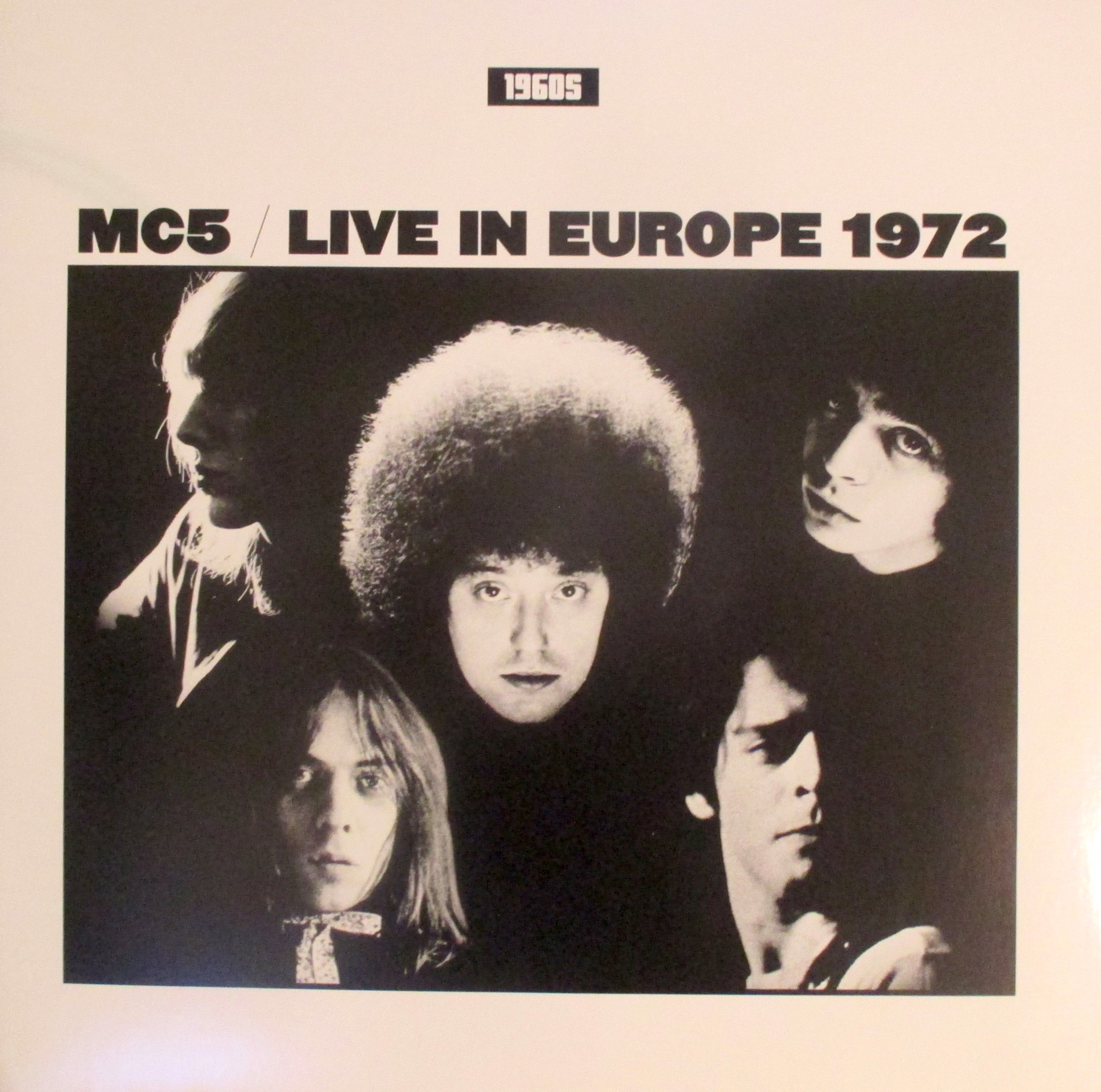
Live In Europe 1972
The MC5
Side One
- Kick Out The Jams (Tyner, Kramer, Smith, Davis, Thompson)
- Ramblin’ Rose (Wilkin, Burch)
- Motor City Is Burning (Smith)
- Tonight (Tyner, Kramer, Smith, Davis, Thompson)
Side Two
- Let It Rock (Berry)
- I Want You (Frechter, Page)
- Looking At You (Tyner, Kramer, Smith, Davis, Thompson)
Recording Details
Side One recorded for Beat Club German TV at Radio Bremen on March 25th
Side Two recorded for Finnish TV at The Kulttuuralo, Helsinki on November 17th
Personnel
Wayne Kramer – guitar, vocals
Fred “Sonic” Smith – guitar, vocals
Derek Hughes – bass
Rob Tyner – vocals (Side One
Dennis ‘Machine Gun” Thompson – drums (Side One)
Ritchie Dharma – drums (Side Two)
Sleevenotes
“The MC5 were the first important American underground rock band to forsake their previous sureness of direction, and ultimately disintegrate, when unable to reconcile the need for commercial success with an original integrity.”Clinton Heylin, From The Velvets To The Voidoids (1993)
The MC5 fought the law and the law won. Repeatedly. The Motor City Five was started by demon twin guitarists Smith and Kramer in 1964 as a Detroit covers band. In autumn 1965 a fierce new rhythm section – Michael Davis (bass) and Dennis Thompson (drums) – plus the addition of jazz-influenced vocalist Rob Tyner lead the MC5 into uncharted territory where their garage band roots were overlaid by free jazz and feedback. With their new manager John Sinclair adding revolutionary rhetoric to the mix the band proved erratic and inflammatory. Danny Fields signed them to Elektra: their debut LP Kick Out The Jams, was recorded live over Halloween 1968 at the bands home venue, the Grande Ballroom. Elektra dropped the MC5 in spring 1969 after a disagreement over obscenities on the record, in the sleeve notes and on promotional posters. Atlantic released two further studio LPs, Back In The USA (1969) and High Time (1972). For the former producer Jon Landau took the bands anarchic live performances and tightened them up into short, sharp rockers: the latter was halfway between the first two LPs and all the better for it. Sinclair was horrified: “they wanted to be bigger than the Beatles, but I wanted them to be bigger than Chairman Mao.”
Whilst the radical politics espoused by the MC5 in their early days resulted in much unwanted police attention what did for them in the end was drugs. The end of the 1960s saw hash, speed and acid replaced by downers, cocaine and heroin. Detroit was no exception. In his autobiography The Hard Stuff,Kramer recalls “we had burned so many promoters by being late that the MC5 could not tour enough to survive. Our drinking and drugging resulted in us arriving late for concerts so often that the word was, don’t book them. When you’re an active drug user, securing your drugs is a top priority: leaving town in time to make the gig was secondary.“
Bass player Michael Davis took this to its logical extension , preferring to stay home and deal rather than tour Europe in spring 1972: he was replaced by Derek Hughes. A lengthy set recorded for Beat Club documents this line-up, sometimes called the MC4. An uncensored Kick Out The Jams makes for a provocative set opener, the song derived from the band’s challenge to headliners they supported in Detroit. Next is the band’s version of Ramblin’ Rose, originally recorded by Jerry Lee Lewis in 1962 and now a feature for Wayne Kramer. Motor City Is Burning is a slow blues originally recorded by John Lee Hooker with a lyric that documents the riots that had decimated the band’s native city. Finally an extended Tonight allows Kramer and Smith to trade solos and phrases.
By November when the band played a lengthy set for Finnish TV both Tyner and Thompson were gone, the latter replaced by a pick-up drummer found in London. These were the band’s penultimate dates – they would reconvene for one final wretched gig at the Grande on New Years Eve – and Kramer has been scathing about their performances. Certainly the absence of Tyner means that they fall back on their garage roots but with guitarists of the calibre of Kramer and Smith (The MC2?) this is not a bad thing. An opening Let It Rock sung by Fred Smith reveals a great rock’n’roll voice. The Troggs I Want You is revisited from the first LP, the opening feedback giving way to a slow and deliberate riff before Kramer shows off at the end. Looking At You is a good place to end, starting slow and rhythmic with a teasing introduction before gradually building to both Kramer and Smith playing in unison.
A mere three years after their New Year nadir the MC5 were highly fashionable again as they were discovered by a new generation of rock’n’rollers. Primal Scream, The Damned, the Hot Rods, The Flamin’ Groovies, The Clash and Patti Smith either namechecked the band or covered their songs. But this is where the sonic revolution began. “Ladies and Gentlemen I Give You A Testimonial…The MC5!”
Sleevenotes: Sister Anne


From the January 2024 edition. Thank you Ian McCann
From the January 2024 edition

Thank you Niall Doherty
Available now from http://www.1960s.london

Cowgirl In The Sand Live 1970 (Vinyl LP)
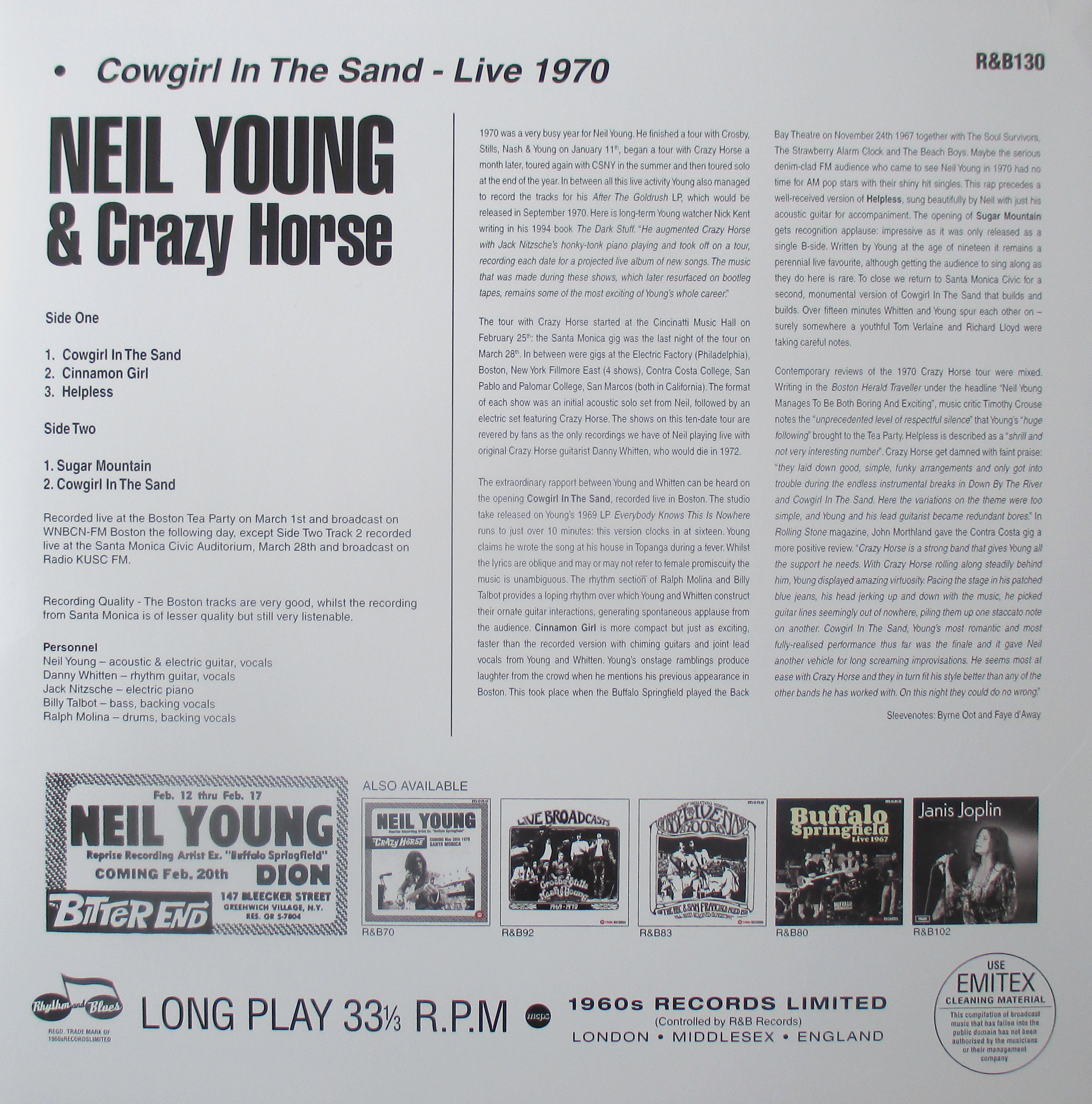
Neil Young & Crazy Horse
Side One
- Cowgirl In The Sand
- Cinnamon Girl
- Helpless
Side Two
1Sugar Mountain
2 Cowgirl In The Sand
All songs written by Neil Young
Personnel
Neil Young – acoustic guitar, electric guitar, vocals
Danny Whitten – rhythm guitar, vocals
Billy Talbot – bass, backing vocals
Ralph Molina – drums, backing vocals
Jack Nitzsche – electric piano
Recording details
Side One Tracks 1 – 4 and Side Two Track 1 recorded live at the Boston Tea Party on March 1st and broadcast on WNBCN-FM Boston the following day
Side Two Track 2 recorded live at the Santa Monica Civic Auditorium, March 28th and broadcast on Radio KUSC FM
Recording Quality
The Boston tracks are all very good, whilst the recording from Santa Monica is of lesser quality but still very listenable
Sleevenotes
The reaction to our Neil Young & Crazy Horse Live At Santa Monica Civic LP (R&B 70) has been so positive that we are now issuing a second excerpt from the US tour performed by Neil Young and Crazy Horse in the spring of 1970.
1970 was a very busy year for Neil Young. He finished a tour with Crosby, Stills, Nash & Young on January 11th, began this tour with Crazy Horse a month later, toured again with CSNY in the summer and then toured solo at the end of the year. In between all this live activity Young also managed to record the tracks for his After The Goldrush LP, which would be released in September 1970. Here is long-term Young watcher Nick Kent writing in his 1994 book The Dark Stuff. “He augmented Crazy Horse with Jack Nitzsche’s honky-tonk piano playing and took off on a tour, recording each date for a projected live album of new songs. The music that was made during these shows, which later resurfaced on bootleg tapes, remains some of the most exciting of Young’s whole career.”
The tour with Crazy Horse started at the Cincinatti Music Hall on February 25th: the Santa Monica gig was the last night of the tour on March 28th. In between were gigs at the Electric Factory (Philadelphia), Boston, New York Fillmore East (4 shows), Contra Costa College, San Pablo and Palomar College, San Marcos (both in California). The format of each show was an initial acoustic solo set from Neil, followed by an electric set featuring Crazy Horse. These ten shows are revered by Neil Young fans because they were the only time that Neil played live with original Crazy Horse guitarist Danny Whitten who would die in 1972.
The extraordinary rapport between Young and Whitten can be heard on the opening Cowgirl In The Sand, recorded live in Boston. The studio take released on Young’s 1969 LP Everybody Knows This Is Nowhere runs to just over 10 minutes: this version clocks in at sixteen. Young claims he wrote this song at his house in Topanga whilst suffering from a fever. Whilst the lyrics are oblique and may or may not refer to female promiscuity the music is unambiguous. The rhythm section of Ralph Molina and Billy Talbot provides a loping rhythm over which Young and Whitten construct their ornate guitar interactions which generate spontaneous applause from the audience. Cinnamon Girl is more compact but just as exciting, faster than the recorded version, with chiming guitars and joint lead vocals from Young and Whitten. Young’s onstage ramblings produce laughter from the crowd when he mentions his previous appearance in Boston. This took place when the Buffalo Springfield played the Back Bay Theatre on November 24th 1967 together with The Soul Survivors, The Strawberry Alarm Clock and The Beach Boys. Maybe the serious denim-clad FM audience who came to see Neil Young in 1970 had no time for AM pop stars with their shiny hit singles. This rap precedes a well-received version of Helpless, sung beautifully by Neil with just his acoustic guitar for accompaniment. The opening of Sugar Mountain gets recognition applause: impressive as it was only released as a single B-side. Written by Young at the age of nineteen it remains a perennial live favourite, although getting the audience to sing along as they do here is rare. To close we return to Santa Monica Civic for a second, monumental version of Cowgirl In The Sand that builds and builds. Over fifteen minutes Whitten and Young spur each other on – surely somewhere a youthful Tom Verlaine and Richard Lloyd were taking careful notes.
Contemporary reviews of the 1970 Crazy Horse tour were mixed. Writing in the Boston Herald Traveller under the headline “Neil Young Manages To Be Both Boring And Exciting”, music critic Timothy Crouse notes the “unprecedented level of respectful silence” that Young’s “huge following” brought to the Tea Party. Helpless is described as a “shrill and not very interesting number”. Crazy Horse get damned with faint praise: “they laid down good, simple, funky arrangements and only got into trouble during the endless instrumental breaks in Down By The River and Cowgirl In The Sand. Here the variations on the theme were too simple, and Young and his lead guitarist became redundant bores.” In Rolling Stone magazine, John Morthland gave the Contra Costa gig a more positive review. “Crazy Horse is a strong band that gives Young all the support he needs. With Crazy Horse rolling along steadily behind him, Young displayed amazing virtuosity. Pacing the stage in his patched blue jeans, his head jerking up and down with the music, he picked guitar lines seemingly out of nowhere, piling them up one staccato note on another. Cowgirl In The Sand, Young’s most romantic and most fully-realised performance thus far was the finale and it gave Neil another vehicle for long screaming improvisations. He seems most at ease with Crazy Horse and they in turn fit his style better than any of the other bands he has worked with. On this night they could do no wrong.”
Sleeevenotes: Byrne Oot and Faye d’Away

LIVE IN LONDON, PARIS AND…FELIXSTOWE 1965 – ’67 (CD)
The Who
Tracklisting
- My Generation (Pete Townshend)
- Daddy Rolling Stone (Otis Blackwell)
- Shout & Shimmy (James Brown)
- Man With Money (Don & Phil Everley)
- My Generation (Pete Townshend)
- So Sad About Us (Pete Townshend)
- Substitute (Pete Townshend)
- Man With Money (Don & Phil Everley)
- Dancing In The Street (Marvin Gaye / William Stevenson / Ivy Jo Hunter)
- Barbara Ann (Fred Fassert)
- My Generation (Pete Townshend)
- Happy Jack (Pete Townshend)
- My Generation (Pete Townshend)
- I’m A Boy (Pete Townshend)
- Substitute (Pete Townshend)
- My Generation (Pete Townshend
- C C Rider (Traditionaal)
- My Generation (Townshend
- Baby Don’t You Do It (Holland, Dozier, Holland)
- Substitute (Townshend)
- Jingle Bells (James Lord Pierpoint)
- You Rang ? (Pete Townshend / John Entwistle / Roger Daltrey / Keith Moon)
Recording Details
Track 1 recorded live at the London Students Carnival Ball at the Empire Pool, Wembley on 19/11/65 and transmitted by ATV on 08/12/65
Track 2 recorded live at Twickenham Film Studio for US TV Shindig (ABC) 03/08/65
Tracks 3-5 recorded live for Ready Steady Go! and transmitted 5.11.65
Track 6 Track recorded for BBC Saturday Club at the Playhouse Theatre, London 13/09/66
Tracks 7-11 recorded for ORTF on 31/3/66 at the Music Hall de France, d’Ailleurs, Issy-les-Moulineaux
Tracks 12 & 13 recorded for Beat Club at the Marquee, London 02/03/67 Tracks 14-16 recorded at the Pier Pavilion, Felixstowe on 08/09/66 and broadcast on the French television show Seize Millions Des Jeunes with DJ Emperor Rosko on 18/10/66.
Tracks 17-20 recorded live at Westminster Technical College on 09.07.66 9th and broadcast on Canadian TV CBC Take 30 on 6.10.66
Track 21 recorded for Ready Steady Go! on 17.12.65 and transmitted 24.12.65.
Track 22 recorded for BBC Saturday Club on 15.03.66 and transmitted on 19.03.66
Personnel
Roger Daltrey – vocals
Pete Townshend – guitar, vocals
John Entwistle – bass, vocals
Keith Moon – drums

Sleevenotes
“Was there ever a more exciting live group than The Who at their first peak, 1965/66? I think not. The Who were two quite different bands. In the early 70’s, after Tommy’s success d’estime bailed them out of a tight spot, they resolved themselves into a different type of act – the world’s greatest stadium band. At Bath Pavilion, in the summer of 197I, I saw a warmup show for the Who’s Next US Tour and they had grown wonderfully; nobody better. But my heart remains forever with the group I first saw in the mid-60s – the flash, noisy, violent, melodic pop group of the Ready Steady Go! years. Here they are…”
John Perry (guitarist and author of Meaty, Beaty, Big and Bouncy (Classic Rock Albums)
London, Paris and…Felixstowe. During their initial burst of success from 1965 to 1967 the band were a blur of live gigs, radio and TV appearances and hurried recording sessions. This CD collates the material from this period that is unavailable elsewhere, albeit sometimes in sound quality that reflects contemporary broadcast standards.
Playing under a string of fairy lights the Who offered London’s students a well-behaved version of My Generation, with Pete and John sharing a microphone Beatles-style. The band don’t seem to know how to finish the song without its usual auto-destructive ending, so that at one point only Keith Moon’s extravagant drumming keeps the song from petering out before Townshend weighs in with a final vocal. Other bands on the bill which ran from 9pm to 4 am included Georgie Fame & The Blue Flames, The Hollies, Wilson Pickett and Donovan. Although listed on the bill, the Kinks failed to appear whilst John Lee Hooker was replaced at the last minute by an 18 year old unknown folk singer called Marc Bolan. The Who’s appearance was delayed when Daltrey took exception to the sound quality of the PA provided and refused to perform until the Who’s own PA had been installed. Daddy Rolling Stone was first released by the Who as the B-side to Anyway, Anyhow, Anywhere. The band base their arrangement on Derek Martin’s exhilarating version from 1963, a favourite with the mods in their audience. This recording was made in London for US TV programme Shindig, Townshend in Union Jacket and birdman poses
The TV programme Ready Steady Go! played a vital part in the early success of the Who. In Andy Neill’s definitive book on RSG! Who co-manager Chris Stamp remembers that band and TV programme were in perfect alignment: “we knew we were made for each other. It was an archetypal Sixties happening.” An exciting Shout and Shimmy demonstrates the bands early James Brown fixation with a rare drums-and-bass interlude and the Everly Brothers’ Man With Money gets a powerful finish. Man With Money was a stage favourite but would not appear officially until the 1995 CD re-release of A Quick One. My Generation receives another outing. The Who would appear seventeen times on RSG! and were part of the very last edition on December 23rd 1966 when they played a spirited version of Johnny Kidd’s Please Don’t Touch. BBC sessions were another vital part of the band’s early promotional strategy. So Sad About Us is a song Pete wrote for The Merseys which turned out so well that The Who nicked it for themselves. This fine version was inexplicably omitted from The Who BBC Sessions (1999). Listen for the immaculate harmonies and the new vocal refrain (“Last Night”) at the end.
Next up are five songs recorded for French TV. France got The Who straight away due to the potent combination of their stylish pop-art visual and Townshend’s overt intelligence. The band open with a lively version of Substitute, Townshend delivering an uncharacteristic solo on a Telecaster whilst looking very Brooks Brothers. From the country influences of Man With Money to Motown – why not ? Dancing In the Street is an obvious, mod-orientated choice and features Townshend using a mike stand to get some wayward sounds, his backing vocals on this number being equally experimental. Surf-nut Keith Moon’s falsetto vocals are a feature but not a highlight of Barbara Ann. The closing My Generation is performed quite conservatively with only a solitary cymbal getting knocked over – maybe the band were under heavy manners to behave themselves.
The Who’s spiritual home at this time was The Marquee Club on Wardour Street. In order to support debut single I Can’t Explain, co-manager Kit Lambert arranged for a Tuesday night residency at the Marquee, fly posted using the legendary Maximum R’n’B poster (later to be included with initial copies of Live At Leeds). Bob Bickford of Ready Steady Go! was so impressed by the band’s Marquee performance in front of an audience of rabid Who fans that he recommended the band for a TV slot. These Beat Club tracks give you an idea of what Bob heard on that Tuesday night. A brief and to the point Happy Jack is followed by Townsend again playing slide with the mike stand at the end of My Generation. Before he can total his guitar a smoke-bomb causes the power to fail. Roger is at the height of his Dippity-Do hair-gel dandy phase, the curly haired Rock God still two years away. Entwistle recreates his bass solo in My Generation with impressive and impassive dexterity. And beaming over all he surveys is Keith Moon, the original Happy Jack, visibly having the time of his life.
Next up are frenetic versions of I’m A Boy, Substitute and My Generation recorded on Felixstowe Pier. My Generation ends with Townshend ramming his Rickenbacker into a Marshall amp that bears the scars of previous assaults whilst Moon upends his kit to the presumed delight of the French TV crew filming the gig. Another TV crew, this time from Canada, caught the band in action at Westminster College in July 1966. Footage of this gig shows a rammed college, with as many mod girls as boys. The four song fragments presented here back up the presenters description of the Who as “formidable” and “extraordinary.” C C Rider is a traditional song recorded by (amongst others) Ma Rainey, Mitch Ryder and Elvis Presley, sung here by a deadpan John Entwistle. Marvin Gaye’s Baby Don’t You Do It was a long-time stage favourite and it features Townshend getting into the power chords and melodic explorations that would come to fruition on Live At Leeds (as well as the riff from Satisfaction). We only have the instrumental from Subsitute, complemented by a mighty My Generation where Townshend pulls out all his tricks – incessant windmilling, birdman feedback and finally shoving his sturdy Telecaster into his amp. Daltrey and Moon carry in regardless as the curtain drops. Reviewing a Yeovil gig from later that week the Melody Maker concluded that “there is no other group on the scene remotely like them…”
To complete this rich musical feast we have a couple of rarely heard musical petit fours. A real period piece from the 1965 Christmas Eve edition of RSG!, Jingle Bells features “John on French Horn, Roger on bell, Keith on kazoo and Pete on feedback” (Keith Altham, NME). By contrast You Rang? is a great Ventures-type instrumental in the style of The Ox and this is the only known recording. The words “You Rang?” are uttered by John Entwistle and are taken from the hit TV show The Munsters, where it was the catchphrase of Lurch (Ted Cassidy). A suitably light-hearted note on which to close this selection of songs – neaty, Petey, gig and flouncy.
Sleeve notes: Harry Blandford

The Betsy Trotwood, Clerkenwell, London
October 31st 2023

To a sold-out but tiny audience of sixty fans, Chris delivered two sets that included songs from Sneakers and The dB’s, his duets with Peter Holsapple and his many solo recordings. Lit by the worlds smallest lighting rig (one bulb) Chris opened as alter-ego Jazzbo Jenkins, adept purveyor of American Songbook-style originals such as I Fall In Love So Easily and Je Ne Sais Quoi. For the second set he was joined by cellist Cristina Munoz, whose sympathetic playing combined beautifully with Stamey’s acoustic guitar and evoked the quieter moments of the Big Star Third collective. Cycles Per Second, From A Window To A Screen and Happenstance were all performed with respect for the originals whilst upbeat versions of early solo singles Cara Lee and (I Thought You) Wanted To Know sounded fresh and dynamic. An extended Something Came Over Me allowed for some rare instrumental improvisation. Throughout Chris provided witty introductions to the songs and explained how they had been written. An encore of 14 Shades Of Green – in response to an audience request – followed by 27 Years In A Single Day emphasised the songwriting quality on display tonight.
Review written for Record Collector magazine

Deep in the depths of Hey! Bo Didsbury studio something stirs…Mick Brophy and Simon Wright recording again!
What will emerge?
Only time will tell…meanwhile thanks to Carole Brophy for the photo (and for lunch)
Available now from http://www.1960s.london
Live On Radio and TV 1969-70 by Fleetwood Mac

Tracklisting
Side One
- You’ll Be Mine (Willie Dixon)
- Good Morning Blues (Ledbetter)
- Shady Little Baby (Bennett)
- Hot Rodding (Instrumental)
- New Worried Blues (Trad. Arr.Korner)
- Early Morning Come
- Linda (Jeremy Spencer)
Side Two
- Oh Well (Green)
- Albatross (Green)
- Rattlesnake Shake (Green)
- Albatross (Green)
- Coming Your Way (Kirwan)
- The Green Manalishi (With The Two Prong Crown) (Green)
Recording Details
Side One
Tracks 1 – 7 recorded for BBC radio in 1969 as follows:
Tracks 1– 5 recorded on March 17th and transmitted on Symonds On Sunday March 23rd (1 & 2) and March 30th (3 – 5)
Track 6 recorded June 10th and transmitted on Chris Grant’s Tasty Pop Sundae June 15th
Track 7 recorded October 6th and transmitted on DLT October 12th
Side Two
Track 2 recorded at the Pop & Blues Festival at the Grugahalle, Essen, Germany October 9th, 1969 and shown on German TV
Tracks 3 – 5 Playboy After Dark, January 8th 1970
Track 6 recorded live at the Cue Club, Gotheburg, Sweden on November 2nd 1969 and broadcast on FM Sveriges radio
Sound Quality
All tracks are Very Good to Excellent, with only Side One Track 5 rated as Good
Personnel
Peter Green – guitar, vocals, bass
Jeremy Spencer – guitars, maracas, vocals
John McVie – bass
Mick Fleetwood – drums
Danny Kirwan – guitar, vocals (Side One Tracks 6 & 7, Side Two Tracks 1-6)
Alexis Korner – guitar, vocals (Side One Tracks 3 – 5),
Tony ‘Duster’ Bennett – vocals, harmonica (Side One Tracks 3 – 5)
Christine Perfect – piano (Side One Tracks 3 – 5)
Sleevenotes
Fleetwood Mac’s sessions for the BBC were legendary. The sessions were always productive – their Top Gear session on August 27th 1968 produced eleven numbers when most bands only managed to record three tracks in their allotted time. The band were also very experimental. Rather than trot out their latest single or recently-recorded album tracks, Fleetwood Mac would frequently perform songs that they never recorded elsewhere. They would also work with special guests, such as Eddie Boyd on their January 1968 session. On March the 17th Fleetwood Mac participated in a one-off all star session with blues godfather Alexis Korner, one-man band Duster Bennett and future band member Christine Perfect (later Christine McVie). The three tracks they recorded together have never been officially released and we are delighted to feature them here.
You’ll Be Mine and Good Morning Blues were two acoustic blues covers that never made it onto a Fleetwood Mac studio LP, originating from Howling Wolf and Leadbelly respectively. Shady Little Baby, Hot Rodding and a stomp through New Worried Blues benefit from the guitar and vocals of Alexis Korner, the vocals and harmonica of Duster Bennett and the distinctive piano of Christine Perfect. The versions of Early Morning Come and Linda are different to those on the official release Fleetwood Mac Live At The BBC. Early Morning Come is mis-introduced by host Brian Mathews as Coming Your Way and is performed on acoustic guitar by Danny Kirwan. Linda illustrates Spencer’s fixation with Buddy Holly: as an homage it is spot on with galloping drums and careful backing vocals.
Moving from radio to TV, the first track on Side Two is an unidentified live-in–the studio version of Oh Well with clearly differentiated guitar lines from Green and Kirwan: the Flying V that Spencer totes seems to be mainly for show. Then warm applause greets a measured, delicate performance of Albatross from German TV. At the other extreme comes bizarre US TV programme Playboy After Dark, hosted by publisher Hugh Hefner and assorted Bunnies. Rattlesnake Shake makes for a wonderfully appropriate choice of song (didn’t anyone notice the lyric?). A hint of Albatross follows, with a truncated Coming Your Way forming a suitably elegant coda. Finally we feature a lengthy instrumental excerpt from The Green Manalishi, joining the song after the vocal section just as Green and Kirwan begin their guitar interplay. This is followed by a drum and bass interlude featuring Green on 8-stringed bass, playing melodically against McVie’s shuffle beat.
Such music seems a long way from the traditional blues with which Fleetwood Mac had started their career. But some things about the band had not changed and would not change: their impeccable rhythm section, a desire to keep moving artistically and a commitment to writing songs rather than jams. Listening to this LP you can hear the full range of their musical capabilities, disrupted when an acid-addled Peter Green announced he was leaving in May 1970. But even after Green’s departure the band was still capable of producing good music, as we shall see…
Sleevenotes: Terri Toome (Miss)

Ready Steady Who – Live In Paris 1972

Tracklisting
Side One
- I Can’t Explain (Townshend)
- Summertime Blues (Cochran, Capehart)
- Baba O’Riley (Townshend)
Side Two
- Relay (Townshend)
Personnel
Roger Daltrey – Vocals, harmonica
Pete Townshend – Guitar, vocals
John Entwhistle – Bass, vocals
Keith Moon – Drums, vocals
Recording Details
All tracks recorded live at the Fête de l’Humanité at Parc Georges-Valbon, Paris
on September 9th 1972 and broadcast on the RTL commercial network
Sound Quality
Source is an AM radio broadcast so sound quality is reasonable but not exceptional.
Sleevenotes
A crowd of over 400,000 attended this open air event, a fund-raiser for the French Communist Party. The Who came onstage at 6pm, preceded by Country Joe McDonald. Townshend had invited a reclusive Eric Clapton and his girlfriend Alice Ormsby-Gore to watch the show from the wings but during the band’s set Eric was mistaken for a fan and ejected by a roadie. Usual set opener I Can’t Explain was short and to the point, ditto the band’s version of Eddie Cochran’s Summertime Blues. Baba O’Reilly required the band to play along to a taped synthesiser track, as did Relay. These last two tracks were written for Townshend’s Lifehouse project and whilst the former had already appeared on Who’s Next the latter would not be released until December 1972 as a non-album single. Relay is longer than the recorded version with call and response vocals and a brief drums-only interlude before Townshend and Entwistle solo simultaneously. The last word goes to Roger Daltrey who thanked the enormous crowd by saying “we’d like to speak in French. Unfortunately we didn’t go to school, so we can’t”.
Sleevenotes: Towser & Jason

My thanks to reviewer Lenny and to Mike at Ugly Things magazine


TMOQ UUP 115
Nine tracks of prime New York raunch, recorded at the legendary Mercer Arts Centre on January 16th 1973, second set. The label TMOQ (remember them?) claim that the source of the tape is Paul Nelson, die-hard Dolls champion who persuaded Mercury to sign the band whilst he was A&R manager there.
Colour sleeve with some cool, mostly unseen photos and a slightly fuzzy fold out colour poster that would look best Blu-tacked to a teenage bedroom wall. An amazingly thick vinyl pressing – thicker even than the discs on my original Exile On Main St. No titles on the LP label, bootleg style.

The sound quality sounds like someone with a portable cassette recorder made a decent recording from the PA which has subsequently been cleaned up digitally. David Johansen’s vocals are not high in the mix but clearly audible. Johnny Thunders and Sylvain Sylvian’s guitar parts are distinct. Jerry Nolan’s driving beat is omnipresent, in one of his first gigs after taking over from the late Billy Murcia. Only Arthur Kane’s bass gets a bit lost in the mix.
Any reservations I have about the sound are overcome by the performance. It is simply the best live recording of the Dolls I have ever heard – so much better than Red Patent Leather, the Paris live LP and the other flotsam and jetsam that has been released since the bands demise. The performances are playful with a light touch that was absent by 1974. It’s great to have a band recording of Give Her A Great Big Kiss, and the other eight tracks are just as good. Johansen’s introductions are witty and give a sense of a band crammed into a small club in their prime. The nearest comparison is The Faces at their most ebullient.

But don’t just take my word for it – here’s Nick Kent’s verdict of a very similar gig at Kenny’s Castaways:
“The music is raw and alive, played with reckless abandon until it becomes a joyous celebration of the whole ‘be young, be foolish, be happy’ school of thought. Believe me the records don’t even begin to capture the special magic of the Dolls playing in a pissy little club to their elite little crowd of mascara-daubed misfits and vagrant vamps.”
Good luck in finding a copy – mine came via Discogs and was posted from Sweden. Worth making the effort!


In Conversation with Gary Lachman, Nina Antonia and Travis Elborough
The Century Club, Shaftesbury Avenue, London
July 4th 2023
Torrential rain was not the best backdrop to trying to find an anonymous Soho doorway but once inside the fourth floor of London’s Century Club turned out to be an excellent space in which to eavesdrop on a three-way conversion between Nina, Travis and Gary – who you might know better as Gary Valentine, bass player with Blondie up until 1977. Now based in London, these days Gary is a writer specialising in consciousness, the esoteric and the occult. Nina shares many of these interests but the discussion tonight was about music – specifically about the New York scene in the mid-1970s. Gary lived there as a budding musician, whilst Nina chronicled the rise and fall of the New York Dolls and their guitarist Johnny Thunders, the subject of her most recent book, In Cold Blood. Travis did well to keep the conversation flowing and we got some excellent anecdotes – who knew that Kung-Fu Girls on the first Blondie LP was written for Thunders? Nina hung around after the event to sign copies of her book (Gary had been too modest to bring his book New York Rocker) and I learnt that guitarist Neal Whitmore and ex-Thunders drummer Chris Musto will be setting some of Nina’s poems to music. A very rewarding couple of hours.
 Only Rock 'n' Roll