
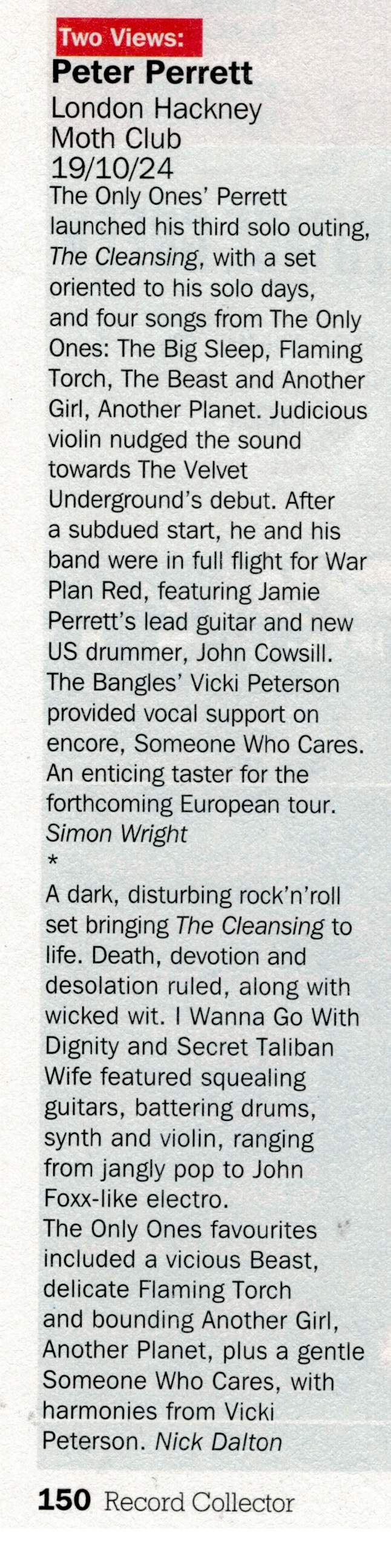
Live at the Moth Club, Hackney October 19th
This tiny club was sold out for the launch of Peter Perrett’s third solo LP, The Cleansing. The set was orientated towards his solo material, with only four songs from The Only Ones – The Big Sleep, Flaming Torch, The Beast and (of course) Another Girl, Another Planet. The judicious use of violin nudged the sound towards the Velvet Underground first LP. After a slightly subdued start, the band were in full flight for War Plan Red which featured Jamie Perrett’s lead guitar and new US drummer John Cowsill. Fellow American Vicki Peterson from The Bangles gave vocal support on encore Someone Who Cares. An enticing taster for the forthcoming European tour.
Review written for Record Collector magazine
Photo by Chris Mackin, reproduced with thanks


Out now from http://www.1960s.london

Side A
- I Can See For Miles (Townshend)
- Summertime Blues (Cochran/Capehart)
Side B
- I Can’t Reach You (Townshend)
- Our Love Was (Townshend)
Personnel
Roger Daltrey – vocals
Pete Townshend – guitar, vocals
John Entwistle – bass, vocals
Keith Moon – drums
Recording Details
All tracks recorded at De Lane Lea Studio, Wembley on October 10th 1967 and broadcast on BBC Radio Top Gear on October 15th
Sound Quality
Excellent throughout
Sleevenotes
This session, The Who’s seventh for the BBC, was the first time any band had been permitted to record outside the corporation’s own studios. The songs here were destined for the bands third LP The Who Sell Out and were specially remixed by Kit Lambert for radio transmission. As a result the tracks sound different to both stereo and mono LP versions. I Can See For Miles features clearer vocals plus a considerably enhanced Entwistle bass track which fills out the track. I Can’t Reach You and Our Love Was both show the simple perfection of Pete Townshend’s songwriting around this time. The former is a completely new mix, the latter has stripped down percussion and a novel country-style guitar part. Summertime Blues was not included on the album but it is a fine version, with reverb on the hand claps and a fuller drum sound than the version that would eventually emerge in 2009. This EP perfectly complements The Who Sell Out, their finest studio LP.

All available now from http://www.1960s.london
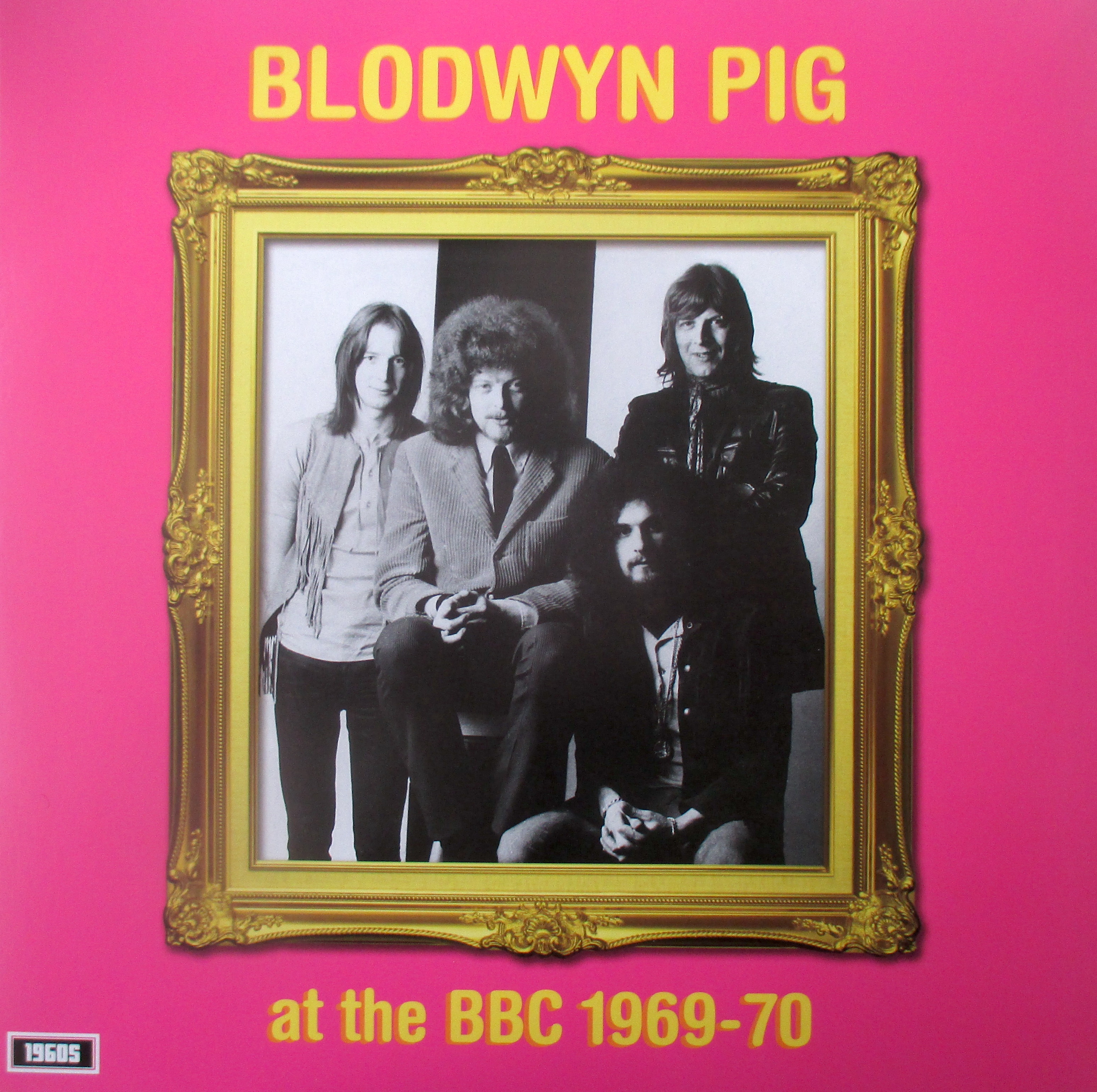
Blodwyn Pig At The BBC 1969 -70
Tracklisting
Side One
- Ain’t Ya Coming Home, Babe? (Abrahams, Lancaster, Pyle)
- The Change Song (Abrahams)
- It’s Only Love (Abrahams)
- The Modern Alchemist (Lancaster)
- Mr. Green’s Blues (Lancaster, Abrahams, Berg)
- It’s Only Love (Abrahams)
Side Two
- Worry (Pyle)
- Somebody Like Me (Abrahams, Fensome)
- See My Way (Abrahams)
- Meanie Mornay (Abrahams)
- Rock Me Baby (Josea, King)
- Same Ol’ Story (Abrahams)
Recording Details
Side One was recorded for BBC radio as follows:
Tracks 1 & 5 recorded on March 24th 1969 for Top Gear, transmitted on 13th April
Track 2 recorded on 24th February 1969 for Symonds on Sunday, transmitted on 2nd March
Track 3, 4 and 6 recorded for Top Gear, transmitted on 18th May 1969
Side Two
Track 1 recorded for BBC radio Top Gear on 29th May 1970 and transmitted on 10th July
Track 2 recorded for BBC World Service Rhythm & Blues, recorded and transmitted 1970
Track 3 & 4 recorded on 30th March 1970 for BBC radio Sounds Of The Seventies, transmitted on April 14th
Track 5 recorded for BBC radio Top Gear on 29th May 1970 and transmitted on 10th July
Track 6 recorded for BBC TV Top Of The Pops and transmitted on January 29th 1970
Personnel
Mick Abrahams – guitar, vocals
Andy Pyle – bass
Jack Lancaster – soprano saxophone, tenor saxophone, bass flute, violin
Ron Berg – drums
Sleevenotes
Many music fans only know Blodwyn Pig as the band that guitarist Mick Abrahams formed after he left Jethro Tull, but they were successful in their own right with two top ten LPs and a reputation as an exciting live band. Abrahams joined his first band The Crusaders in 1964. Next came a stint with Alexis Korner in Blues Incorporated where he met drummer Clive Bunker. This was followed by The Toggery Five and then McGregory’s Engine. McGregory’s Engine then merged with the group John Evan’s Smash, whose members included Ian Anderson and Glen Cornick, to form Jethro Tull. Abrahams blues guitar was a strong feature of debut album This Was (1968) and second single A Song For Jeffrey but his stay in Jethro Tull was short-lived. “ I got very pissed off with Ian, who saw Tull as his band, and wasn’t prepared to let anyone else voice their opinion on what was going on,” Mick explained in 2024 to Malcolm Dome of Prog magazine. “So I left. But I told them that I’d stay on until they found a replacement for me, because there was no way I wanted to leave them in the shit. A short while later, I was called to a meeting at the office of Terry Ellis, the band’s manager, who said ‘Ian and the boys don’t want you in the band any more so you’ve been fired.’ I just replied to Terry, ‘How can you fire me when I quit three weeks ago?’”
Mick had strong views of what he wanted his next band to be. They were named Blodwyn Pig by Mick’s friend Graham Waller, ‘Blodwyn’ being Welsh for ‘love’. “I’ve always thought of myself as a blues player, but with a little country, jazz and other styles thrown in for good measure. I never wanted us to be seen as performing one type of music or another. Some called us blues while there were those who insisted we were progressive. And when we did Top Of The Pops, the band were introduced as being ‘avant-garde’. It would have been closer to the point to call us ‘aven’t a fucking clue’!”. Rhythm section Andy Pyle and Ron Berg plus multi-instrumentalist Jack Lancaster were all strong musicians. However their ability to operate across a wide range of styles made it more difficult for the band to forge a coherent musical identity, as we can hear in the recordings made for the BBC through the support of John Peel and the other late-night DJs.
Taken from debut LP Ahead Rings Out (1969) Ain’t Ya Coming Home, Babe? illustrates this well. After a spoken-word introduction, Lancaster wails on sax and an extended guitar-solo from Abrahams follows, all over the top of a distinctly non 4/4 beat. The Change Song is more thoughtful, based around acoustic guitar and violin and with Abrahams’ country influences coming through. Two versions of It’s Only Love showcase an uptempo rocker where the brass helps drive the song. Lancaster wrote The Modern Alchemist and his jazz influence is to the fore with Abrahams guitar responding in the same idiom. Mr Green’s Blues never made it on to either studio LP: the lyric “he got the blues cos he got the greens!” refers to Peel’s vegetarian eating habits. Here Abrahams’ guitar combines well with Lancaster’s flute in a more recognisable twelve-bar blues.
Abrahams wrote Worry but gifted the songwriting to Andy Pyle who was complaining about his lack of credits on the second studio album LP, Getting To This (1970). See My Way also came from the second LP and sounds more ‘progressive’ with Abrahams demonstrating his speed and fluidity. Somebody Like Me is unavailable elsewhere and features Lancaster on violin. Meanie Mornay was another song not included on either studio LP and highlights Abrahams’ slide guitar. A cover of B.B. King’s Rock Me Baby enables Mick Abrahams to demonstrate his considerable ability to play a straight blues. At a time when groups such as Deep Purple and Black Sabbath were starting to have hit singles, Blodwyn Pig were invited to play Same Ol’ Story on Top Of The Pops. A stand-alone single and a catchy number, Same Ol’ Story was not a hit, despite the band looking suitably ‘heavy’ with lots of hair and fringed jerkins. Lancaster demonstrated his ability to play two saxes at once, a homage to key influence Rahsaan Roland Kirk.
Sadly in 1970 inter-band tensions resulted in Abrahams effectively being sacked from the group he had formed. Since then Aerosmith has cited Blodwyn Pig as an influence, Joey Ramone has covered See My Way and Cameron Crowe selected album track Dear Jill for the soundtrack of Almost Famous (2000). Regrets? Mick Abrahams has a few. “I do feel that had we stayed together this band would have been huge. There was a lot of potential we never got to explore, and we had a unique magic which you can hear on our albums.” And on the twelve tracks included here.
Sleevenotes: Jethro Toe


Spooky Tooth Broadcasts 1966 – 1969
Tracklisting
Side One
- Tobacco Road (Loudermilk)
- Yesterday (Lennon, McCartney)
- Sunshine Help Me (Wright)
- I Can’t Quit Her (Kooper, Levine)
- Evil Woman (Weiss)
- Love Really Changed Me (Wright, Miller, Grosvenor)
- Better By You, Better Than Me (Wright)
Side Two
- Tobacco Road (Loudermilk)
- Oh, Pretty Woman (Williams)
- Feelin’ Bad (Wright, Kellie)
- Better By You, Better Than Me (Wright)
- That Was Only Yesterday (Wright)
- My Babe (Medley, Hatfield)
- I Wanna Be Free (Tex)
- Stagger Lee (Lopez)
Recording Details
Side One
Tracks 1-3 recorded at Gala du MIDEM, Cannes 24.01.68 and broadcast on French TV
Tracks 4 – 6 recorded for BBC Radio Top Gear on 17.06.68
broadcast on 23.06.68
Track 7 recorded for Forum Musiques and broadcast on 24.05.69
Side Two
Track 1 recorded for BBC Radio Top Gear on 21.02.68, broadcast 17.03.68
Tracks 2 & 3 recorded 23.04.69 for BBC Radio Johnnie Walker and broadcast 26.04.69
Tracks 4 & 5 recorded for BBC Radio Top Gear on 03.02.69, broadcast 23.02.69
Track 6 recorded at the First International Festival Of Pop Music, Palais Des Sports, Paris on 14.04.67 and broadcast on French TV
Tracks 7 & 8 recorded for Reveillon Sur Les Deux Chaines 31.12.66 and broadcast on French TV
Sound Quality
The tracks recorded for the BBC are Excellent sound quality, the remaining tracks are Very Good
Personnel
Mike Harrison – keyboards, electric harpsichord, vocals
Luther Grosvenor – guitar
Mike Kellie – drums
Greg Ridley – bass
Gary Wright – keyboards, vocals (except Side Two, tracks 6-8)
Sleevenotes
“Spooky Tooth made a wonderful noise, creating a rushing hybrid of hard white soul and bluesy prog, with a rich inflection of gospel and psychedelia. The twin vocals of Harrison and Wright rang through the air like a hipper, more muscular version of the Righteous Brothers. At other times with Wright singing falsetto against Harrison’s bullish lead and the band blazing behind them they sounded as unbound as anything that West Coast acid rock could offer” Rob Hughes.
Before Spooky Tooth there was The V.I.P.’s, a tough R & B band from Carlisle formed in 1963 by lead singer Mike Harrison and bassist Greg Ridley. The band were eventually signed to Island by A&R extraordinaire Guy Stevens. They became popular in France and Germany but had no success in the UK. Keith Emerson was briefly a member en route to The Nice. After he left the remaining foursome – by now including guitarist Luther Grosvenor and drummer Mike Kellie – morphed into Art at the suggestion of Guy Stevens, who produced their sole LP Supernatural Fairy Tales (1967). Art were also the backing group for fashionable design collective Hapshash And The Coloured Coat on their LP Featuring the Human Host and the Heavy Metal Kids (1967). Neither LP was commercially successful.
The breakthrough came when Island producer Jimmy Miller recommended his New Jersey friend Gary Wright to the band. Wright played keyboards and was a strong vocalist with good songwriting skills. Anglo-American, twin keyboards, twin vocalists: Spooky Tooth was born. The band auditioned for the BBC. They were passed by the panel but comments ranged from “I like the group, loads of attack and screaming feeling” to “loud and pretentious psychedelic rubbish”.
The BBC tracks presented here demonstrate Spooky Tooth’s ability to remodel outside material to fit their distinctive sound. The soulful I Can’t Quit Her was written by Al Kooper and Irwin Levine for the first Blood, Sweat & Tears album. Larry Weiss’s Evil Woman was first released by Guy Darrell in 1967 and subsequently covered by Canned Heat and The Troggs. Here it builds from a delicate keyboard introduction to full-on raver. The catchy Love Really Changed Me was a band original from their first LP It’s All About (1968) but did not chart when released as a single. Tobacco Road had been a pop hit for The Nashville Teens in 1964 but this version is much slower and heavier. Oh, Pretty Woman was an A.C. Williams composition that came to prominence when covered by Albert King in 1966, Grosvenor taking the solo here. Feelin’ Bad was a rare co-write between Gary Wright and Mike Kellie. Wright’s Better By You, Better Than Me appeared on second album Spooky Two(1969). The track is built around an insidious guitar riff and remains Spooky Tooth’s best-known number thanks to a cover version by Judas Priest. That Was Only Yesterday shows a more sensitive side of the band with a subtle keyboard motif complementing the dual vocals of Wright and Harrison.
Spooky Tooth appeared regularly on French television throughout their career. A performance of Tobacco Road from Cannes in 1968 was performed to a seated and bow-tied audience but this did not inhibit the band with Wright’s falsetto particularly impressive. The same session saw the band perform a slow-paced orchestral Yesterday followed by their debut single Sunshine Help Me. A catchy pop song written by Gary Wright, its chart failure took everyone by surprise. The promotional film for Better By You, Better Than Me appears to be recorded live in a barn, preceded by the obligatory shot of the band running round a lake
The V.I.Ps were also filmed performing live for French TV. The band’s 1967 appearance at the First International Festival Of Pop Music in Paris (predating Monterey) saw them covering the Righteous Brothers’ My Babe. Even at this early stage the band’s distinctive sound was in place with Grosvenor’s guitar particularly prominent. The versions of Joe Tex’s I Wanna Be Free and the traditional Stagger Lee demonstrate why they went down so well with continental audiences and makes their lack of success in the UK inexplicable.
In 1969 Ridley left Spooky Tooth to form Humble Pie with Steve Marriott and Peter Frampton. Wright then quit the band after Island MD Chris Blackwell had arranged for Spooky Tooth to record some sessions backing French avant-garde musician Pierre Henry. To the horror of the band the resulting tracks were released under the Spooky Tooth name as Ceremony (1969). According to Harrison, Blackwell later told him “that was the biggest mistake I ever made.”
Spooky Tooth’s career never recovered from this setback and although various incarnations would tour and record until 2009, they lacked the cohesion and focus of the band in their prime. Band members would reappear in a variety of more successful groups including Foreigner, Humble Pie, Mott The Hoople and The Only Ones. Why did Spooky Tooth never achieve the success that was predicted for them? Wright reckons “the recordings peaked when we did our second album Spooky Two, but then we got sidetracked.” Mike Kellie is more direct: “I can’t tell you why we didn’t have hits. But I think we were our own worst enemies. Sometimes we needed a good slap.”
Sleevenotes: Pinque LaBelle


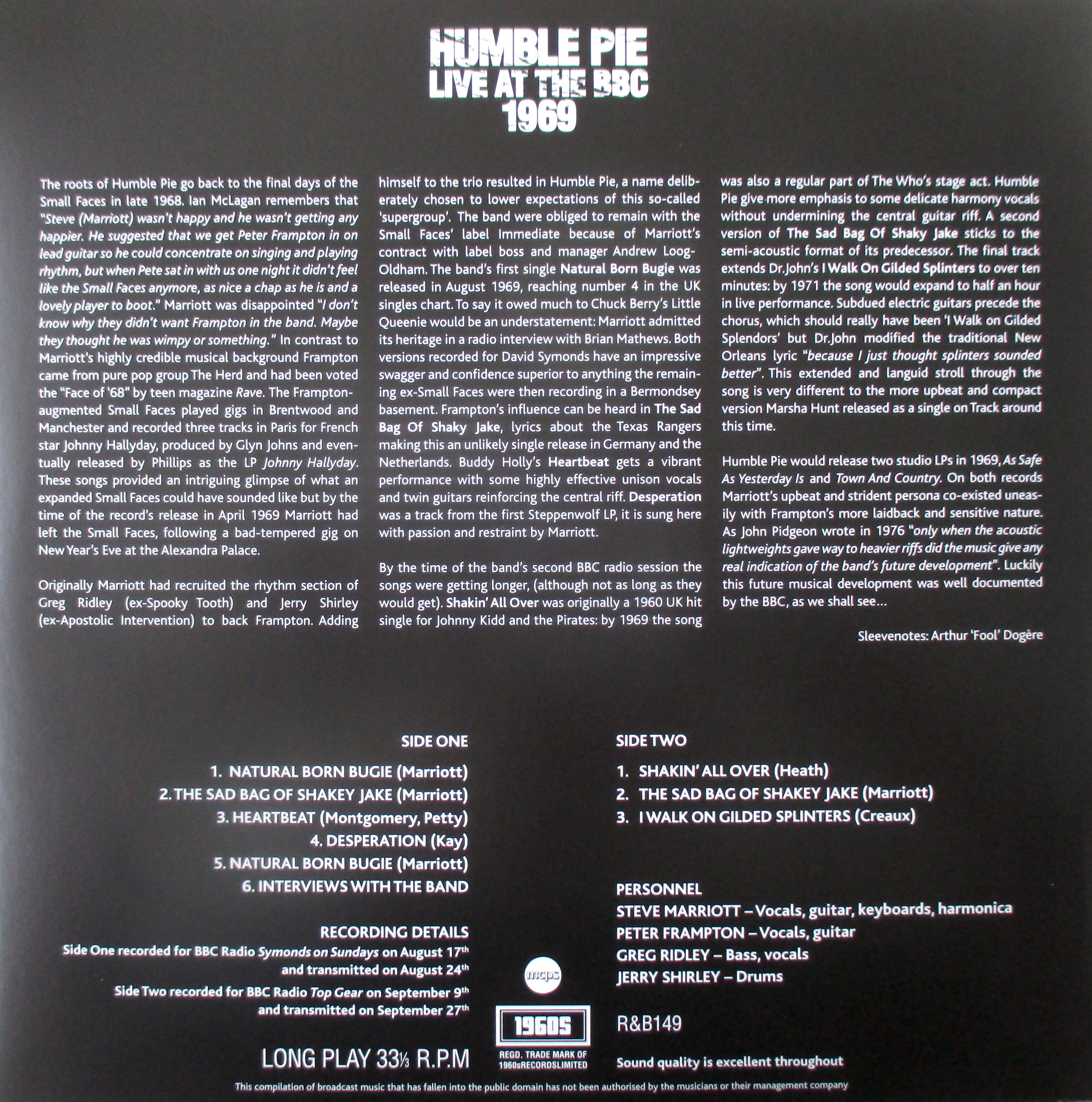
Humble Pie – Live At The BBC 1969
Tracklisting
Side One
- Natural Born Bugie (Marriott)
- The Sad Bag Of Shakey Jake (Marriott)
- Heartbeat (Montgomery, Petty)
- Desperation (Kay)
- Natural Born Bugie – Alternate (Marriott)
Side Two
- Shakin’ All Over (Heath)
- The Sad Bag Of Shakey Jake (Marriott)
- I Walk On Gilded Splinters (Creaux)
Recording Details
Side One recorded for BBC Radio Symonds on Sundays on August 17th and transmitted on August 24th
Side Two recorded for BBC Radio Top Gear on September 9th and transmitted on September 27th
Sound Quality
Sound us Excellent throughout
Personnel
Steve Marriott – Vocals, guitar, keyboards, harmonica
Peter Frampton – Vocals, guitar
Greg Ridley – Bass, vocals
Jerry Shirley – Drums
Sleevenotes
The roots of Humble Pie go back to the final days of the Small Faces in late 1968. Ian McLagan remembers that “Steve (Marriott) wasn’t happy and he wasn’t getting any happier. He suggested that we get Peter Frampton in on lead guitar so he could concentrate on singing and playing rhythm, but when Pete sat in with us one night it didn’t feel like the Small Faces anymore, as nice a chap as he is and a lovely player to boot.” Marriott was disappointed “I don’t know why they didn’t want Frampton in the band. Maybe they thought he was wimpy or something.” In contrast to Marriott’s highly credible musical background Frampton came from pure pop group The Herd and had been voted the “Face of ‘68” by teen magazine Rave. The Frampton-augmented Small Faces played gigs in Brentwood and Manchester and recorded three tracks in Paris for French star Johnny Halliday, produced by Glyn Johns and eventually released by Phillips as the LP Johnny Hallyday. These songs provided an intriguing glimpse of what an expanded Small Faces could have sounded like but by the time of the record’s release in April 1969 Marriott had left the Small Faces, following a bad-tempered gig on News Year’s Eve at the Alexandra Palace.
Originally Marriott had recruited the rhythm section of Greg Ridley (ex-Spooky Tooth) and Jerry Shirley (ex-Apostolic Intervention) to back Frampton. Adding himself to the trio resulted in Humble Pie, a name deliberately chosen to lower expectations of this so-called ‘supergroup’. The band were obliged to remain with the Small Faces’ label Immediate because of Marriott’s contract with label boss and manager Andrew Loog-Oldham. The band’s first single Natural Born Bugie wasreleased in August 1969, reaching number 4 in the UK singles chart. To say it owed much to Chuck Berry’s Little Queenie would be an understatement: Marriott admitted its heritage in a radio interview with Brian Mathews. Both versions recorded for David Symonds have an impressive swagger and confidence superior to anything the remaining ex-Small Faces were then recording in a Bermondsey basement. Frampton’s influence can be heard in the The Sad Bag Of Shaky Jake, lyrics about the Texas Rangers making this an unlikely single release in Germany and the Netherlands. Buddy Holly’s Heartbeat gets a vibrant performance with some highly effective unison vocals and twin guitars reinforcing the central riff. Desperation was a track from the first Steppenwolf LP, it is sung here with passion and restraint by Marriott.
By the time of the band’s second BBC radio session the songs were getting longer, (although not as long as they would get). Shakin’ All Over was originally a 1960 UK hit single for Johnny Kidd and the Pirates: by 1969 the song was also a regular part of The Who’s stage act. Humble Pie give more emphasis to some delicate harmony vocals without undermining the central guitar riff. A second version of The Sad Bag Of Shaky Jake sticks to the semi-acoustic format of its predecessor. The final track extends Dr.John’s I Walk On Gilded Splinters to over ten minutes: by 1971 the song would expand to half an hour in live performance. Subdued electric guitars precede the chorus, which should really have been ‘I Walk on Gilded Splendors’ but Dr.John modified the traditional New Orleans lyric “because I just thought splinters sounded better”. This extended and languid stroll through the song is very different to the more upbeat and compact version Marsha Hunt released as a single on Track around this time.
Humble Pie would release two studio LPs in 1969, As Safe As Yesterday Is and Town And Country. On both records Marriott’s upbeat and strident persona co-existed uneasily with Frampton’s more laidback and sensitive nature. As John Pidgeon wrote in 1976 “only when the acoustic lightweights gave way to heavier riffs did the music give any real indication of the band’s future development”. Luckily this future musical development was well documented by the BBC, as we shall see…
Sleevenotes: Arthur ‘Fool’ Dogère

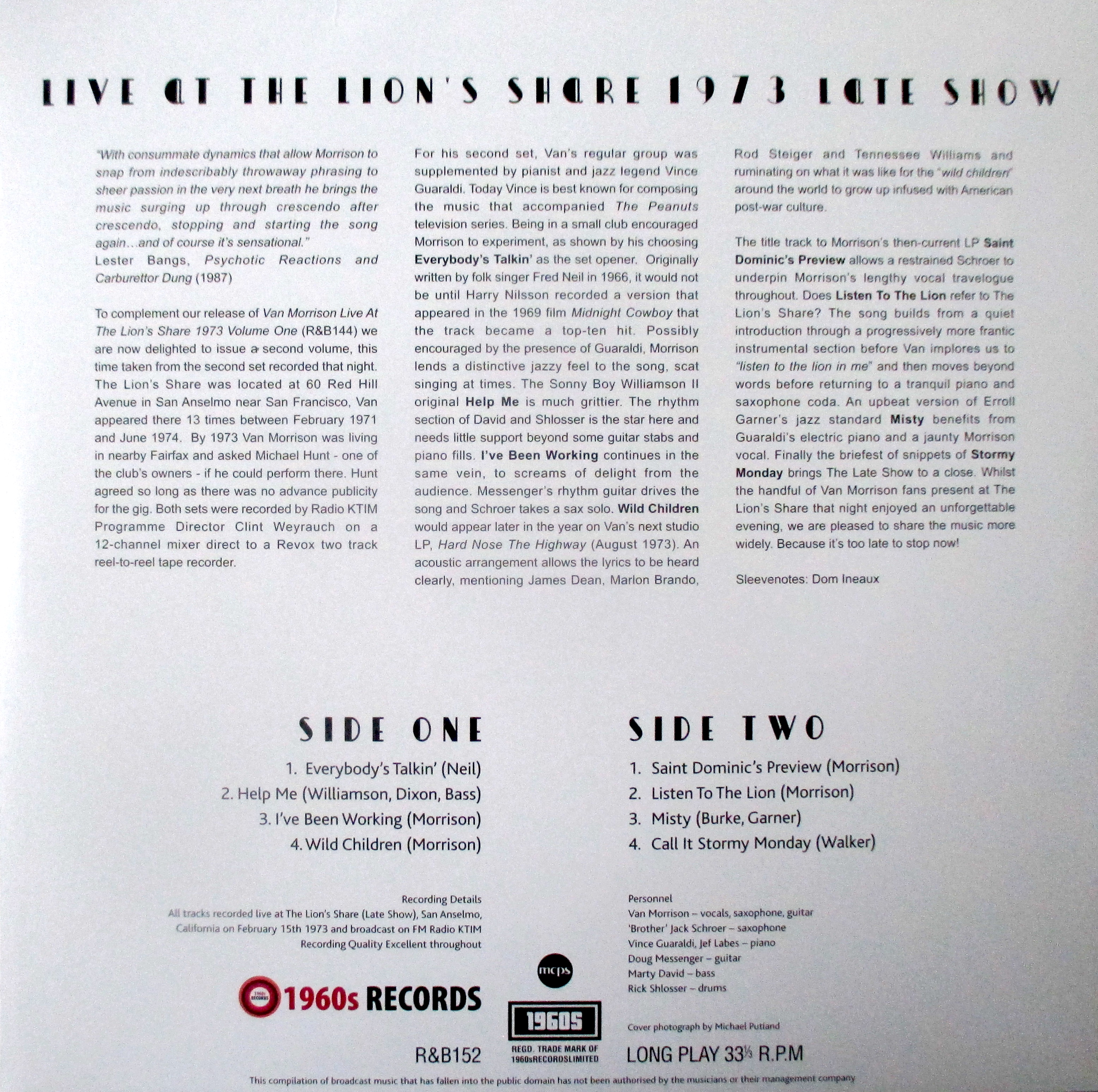
Van Morrison Live At The Lion’s Share 1973 L:ate Show
Tracklisting
Side One
- Everybody’s Talkin’ (Neil)
- Help Me (Williamson, Dixon, Bass)
- I’ve Been Working (Morrison)
- Wild Children (Morrison)
Side Two
- Saint Dominic’s Preview (Morrison)
- Listen To The Lion (Morrison)
- Misty (Burke, Garner)
- Call It Stormy Monday (But Tuesday Is Just As Bad) (Walker)
Personnel
Van Morrison – vocals, saxophone, guitar
‘Brother’ Jack Schroer – saxophone
Jef Labes – piano
Doug Messenger – guitar
Marty David – bass
Rick Shlosser – drums
Vince Guaraldi – piano
Recording Details
All tracks recorded live at The Lion’s Share, San Anselmo, California on February 15th 1973 and broadcast on FM Radio KTIM. All songs are from the Late Show.
Recording Quality
Excellent throughout
Sleevenotes
“With consummate dynamics that allow Morrison to snap from indescribably throwaway phrasing to sheer passion in the very next breath he brings the music surging up through crescendo after crescendo, stopping and starting the song again…and of course it’s sensational.”
Lester Bangs, Psychotic Reactions and Carburettor Dung (1987)
To complement our release of Van Morrison Live At The Lion’s Share 1973 Volume One (R&B??) we are now delighted to issue a second volume, this time taken from the second set recorded that night. The Lion’s Share was located at 60 Red Hill Avenue in San Anselmo near San Francisco, Van appeared there 13 times between February 1971 and June 1974. By 1973 Van Morrison was living in nearby Fairfax and asked Michael Hunt – one of the club’s owners – if he could perform there. Hunt agreed so long as there was no advance publicity for the gig. Both sets were recorded by Radio KTIM Programme Director Clint Weyrauch on a 12-channel mixer direct to a Revox two track reel-to-reel tape recorder.
For his second set, Van’s regular group was supplemented by pianist and jazz legend Vince Guaraldi. Today Vince is best known for composing the music that accompanied The Peanuts television series. Being in a small club encouraged Morrison to experiment, as shown by his choosing Everybody’s Talkin’ as the set opener. Originally written by legendary US folk singer Fred Neil in 1966, it would not be until Harry Nilsson recorded a version that appeared in the 1969 film Midnight Cowboy that the track became a top-ten hit. Possibly encouraged by the presence of Guaraldi, Morrison lends a distinctive jazzy feel to the song, scat singing at times. Help Me is much grittier. Originally sung by Sonny Boy Williamson II the song shares much of its DNA with Green Onions (Booker T. & the M.G.’s). The rhythm section of David and Shlosser is the star here and needs little support beyond some guitar stabs and piano fills. I’ve Been Working continues in the same vein, to screams of delight from the audience. Messenger’s rhythm guitar drives the song and Schroer takes a sax solo. Wild Children would appear later in the year on Van’s next studio LP, Hard Nose The Highway (August 1973). An acoustic arrangement allows the lyrics to be heard clearly, mentioning James Dean, Marlon Brando, Rod Steiger and Tennessee Williams and ruminating on what it was like for the “wild children” around the world to grow up infused with American post-war culture.
The title track to Morrison’s then-current LP Saint Dominic’s Preview allows a restrained Schroer to underpin Morrison’s lengthy vocal travelogue throughout. Does Listen To The Lion refer to The Lion’s Share? The song builds from a quiet introduction through a progressively more frantic instrumental section before Van implores us to “listen to the lion in me” and then moves beyond words before returning to a tranquil piano and saxophone coda. An upbeat version of Erroll Garner’s jazz standard Misty benefits from Guaraldi’s electric piano and a jaunty Morrison vocal. Finally the briefest of snippets of Stormy Monday brings The Late Show to a close. Whilst the handful of Van Morrison fans present at The Lion’s Share that night enjoyed an unforgettable evening, we are pleased to share the music more widely. Because it’s too late to stop now!
Sleevenotes: Dom Ineaux
All available now from http://www.1960s.london

Village Green – Live! EP
The Kinks
Tracklisting
Side One
- The Last Of The Steam Powered Trains
- Picture Book
Side Two
- Big Sky
- Autumn Almanac
All songs written by Raymond Douglas Davies
Main photo by Peter Rand for Vogue, June 26th 1968
Recording Details
Side One recorded for BBC TV Once More With Felix on January 7th 1969 and broadcast on February 1st
Side Two recorded live at Colden Center Auditorium, Queens College, New York on March 27th 1971 and broadcast on WLIR-FM
Sound Quality
All tracks are Very Good
Personnel
Ray Davies – Vocals, guitar
Dave Davies – Guitar, vocals
Mick Avory – Drums
Pete Quaife – Bass (Side One)
John Dalton – Bass (Side Two)
John Gosling – Keyboards (Side Two, Track 1)
Ben Rosenblatt – Keyboards (Side Two, Track 2)
Sleevenotes
The Kinks Village Green LP is now rightly regarded as a great LP and one of the best records from the 1960s. However when first released in November 1968 it sold poorly, a situation exacerbated by Ray Davies refusing to let Pye release a single in the UK or the US. Virtually the only promotional activity undertaken by the band was an appearance on folk singer Julie Felix’s Saturday night BBC TV show. These are some of Pete Quaife’s last appearances with the Kinks – he would leave to form his own band Maple Oak in April 1969. The Last Of The Steam Powered Trains makes no secret of its debt to Smokestack Lightnin’. Picture Book was the B side to Starstruck, a European-only single released in January 1969. Big Sky is a memento of the US tours that the Kinks were able to undertake when a lengthy union ban finally ended, this version demonstrating that the band was capable of effectively re-creating the complex Village Green songs in a live setting. From the same gig comes the rarely played Autumn Almanac, one of the 15 songs considered for inclusion on the Village Green LP. Ben Rosenblatt, a student in the audience, knew the song and offered to play the piano part. The Kinks were always keen on audience participation…
Sleevenotes: Johnny Thunder


Live At The Lion’s Share 1973 Early Show
Van Morrison
Tracklisting
Side One
- Saint Dominic’s Preview (Morrison)
- Hey, Good Lookin’ (Williams)
- Since I Fell For You (Johnson)
- Caravan (Morrison)
Side Two
- I’ve Been Working (Morrison)
- Beyond Words (Morrison)
- I Just Want To Make Love To You (Dixon)
- Hard Nose The Highway (Morrison)
Personnel
Van Morrison – vocals, saxophone, guitar
‘Brother’ Jack Schroer – saxophone
Jef Labes – piano
Doug Messenger – guitar
Marty David – bass
Rick Shlosser – drums
Recording Details
All tracks recorded live at the Early Show, The Lion’s Share, San Anselmo, California on February 15th 1973 and broadcast on FM Radio KTIM.
Recording Quality
Excellent throughout
Sleevenotes
Throughout his lengthy career Van Morrison has always enjoyed performing in small clubs. Our release It’s Too Great To Stop Now (R&B 88) showcased an exuberant set from Pacific High Recorders in October 1971. This new release is a worthy successor, featuring Van Morrison and his band kicking back in the tiny Lion’s Share club. Located at 60 Red Hill Avenue in San Anselmo near San Francisco, Van appeared here 13 times between February 1971 and June 1974. The club was a drab 1940s single storey building with a legal capacity of around 150 which became known as a musician’s hangout. In 1969 it was the venue for Randy Newman’s first ever concert. Janis Joplin’s funeral party was held at The Lion’s Share on October 26th 1971 and featured a performance by The Grateful Dead. By 1973 Van Morrison was living in nearby Fairfax and asked Michael Hunt – one of the club’s owners – if he could perform there. Hunt agreed so long as there was no advance publicity for the gig. Van played two sets that night, both recorded by Radio KTIM Programme Director Clint Weyrauch on a 12-channel mixer direct to a Revox two track reel-to-reel tape recorder.
Later in 1973 Van would record the famous live LP It’s Too Late To Stop Now with a ten-piece band he named the Caledonian Soul Orchestra. Comparing the version of Caravan performed at the Lion’s Share with that performed at London’s Rainbow Theatre on July 24th reveals that the Lion’s Share crew were more flexible and capable of greater instrumental subtlety than their successors. Both Jack Shroer and Jef Labes would progress from The Lion’s Share to become members of the Caledonian Soul Orchestra.
At The Lion’s Share the intimate atmosphere encouraged Morrison to experiment with his choice of material. Opener Saint Dominic’s Preview was well-known as the title track of Van’s most recent LP but to follow it with a cover of Hank Williams’ Hey, Good Lookin’ demonstratesboth the breadth of Morrison’s musical influences and his ability to surprise his audience. The former is based around Labes’ piano and Messenger’s guitar whilst the latter receives an upbeat jazzy arrangement featuring Schroer’s saxophone. Since I Fell For You had not been released by Morrison at this point – it was originally written as a blues ballad by Buddy Stephens in 1952 and was a hit single for Lenny Welch in October 1963. The sparse arrangement gives Morrison the space to sing this lament with a light touch but no lack of conviction.
I’ve Been Working was originally recorded for both Astral Weeks and Moondance, before finally being released on His Band and the Street Choir (1970). Highly danceable, the groove references Van’s r’n’b roots with Them at The Maritime Hotel. The scat-sung Beyond Words shares some musical structure with Into The Mystic, but Morrison confirmed it was a separate song when he released a studio version on Beyond Words: Instrumental (2023). The measured pace of Muddy Waters’ I Just Want To Make Love To You adds a sly menace to Morrison’s vocal. Finally Hard Nose The Highway, the then-unreleased title track of Morrisons next LP and his paean to life “further on up the road”.
And The Late Show? Watch this space…
“Morrison remains a singer who can be compared to no performer in rock’n’roll, a singer who cannot be pinned down, dismissed, nor fitted into anyone’s expectations. Morrison is a man on a quest: it will be a long one, but there are listeners who will be with him for the duration” Greil Marcus, Rolling Stone 1981
Sleevenotes: Jock E Wilson


Rory Gallagher – In Concert At The BBC 1972
Side One (22:45)
- Tore Down (Sonny Thomson)
- Used To Be (Rory Gallagher)
- Pistol Slapper Blues (Blind Boy Fuller)
- Going To My Hometown (Rory Gallagher)
Side Two (20:15)
- The Cuckoo (Trad arr. Gallagher)
- In Your Town (Rory Gallagher)
- Bullfrog Blues (William Harris)
Personnel
Rory Gallagher – Guitar, vocals, mandolin
Gerry McAvoy – Bass
Wilgar Campbell – Drums
Recording Details
All tracks recorded live at the Paris Theatre, Lower Regent Street on 13th July 1972 and broadcast on BBC radio In Concert on 29th July.
Recording Quality
Excellent throughout
Sleevenotes
“Rory Gallagher knows more about playing the electric blues than all the Allman Brothers – living or dead – put together. A punky little Irishman, and the only rocker with enough nerve to pay Belfast while the shit was still flying hard and heavy. It would be difficult to match a song with its album because the character of Rory’s writing and recording has changed only slightly over the years. That’s no problem…it’s consistently GREAT!” Ira Robbins, Trouser Press
Our previous Rory Gallagher release (R&B 99) showcased his early career as the creative force in power trio Taste. Going solo saw Gallagher stay with the trio format, recruiting a rhythm section of bass player Gerry McAvoy and drummer Wilgar Campbell. Both came from Belfast band Deep Joy, who had supported Taste on tour. This line-up recorded three LPs, Rory Gallagher (1971), Deuce (1971)and Live In Europe (1972). Rory’s unpretentious appearance – flannel shirt, sneakers, battered jeans and an equally battered Stratocaster – illustrated his complete lack of pretension. This In Concert performance was the third that Gallagher had recorded for BBC Radio, reflecting his enormous popularity amongst blues fans who might previously been digging Jeff Beck, Eric Clapton or Peter Green. Rory was a scholar of the blues and frequently unearthed forgotten tunes to cover live or in the studio, always being careful to credit the original songwriters. When it comes to Rory’s song writing John Perry has pointed out that his originals were often “blues based songs with melodies instead of constant 12 bars.”
The dramatic opening chords of Used To Be make for an exciting set opener, Gallagher’s solo demonstrates the memorable searing tone he extracted from his faithful Strat and a second-hand AC30. The hard-boiled lyric “get used to bein’ my use to be” reflects Gallagher’s love of Dashiell Hammett and Raymond Chandler. Pistol Slapper Blues made its debut on Live In Europe. Originally written by Blind Boy Fuller here it is a showcase for Gallagher’s dexterity on acoustic guitar. Going To My Hometown gets an enthusiastic welcome and has fans spontaneously clapping along to a semi-acoustic, mandolin-driven stomp. The call and response vocals between Gallagher and the audience seem spontaneous and unforced.
The Cuckoo is a traditional number, Gallagher bases his acoustic arrangement on the versions recorded by Tom Rush, Doc Watson and Clarence Ashley. Gallagher’s own version would not appear until the Wheels Within Wheels out-takes LP in 2003. The Stratocaster is back for In Your Town, where a driving riff is interspersed by some ferocious slide-guitar solos. The rhythm section never miss a beat whilst the lyric is a tale of wrongful arrest involving the local D.A. and Chief Of Police. A roar of recognition greets perennial stage favourite Bullfrog Blues, first heard on Live In Europe. William Harris’ original is injected with a liberal dose of Chuck Berry resulting in the sort of rave-up that the Yardbirds used to unleash at the Crawdaddy. McAvoy and Wilgar both take commendably brief solos and Gallagher weaves in some lines from John Lee Hooker’s Boogie Chillun.
“Apart from the fact that he was a great player, the most noticeable thing about Rory was that he never compromised himself musically in any way. He would never do something that was, for him, below a certain level of integrity. He wouldn’t do singles. He didn’t want to do videos. He was such a purist. He wouldn’t sell himself out. If there weren’t people like Rory Gallagher around to set that kind of example then it would probably spell the end of quality music.” Gary Moore
Sleevenotes: Juke Box Annie


The Spencer Davis Group At The BBC 1966
Tracklist
Side One
1. Keep On Running (Edwards)
2. Ramblin’ Rose (Burch, Wilkin)
3. Please Do Something (Covay)
4. Somebody Help Me (Edwards)
5. Let Me Down Easy (Ford, McDougal)
6. Don’t Mess Up A Good Thing (Sain)
7. Dust My Blues (James)
8. Mean Woman Blues (Demetrius)
9. I’m Getting Better (Bruce)
Side Two
1. Together ‘Til The End Of Time (Wilson)
2. When I Come Home (Edwards, Winwood)
3. Mean Woman Blues (Demetrius)
4. Take This Hurt Off Me (Covay)
5. Dust My Blues (James)
6. Gimme Some Lovin’ (Winwood)
7. BBC Interviews with Spencer Davis
Recording Details
All tracks recorded for BBC Radio in 1966
Side One
Tracks 1-3 broadcast in January
Tracks 4-6 broadcast in April
Tracks 7-9 broadcast in July
Side Two
Tracks 1-3 broadcast in October
Tracks 4 – 6 broadcast in December
Personnel
Steve Winwood – Keyboards, guitar, vocals
Spencer Davis – Guitar, vocals
Muff Winwood – Bass, vocals
Pete York – Drums
Sound Quality
Excellent throughout
Sleeve Notes
Bursting out of the Birmingham beat scene in 1964 The Spencer Davis Group featured the Winwood brothers, Muff on bass and a teenage Stevie on guitar, organ, piano and the vocals of someone much older. Spencer played guitar and sang and Pete York was the drummer. Their first album, unsurprisingly named Their First LP, was released in July 1965. “The first album group? Certainly their first LP sold much more than their early singles success should suggest. Already the unique Davis approach is there, where several strands of black music are pulled together. It isn’t pure R&B; not quite, but a contemporary soul approach to all the songs.” Brian Hogg, Bam Balam magazine (1980).
Recording for the BBC provided The Spencer Davis Group with an opportunity to feature songs from their live set that were not otherwise recorded in the studio. Other bands that did this included The Beatles, The Stones, The Yardbirds, The Small Faces and The Move. The LP we released documenting The Spencer Davis Group at the BBC in 1965 (R&B108) was a great success and we are delighted to be issuing this sequel which brings together tracks recorded for the BBC the following year.
We start 1966 where we finished 1965, with the breakthrough hit Keep On Running, here in a slightly extended version with Muff Winwood’s bass driving the song. Ramblin’ Rose, sung by Steve Winwood, has quite a history. Originally written by Fred Burch and Marijohn Wilkin, it was first recorded by Jerry Leee Lewis and his Pumping Piano in 1961: it would be later sped up and rocked out as a showcase for Brother Wayne Kramer of the MC5. Please Do Something was written by Don Covay who was also responsible for Take This Hurt Off Me. Both are tightly arranged and totally danceable and feature more of Steve Winwood’s soulful vocals. Please Do Something was the opening track on the band’s second LP, imaginatively called The Second Album (February 1966).
Somebody Help Me was the follow-up single to Keep On Running: it too was written by Jackie Edwards. Like its predecessor it reached number one in the UK singles chart and was another upbeat song. The distinctive guitar introduction lead straight into the chorus for maximum hummability. Betty LaVette’s Let Me Down Easy is a complete contrast, a slower number with a mournful vocal from Stevie and an economical guitar solo. Spencer and Stevie recreate the duet between Fontella Bass and Bobby McClure on Don’t Mess Up A Good Thing.The group show their versatility on a version of Elmore James’ Dust My Blues where a Spencer vocal is ably supported by Winwood’s guitar, a precursor to the whole “Fleetwood Mac Chicken Shack John Mayall Can’t Fail Blues” (thank you, Adrian Henri). From the blues to Elvis: Mean Woman Blues gets a country treatment with Jordanaire backing vocals. Less well known is Jimmy Hughes, whose I’m Getting Better brings Side One to a close. Unsuccessful when Hughes released the song as single here it benefits from a minimal backing which allows the quiet passion in Steve Winwood’s vocal to really come through.
Together ‘Til The End Of Time was the lead track on the third Spencer Davis LP Autumn 66 (September 1966). The song was written by Frank Wilson for Brenda Holloway, who also sang Every Little Bit Hurts from Their First LP. The Spencer Davis Group keep the slow tempo of Holloway’s version which gives Stevie plenty of space to emote, his vocals underpinned by rolling organ. When I Come Home is a rare co-write between Jackie Edwards and Steve Winwood – it reached number 12 in the charts and featured in the film The Ghost Goes Gear, an otherwise unremarkable piece of mid-‘60s fluff featuring Nicholas Parsons. The footage of the band lipsynching on a pleasure cruiser going past Windsor Castle is avilable online and well worth watching. Repeat performances of Mean Woman Blues and Dust My Blues are similar to those recorded earlier in the year. Our final selection is the first Spencer Davis Group A-side to be entirely self-written. Stevie Winwood wrote Gimme Some Lovin’ and would go on to perform it throughout his lengthy career in Traffic and beyond. The Spencer Davis Group single version reached number 2 in the UK and (crucially) number 7 in the US when released there by United Artists. It was a heady mix of another bass-driven intro plus Stevie Winwood’s distinctive organ and some “heh”s on the chorus. The version here shows the band could replicate the fabulous sound of the single but in truth this was more Stevie Winwood than Spencer Davis Group and Winwood would leave to go solo the following year. To finish the LP we include a series of interviews conducted with Spencer at the BBC throughout 1966.
Sleevenotes: Perry Barr


Curzon Mayfair 17th May
Review written for Record Collector magazine
Special screening with Q&A featuring directors Alexis Bloom and Sverlana Zillwas plus Anita’s son Marlon Richards and her daughter Angela (formerly Dandelion), chaired by an extremely well-informed Miranda Sawyer.
Celebs present: Noel Gallagher, Bob Geldorf, Pam Hogg, Matt Lee
Instead of the traditional rock-doc format of talking heads pontificating about “the Anita they knew” we got lots of previously-unseen home movies and a running commentary using Anita’s own words, taken from an unpublished autobiography and read by Scarlett Johansson. There is fascinating footage from the ill-fated 1967 road trip to Morocco taken by Anita, Keith Richards, Brian Jones and (an uncredited) Tom Keylock. The 1969 boat trip to Brazil by Pallenberg, Richards, Mick Jagger and Marianne Faithful also features. Most startling is the footage of Richards in 1976, playing live in Paris immediately after hearing that Tara, his third child with Anita, had died of a cot death. Richard insisted that the concert not be cancelled although Nick Kent described the couple after the show as “no longer the Scott and Zelda of the rock’n’roll era they looked like some tragic shell-shocked couple leading each other out of a concentration camp.”
Many Stones fans regard the 1971 sessions in Nellcote, a villa in the South of France rented by newly tax-exiled Richards, as the setting for some of the finest music the band would ever make, subsequently released as Exile On Main Street. Catching Fire uses film, photography and eye-witness interviews to reframe Nellcote through Pallenberg’s eyes. There may have been a makeshift recording studio in the basement, but Nellcote was also a home where Richards, Pallenberg and three-year old Marlon were living. The practicalities of trying to run what was essentially a hotel with an ever-changing population of twenty plus rock’n’roll degenerates and the associated sex, drugs and rock’n’roll fell mainly to Anita, the only woman consistently present who was also the only French speaker.
This traditional approach towards male and female roles was echoed by Richards’ shutting down of Anita’s acting career. Here the film errs on the generous – Anita is brilliant in Performance and good in Barbarella, both times when she was effectively playing herself, but her starring role in A Degree Of Murder is wooden and unconvincing. It is claimed Richards paid her to stop acting and stay at home whilst he went on tour, fuelling her drug habit. It got worse when they moved to upstate New York where Pallenburg is portrayed as a virtual prisoner with no money of her own and her passport held by the Stones management.
It was alcohol rather than drugs that caused Anita to hit rock bottom. After several attempts she got herself clean and sober and the second act of her life began. She moved to Chelsea, got a degree in fashion and textiles from St.Martin’s, became a doting grandmother and began to be recognised as a style icon, particularly by Kate Moss who appears here and admits to deliberately recreating some of Anita’s iconic outfits. Of the folks who were around in the ‘60s her drug buddy Prince Stash appears on screen, whilst Keith Richards recorded a long interview which is used sparingly throughout. He calls her “a piece of work” and still sounds enmeshed with her.
What comes through most clearly is the intense love shared by Anita and Keith, and how drugs poisoned that love. Although towards the end of the film Pallenburg claims that “I regret nothing”, Marlon now admits this was bravado. During the Q&A both he and Angela were clear that Anita and Keith have said that they were sorry for what they put their young family through.
Anita Pallenberg would be a key figure in 20th century culture if all she had done was cause Keith Richards to write Gimme Shelter. That she was much more than an artist’s muse is made clear by this fascinating film.
Available now from http://www.1960s.london
Review from Record Collector magazine (August 2024)


Roxy Music Live At The BBC and Beyond 1972-73
Tracklisting
Side One
- Grey Lagoons
- Pyjamarama
- Do The Strand
- Editions Of You
- In Every Dream Home A Heartache
- Grey Lagoons
Side Two
- Virginia Plain
- Do The Strand
- Editions Of You
- In Every Dream Home A Heartache
- Remake / Remodel
All songs written by Bryan Ferry
Personnel
Bryan Ferry – Vocals, piano, guitar, harmonica
Andy Mackay – Oboe, saxophone, keyboards, vocals
Brian Eno – Synthesiser, tapes, vocals
Phil Manzanera – Guitar
The Great Paul Thompson – Drums
Rik Kenton – Bass (Side One, Tracks 1 & 6)
Sal Maida – Bass (Side One, Tracks 2-5)
John Porter – Bass (Side Two)
Recording Details
Side One
All tracks recorded live for the BBC
Track 1 Radio In Concert transmitted 03.08.72
Tracks 2 – 5 Radio John Peel’s Sounds Of The Seventies transmitted 08.03.73
Track 6 TV Full House transmitted 25.11.72
Side Two
All tracks recorded in Bremen for the Musikladen TV show and transmitted 30.05.73
Sound Quality
Excellent throughout except Side One, Track 5 which is Very Good
Sleevenotes
“There’s a new sensation…” sang Bryan Ferry and by the time these tracks were recorded he was right on the button. The new sensation was Roxy Music, simply the most exciting and glamorous band to burst through the double-denim years of the early 1970s. Their self-titled first album released in 1972 was a heady blend of prog (Phil Manzanera), avant garde (Andy Mackay and Brian Eno) and thumping rock’n’roll (Thompson), providing the perfect setting for the arty but catchy tunes of crooning hearthrob Bryan Ferry. Ferry was determined to avoid the grind of endless college support gigs and instead persuaded EG Management to fund the band until a record contract with Island Records could be negotiated. Thus Roxy Music emerged fully-formed as if from nowhere. Critical and chart success was immediate.
The BBC were early supporters of the band. The first version of Grey Lagoons was recorded as part of a 1972 In Concert radioslot, ostensibly to promote the first LP. However the song would not be released on record until For Your Pleasure (1973) where it was sandwiched between two instrumentally-driven pieces The Bogus Man and the LP’s title track. By comparison Grey Lagoons is positively conventional, containing the classic Ferry line “morning sickness on Friday nights” and an unexpected harmonica solo. The first song to be written by Ferry on guitar, Pyjamarama was the band’s second single, but according to Manzanera the production, cutting and pressing process were all hurried. The version here recorded for John Peel has more prominent guitars, a more distinctive bass line and a slinkier vocal. From the same session comes the great-single-that-never-was, the dance craze anthem Do The Strand where Andy Mackay blows up a storm. The remaining tracks from this session are two further selections from For Your Pleasure, Editions Of You and In Every Dream Home A Heartache. The former is Roxy’s most straightforward rocker, albeit with classical allusions to the Lorelei, whilst the latter allows Manzanera to stretch out. Finally a second version of Grey Lagoons from BBC2 art programme Full House where Manzanera is again the star, his white Strat not the only Hendrix reference.
In May 1973 the band played a short set for German TV’s Musikladen as part of their spring European tour promoting For Your Pleasure. Debut single Virginia Plain is a strong statement of intent – “teenage rebel of the week” indeed. The instrumental break sees Mackay and Manzanera synchronise their dance steps whilst Eno glitters like a glam-rock ostrich and Ferry’s quiff gleams impossibly black. Paul Thompson does a great job of stopping it all getting too precious. For Do The Strand Ferry changes into a white-double breasted number whilst Eno favours an extravagance of black feathers. Editions Of You has Ferry moving centre-stage away from his piano, whilst Eno responds with some vigorous tambourine bashing and a wild synth solo. The spooky first half of In Every Dream Home A Heartache is dominated by Mackay on organ, until Manzanera shatters the tension on his Les Paul with Ferry playing a rare rhythm guitar part. On Remake/Remodel Eno, Manzanera and Mackay all sing the chorus of “CPL 593A”,emphasising what a visual band this first incarnation had become. The futuristically-garbed Mackay (great codpiece) gives us a snippet of “Deutschland über alles” and after a final explosion of drums the set ends to enthusiastic applause.
Sadly by June 1973 it was all over. During an appearance at York Festival shouts of “Eno” interfered with the bands performance. Eno withdrew in an attempt to quieten his fans, but Ferry informed EG that he would never share a stage with Eno again. Roxy would recover from Eno’s departure, becoming more focused around Ferry but no less successful. As we will see…
Sleevenotes
Lolita & Guernica


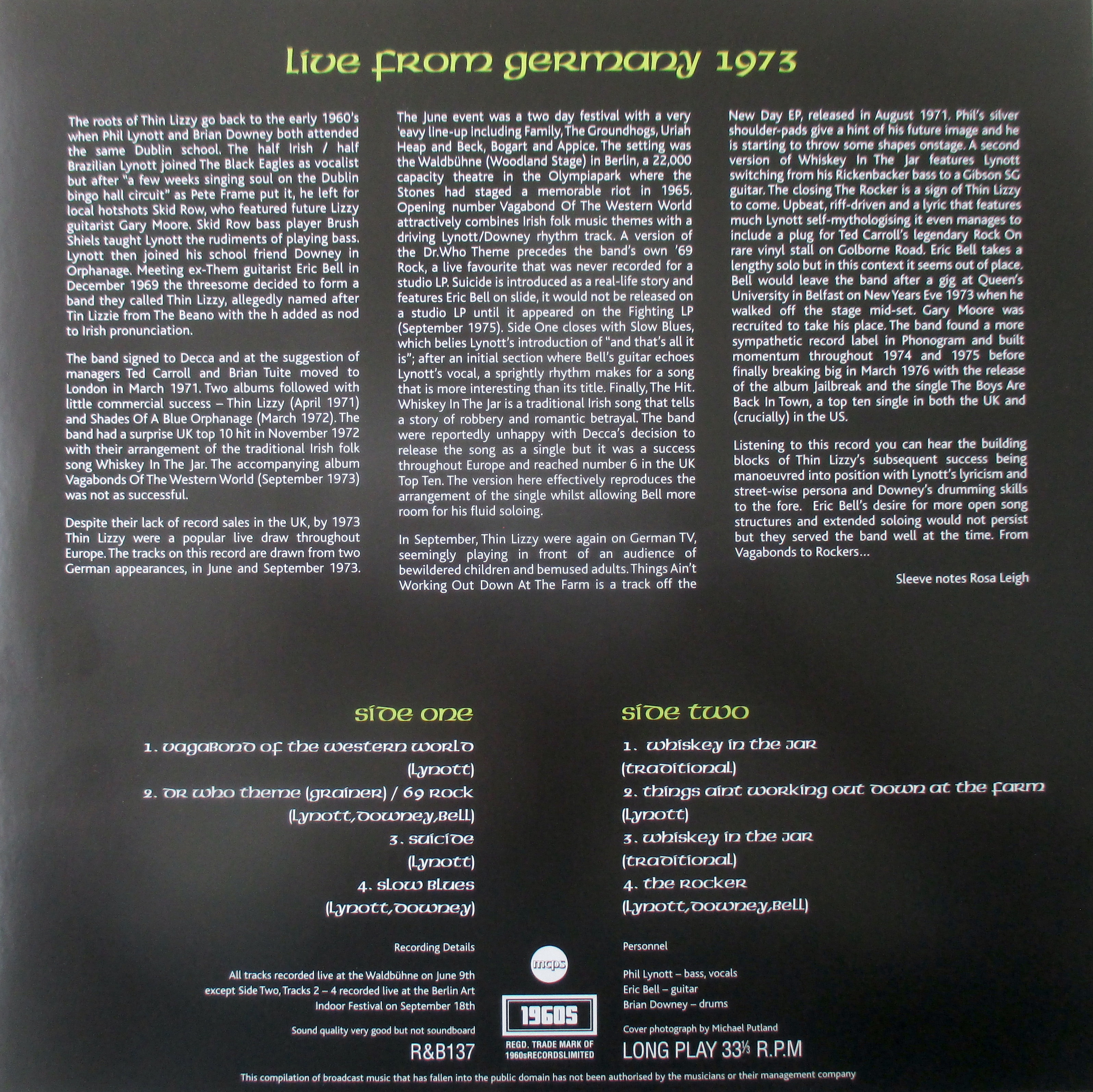
Thin Lizzy Live From Germany 1973
Side One
- Vagabond Of The Western World (Lynott)
- Dr Who Theme (Grainer) /
- ‘69 Rock (Lynott, Downey, Bell)
- Suicide (Lynott)
- Slow Blues (Lynott, Downey)
Side Two
- Whiskey In The Jar (traditional arranged Lynott, Downey, Bell)
- Things Ain’t Working Out Down At The Farm (Lynott)
- Whiskey In The Jar (traditional arranged Lynott, Downey, Bell)
- The Rocker (Lynott, Downey, Bell)
Recording Details
Side One and Side Two, Track 1 recorded live at the Waldbuhne on June 9th and broadcast on German TV
Side Two, Tracks 2 – 4 recorded live at the Berlin Art Indoor Festival on September 18th and broadcast on German TV
Personnel
Phil Lynott – bass, vocals
Eric Bell – guitar
Brian Downey – drums
Sleevenotes
The roots of Thin Lizzy go back to the early 1960’s when Phil Lynott and Brian Downey both attended the same Dublin school. The half Irish / half Brazilian Lynott joined The Black Eagles as vocalist but after “a few weeks singing soul on the Dublin bingo hall circuit” as Pete Frame put it, he left for local hotshots Skid Row, who featured future Lizzy guitarist Gary Moore. Skid Row bass player Brush Shiels taught Lynott the rudiments of playing bass. Lynott then joined his school friend Downey in Orphanage. Meeting ex-Them guitarist Eric Bell in December 1969 the threesome decided to form a band they called Thin Lizzy, allegedly named after Tin Lizzie from The Beano with the h added as nod to Irish pronunciation.
The band signed to Decca and at the suggestion of managers Ted Carroll and Brian Tuite moved to London in March 1971. Two albums followed with little commercial success – Thin Lizzy (April 1971) and Shades Of A Blue Orphanage (March 1972).The band had a surprise UK top 10 hit in November 1972 with their arrangement of the traditional Irish folk song Whiskey In The Jar. The accompanying album Vagabonds Of The Western World (September 1973) was not as successful.
Despite their lack of record sales in the UK, by 1973 Thin Lizzy were a popular live draw throughout Europe. The tracks on this record are drawn from two German appearances, in June and September 1973. The June event was a two day festival with a very ‘eavy line-up including Family, The Groundhogs, Uriah Heap and Beck, Bogart and Appice. The setting was the Waldbhune (Woodland Stage) in Berlin, a 22,000 capacity theatre in the Olympiapark where the Stones had staged a memorable riot in 1965. Opening number Vagabond Of The Western World attractively combines Irish folk music themes with a driving Lynott/Downey rhythm track. A version of the Dr.Who Theme precedes the bands own ’69 Rock, a live favourite that was never recorded for a studio LP. Suicide is introduced asa real-life story and features Eric Bell on slide, it would not be released on a studio LP until it appeared on the Fighting LP (September 1975). Side one closes with a Slow Blues. Another track from Vagabonds… the song belies Lynott’s introduction of “and that’s all it is”. After an initial section where Bell’s guitar echoes Lynott’s vocal, a sprightly rhythm makes for a song that is more interesting than its title. Finally, The Hit. Whiskey In The Jar is a traditional Irish song that tells a story of robbery and romantic betrayal. The band were reportedly unhappy with Decca’s decision to release the song as a single but it was a success throughout Europe and reached number 6 in the UK Top Ten. The version here effectively reproduces the arrangement of the single whilst allowing Bell more room for his fluid soloing.
In September Thin Lizzy were again on German TV, seemingly playing in front of an audience of bewildered children and bemused adults. Things Ain’t Working Out Down At The Farm is a track off the New Day EP, released in August 1971. Phil’s silver shoulder-pads give a hint of his future image and he is starting to throw some shapes onstage. A second version of Whiskey In The Jar features Lynott switching from his Rickenbacker bass to a Gibson SG guitar. The closing The Rocker is a sign of Thin Lizzy to come. Upbeat, riff-driven and a lyric that features much Lynott self-mythologising it even manages to include a plug for Ted Carroll’s legendary Rock On rare vinyl stall on Golborne Road. Eric Bell takes a lengthy solo but in this context it seems out of place. Bell would leave the band after a gig at Queen’s University in Belfast on New Years Eve 1973 when he walked off the stage mid-set. Gary Moore was recruited to take his place. The band found a more sympathetic record label in Phonogram and built momentum throughout 1974 and 1975 before finally breaking big in March 1976 with the release of the album Jailbreak and the single The Boys Are Back In Town, a top ten single in both the UK and (crucially) in the US.
Listening to this record you can hear the building blocks of Thin Lizzy’s subsequent success being manoeuvred into position with Lynott’s lyricism and street-wise persona and Downey’s drumming skills to the fore. Eric Bell’s desire for more open song structures and extended soloing would not persist but they served the band well at the time. From Vagabonds to Rockers…
Sleeve notes
Rosa Leigh

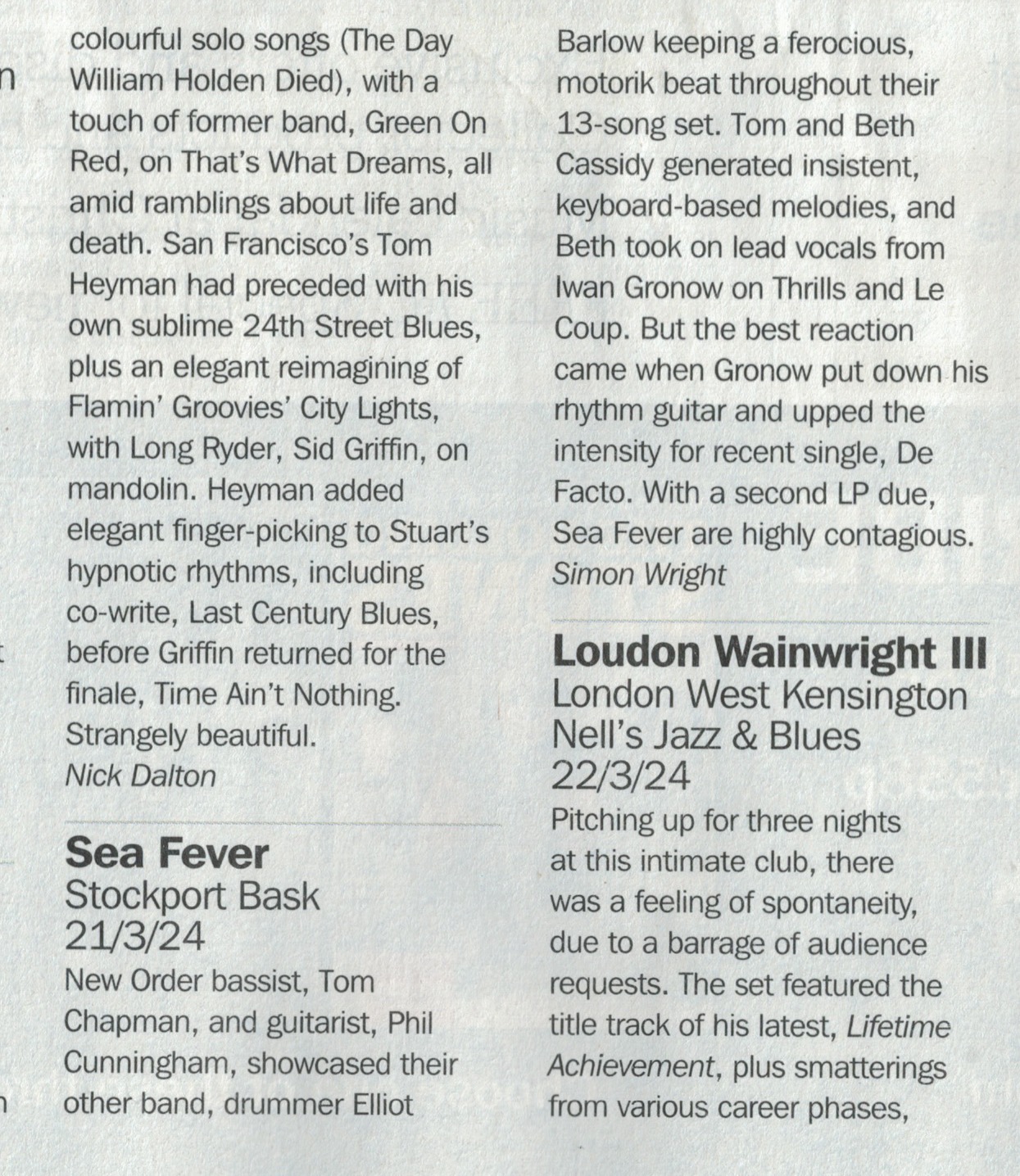
New Order fans will know Tom Chapman and Phil Cunningham as the band’s bass player and guitarist but this sold-out gig was a showcase for their other band. Drummer Elliot Barlow kept up a ferocious motorik dance beat throughout the thirteen song set with Tom and Beth Cassidy both generating insistent keyboard-based melodies. Beth took over on lead vocals from Iwan Gronow on Thrills and Le Coup but the best reaction of the night came when Iwan put down his rhythm guitar and upped the intensity for recent single De Facto. With a second LP ready to go, Sea Fever are highly contagious.
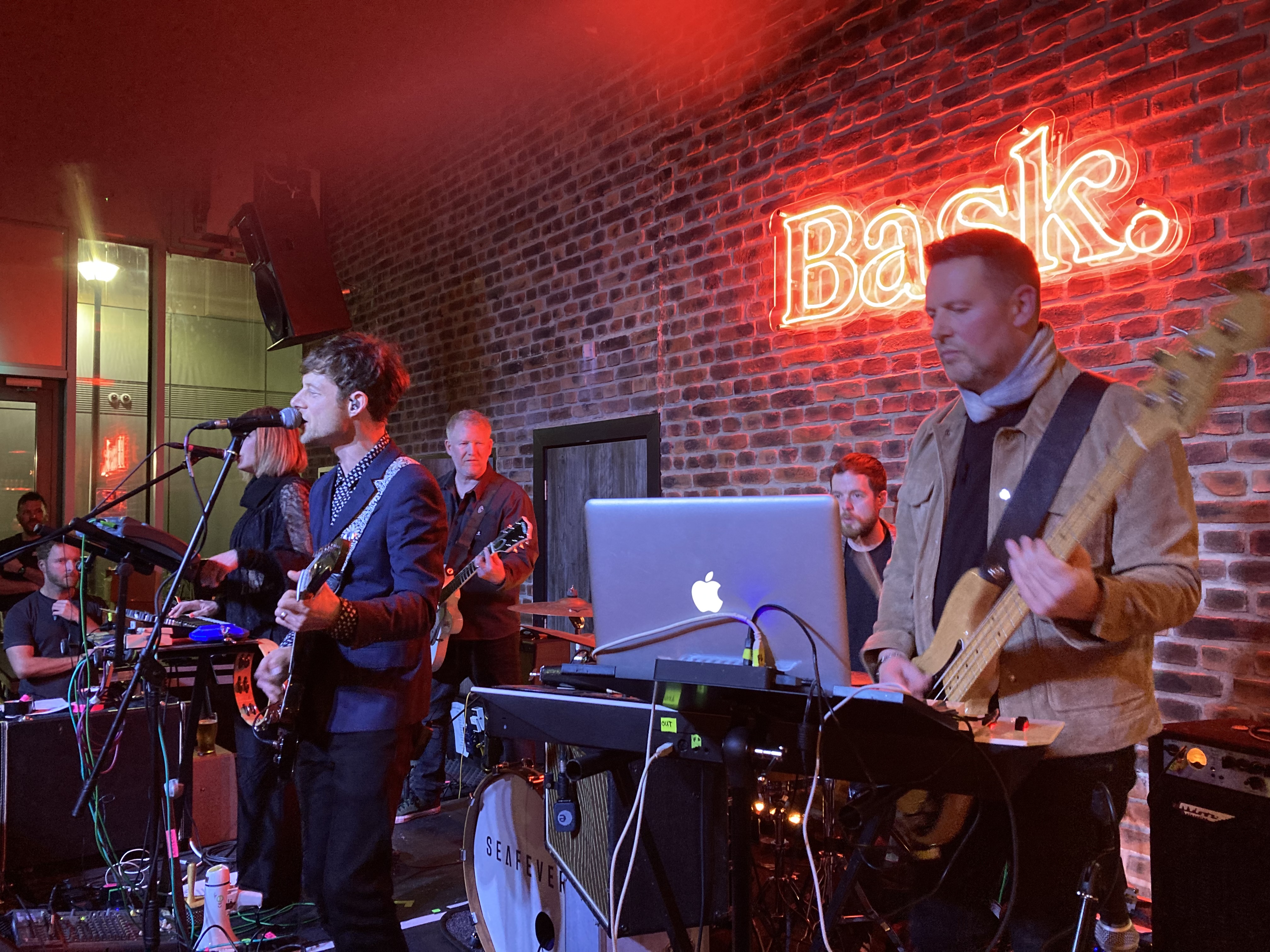
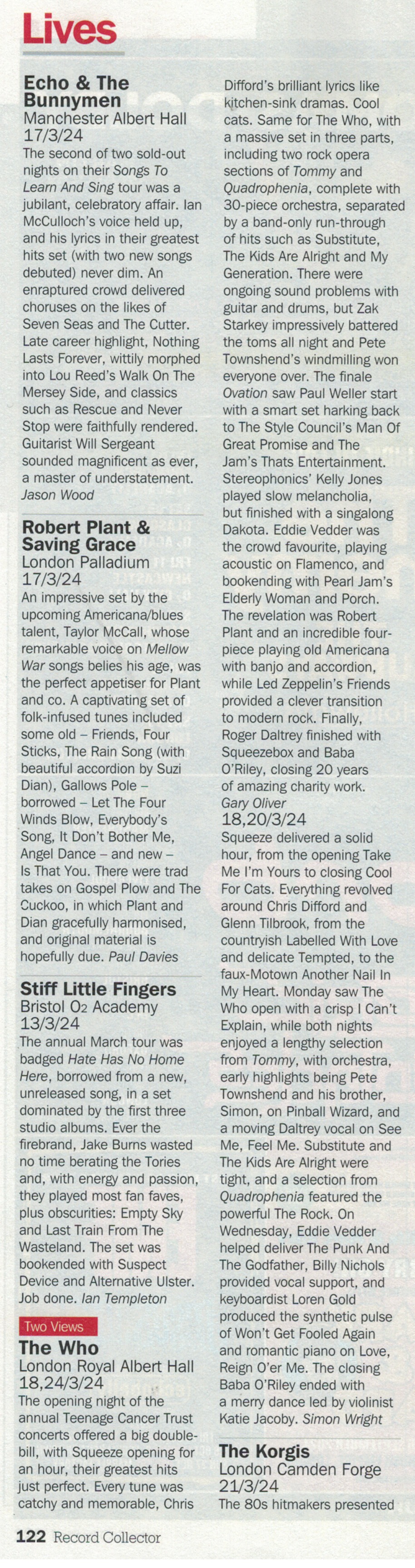
This review was written for Record Collector magazine, it appeared in the June 2024 edition (below)
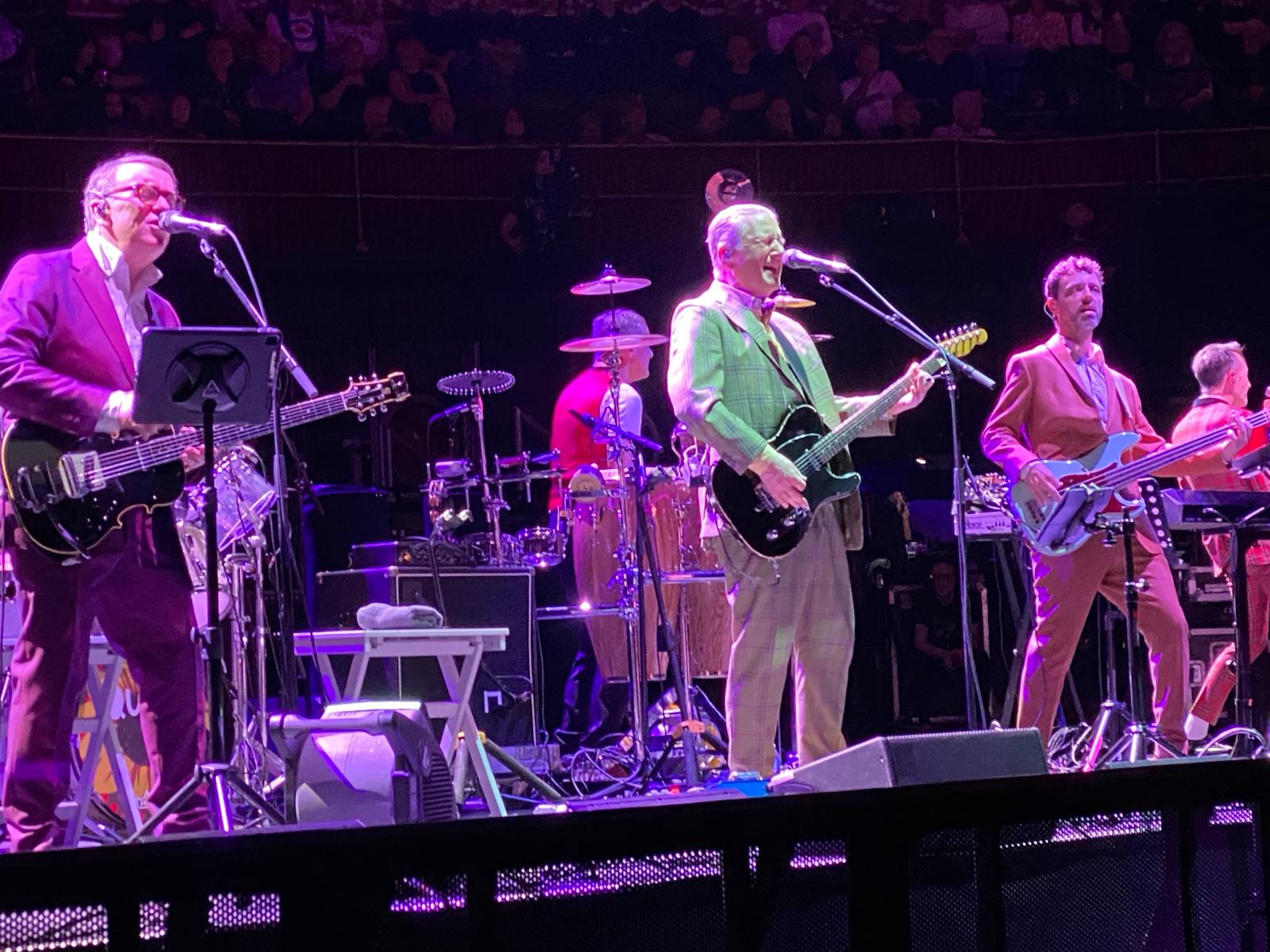
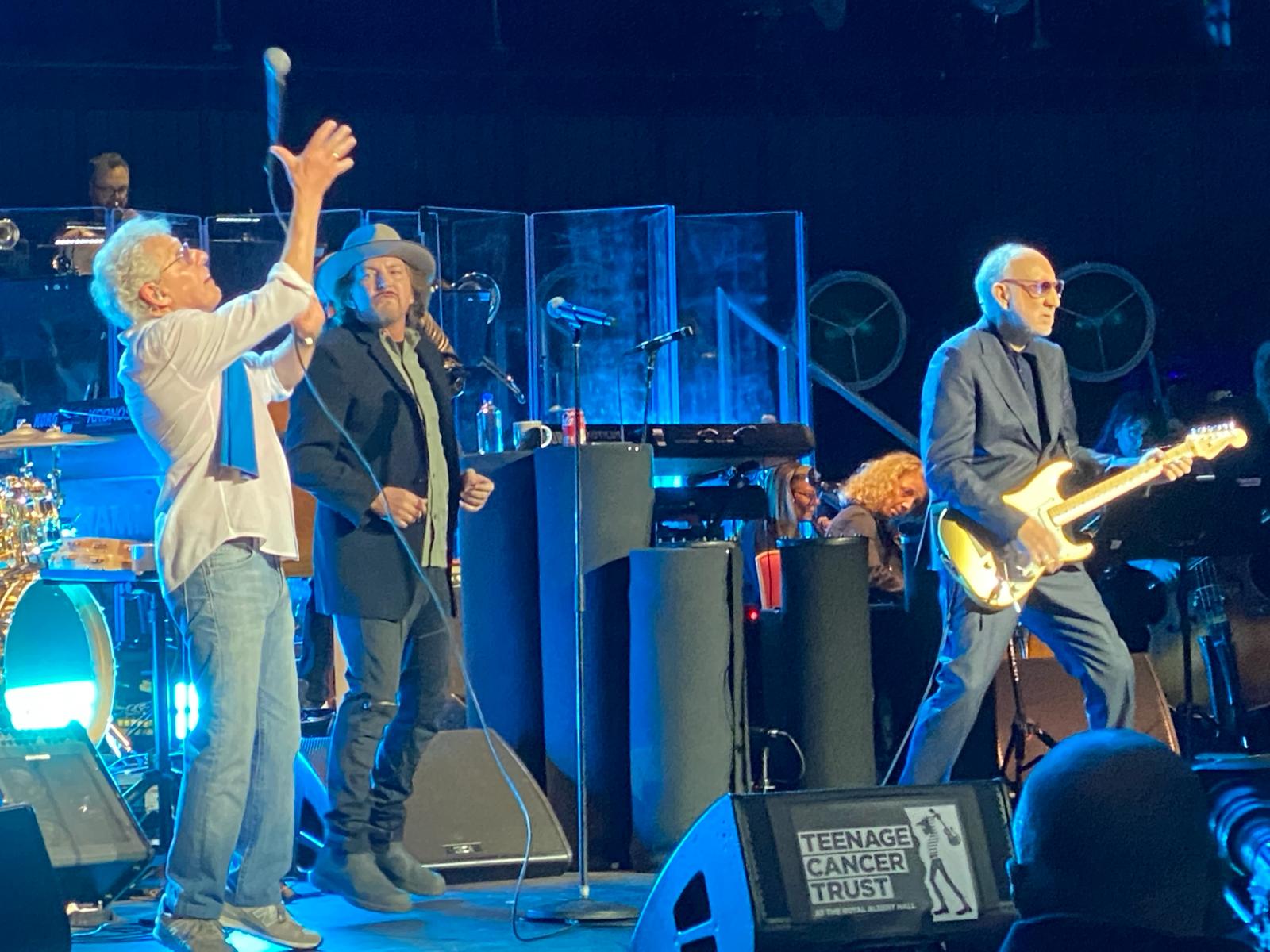
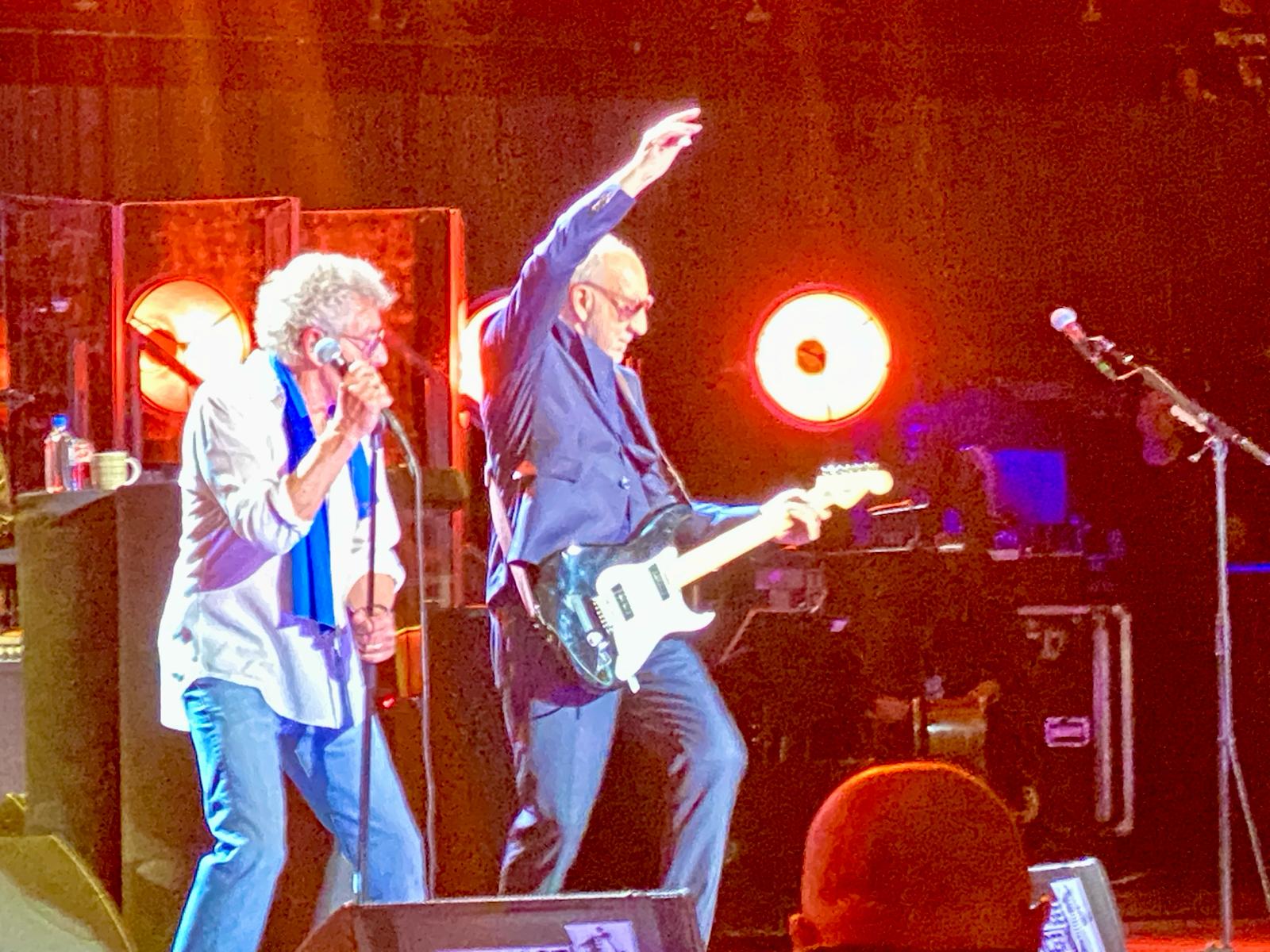
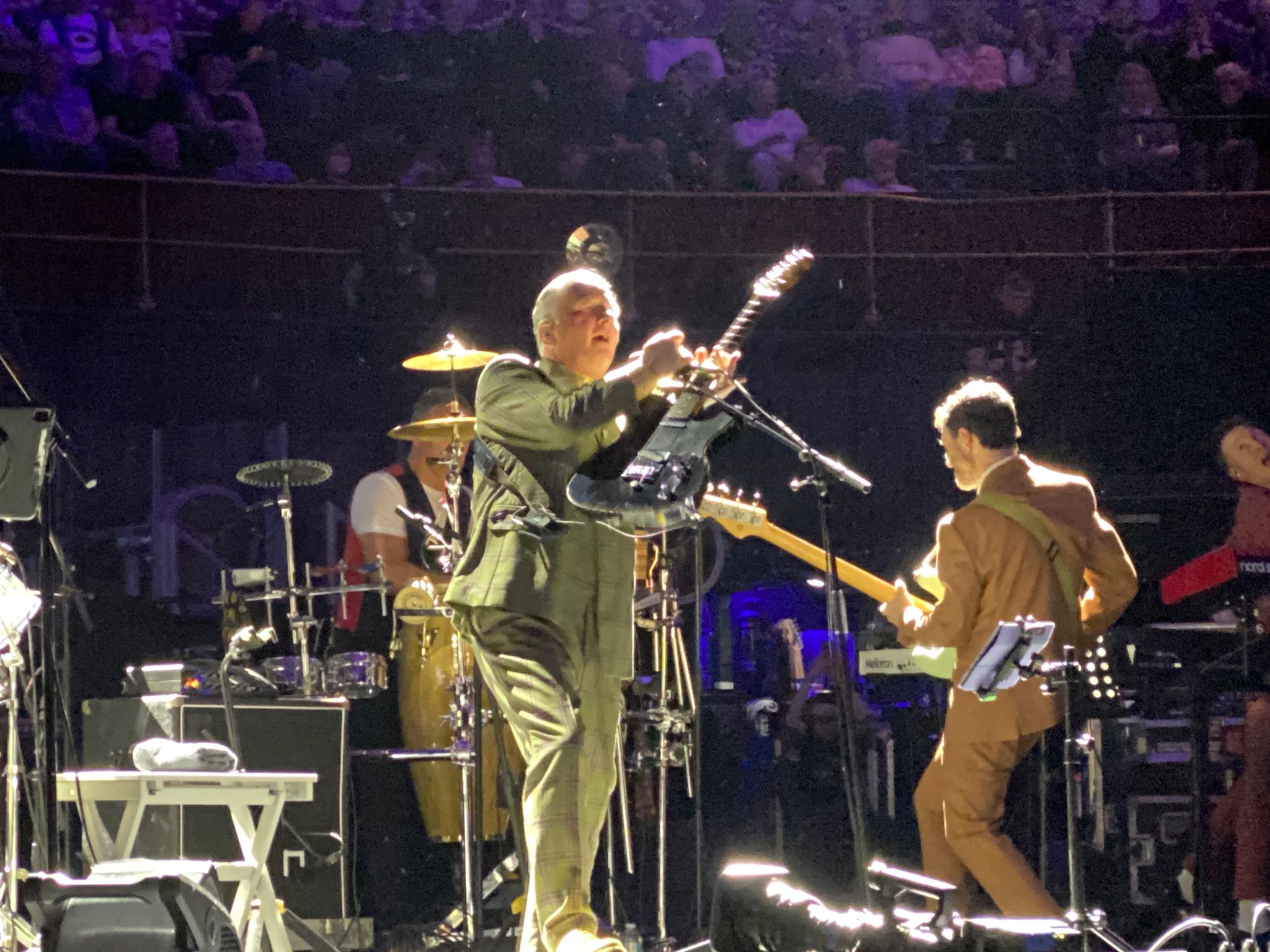
Royal Albert Hall, March 18th and 20th
Stage view: right down the front
After 24 years Roger Daltrey has retired as the curator of the annual Teenage Cancer Trust fundraiser and his parting gift was this brace of sold-out rock’n’roll shows. A suited and booted Squeeze delivered a solid hour of hits, from the opening Take Me I’m Yours to a closing Cool For Cats. Everything revolved around the songs and singing of front men Chris Difford and Glenn Tilbrook, from the countryish Labelled With Love, through a delicate rendition of Tempted to the faux-Motown of Another Nail In My Heart.

Monday night only saw The Who opening with a crisp I Can’t Explain. Both nights enjoyed a lengthy selection from Tommy where the orchestral backing really came into its own, early highlights being the synchronised guitar strumming of Pete Townshend and his brother Simon on Pinball Wizard and a moving Roger Daltrey vocal on See Me, Feel Me. A handful of singles without the orchestra included Substitute and The Kids Are Alright, performed as tightly as the original recordings. The orchestra returned for a selection from Quadrophenia, their performance of The Rock instrumental track being especially powerful. On the Wednesday night Eddie Vedder from Pearl Jam helped deliver The Punk And The Godfather. Daltrey and Townshend wore the same clothes both nights, suggesting the gigs were being filmed.
Throughout Zak Starkey embodied Keith Moon’s manic glee on drums, Jon Button made no attempt to emulate John Entwistle on bass, Billy Nichols provided vocal support and keyboard player Loren Gold provided the synthetic pulse of Won’t Get Fooled Again and the romantic piano intro to Love, Reign O’er Me. These last two numbers were a remarkable demonstration of Daltrey’s enduring vocal power and range. The closing Baba O’Riley ended with the band being lead a merry dance by first violinist Katie Jacoby culminating in a standing ovation from all present.
Review written for Record Collector magazine
Photography: Dave Alexander / Simon Wright


Out now from http://www.1960s.london and released over two vinyl LPs

The Who – Quadrophenia Live 1973
Tracklisting
Side One
- I Am The Sea
- The Real Me
- I’m One
- Sea And Sand
Side Two
- Drowned
- Bell Boy
- Doctor Jimmy
All songs written by Pete Townshend
Recording Details
All tracks recorded live at The Spectrum, Philadelphia on 4.12.73 and broadcast on The King Biscuit Flower Hour US FM radio
Personnel
Roger Daltrey – lead vocals
Pete Townshend – guitars, vocals
John Entwistle – bass, vocals
Keith Moon – drums, vocals
Sound Quality
All tracks sound exceptional
Sleevenotes
“Abetted by a much clearer sound than on the last tour Quadrophenia was, in a word, stunning. The concert rendition supplied all the raucous power seemingly latent in the storyline, and the added dimension invested the monolithic Quad with the true rock’n’roll excitement missing in large parts from the album. The Who, especially Townshend, seemed genuinely enthusiastic playing the new material. At their best, The Who are still, simply, the best.”
Ken Barnes, Phonograph Record
Quadrophenia came about in part because Townshend was desperate to add new material to The Who’s live show. His cherished Lifehouse project had been heavily edited to form the Who’s Next LP but only three of its songs were regularly played live. As a result the band onstage still depended heavily on Tommy, now four years old. Quadrophenia was a double LP song cycle about a mod called Jimmy, which allowed Townshend to write about the relationship between the band and its fans. Ken Barnes was not the only reviewer to feel there was something missing from the original studio recording. The initial mix was heavy and dense with Daltrey’s vocals lost in Townshend’s synthesisers and orchestrations. Subsequently the record was repeatedly remixed and remastered in an attempt to make the sound sharper and clearer.
For the autumn 1973 UK tour the band included in their set a segment of twelve Quadrophenia songs from the just-released LP. Unfortunately Townshend’s artistic ambition ran ahead of what was then technically possible. When played live the Quadrophenia tracks relied heavily on taped synthesiser tracks which were prone to malfunction. This happened most dramatically at the Newcastle Odeon on November 5th. According to The Who Concert File (Joe McMichael and Jack Lyons) “Pete exploded into a furious rage. He screamed at soundman Bob Pridden, smashed his guitar onto the stage and began tearing down the backing tapes and equipment. Roger, Keith and John stared on in disbelief.” Veteran keyboard player Chris Stainton had played on the studio sessions. Had he been invited to join the band on tour many of the technical problems might have been avoided.
By the winter US tour the Quadrophenia segment was down to ten songs and many of the technical issues had been resolved. Because the album had only just been released in the US both Roger and Pete took it upon themselves to give lengthy song introductions in an attempt to explain the plot of the LP, impeding the momentum of the early US gigs. However by the time the band played their penultimate gig at Philadelphia the Quadrophenia sequence was working well. The opening I Am The Sea is highly atmospheric, relying heavily on taped effects to portray the four recurrent themes. Townshend comes in too early at the start of The Real Me but the band recover well and deliver a tough version of the song with Daltrey singing a verse over just bass and drums, guitar crashing in for the chorus. I’m One is a duet between a reflective and uncertain Townshend and a brash, blustery Daltrey, effectively portraying two very different sides of Jimmy. There is more light and shade in Sea and Sand, again effectively sung by Townshend and Daltrey taking alternate parts. The backing by Entwistle and Moon mirrors this, moving from sparse understatement to full-scale rocking out as Daltrey recalls The High Numbers by singing “I’m The Face if you want it…”
Drowned is a showcase for Townshend’s playing, enhanced by close support from the rhythm section and some powerful vocal improvisation from Daltrey. Keith Moon, manages to sing and drum at the same time on Bell Boy. By changing the lyrics to “Remember the place in Canada that we smashed?” Moon alludes to the after-party that followed their Montreal date on December 2nd, where some post-show renovations to the Bonaventure Hotel resulted in the touring party spending the night in jail. The final track is Doctor Jimmy, where the band demonstrate how well they could integrate their live performance with the taped sounds and we get a glimpse of how good Quadrophenia could have sounded live.
The band would return from the US to play four nights in London at the Edmonton Sundown, with the December 23rd gig held by some Who fans as the best live performance of Quadrophenia that year. A short French tour with a similar set-list followed in February 1974 but by the time The Who played Charlton Football Club in May they included only four songs from Quadrophenia. Critical rehabilitation would eventually follow, culminating in an acclaimed 2013 tour which featured a live rendition of all seventeen Quadrophenia tracks. By then only Townshend and Daltrey would remain. So for an authentic 1973 performance by the original four piece line-up in stunning sound, walk this way…and for the other songs that The Who plated that night check out Live In Philadelphia (R&B136).
Sleevenotes:
Mel and Collyer


The Who – Live in Philadelphia 1973
Tracklisting
Side One
- I Can’t Explain (Townshend)
- Summertime Blues (Cochran / Capehart)
- My Wife (Entwistle)
- See Me, Feel Me / Listening To You (Townshend)
Side Two
- Pinball Wizard (Townshend)
- My Generation (Townshend)
- Naked Eye (Townshend)
Recording Details
All tracks recorded live at The Spectrum, Philadelphia on 4.12.73 and broadcast on The King Biscuit Flower Hour US FM radio
Personnel
Roger Daltrey – lead vocals
Pete Townshend – guitars, vocals
John Entwistle – bass, vocals
Keith Moon – drums, vocals
Sound Quality
All tracks sound exceptional
Sleevenotes
The Spectrum in Philadelphia was the penultimate date of the Who’s US 1973 Winter Tour. By now thoroughly road-hardened, the band performed a sold-out show for 13,500 enthusiastic fans. Fortunately the leading US syndicated FM radio programme The King Biscuit Flower Hour arranged for the entire set to be recorded by the Record Plant Mobile 16 track studio. The newly-released Quadrophenia featured extensively, we have released these tracks as R&B135. The new material was complemented by a variety of Who classics, which are presented here.
Traditional set opener I Can’t Explain is played crisply and precisely with some fine vocal harmonies and a sharp Towshend solo. Given that the Who specialised in songs of teenage disaffection Eddie Cochran’s Summertime Blues was an obvious choice and this cover blasts off in a welter of powerchords and exuberant Keith Moon drumming. More tight vocal harmonies are complemented by the gruff voice of John Entwistle taking the role of The Man. Entwistle provided some fine live numbers for the Who – Boris The Spider, Heaven and Hell and now My Wife. This characteristically dark-humoured tale of marital discord has Entwistle pursued by a heavily armed and enraged spouse. The song is extended to allow Townshend to solo, but rather than merely support him Moon and Entwistle solo as well without getting lost or becoming self-indulgent. See Me, Feel Me / Looking At You was the closing number of the 1969 rock opera Tommy. The band’s performance of this number at Woodstock and its appearance in the resultant movie had helped build the band’s US profile. Daltrey inhabits the Tommy persona with power and conviction, making this song a live highlight – he exhorts the crowd to join in on the chorus and “Let them hear in New York!”
Of the second Tommy number Pinball Wizard, Nik Cohn wrote that the song was “as good as anything Townshend has written, which means as good as anything anyone has written since Chuck Berry.” Despite being introduced as Pineball Blizzard the band play a faithful version of the song with Townshend reprising his flamenco-syle strummed guitar parts. By 1973 My Generation had been through a lot of changes. In 1965 it was played live as a tight three-minute wonder. At Monterey in 1967 the song had expanded to four and a half minutes and by the time Live At Leeds was recorded in 1970 My Generation was over thirteen minutes long and had evolved into a mini-history of the Who, incorporating riffs from Tommy and elsewhere. This seven-minute version retains the power and drive of the original even during an extended instrumental coda which almost veers off into Big Boss Man whilst Daltrey manages to slip a four-letter word past the radio censors. In live dates the following year the song would change again, slowed down to form My Generation Blues. Naked Eye was recorded for an unreleased 1970 EP but the studio track would not appear until the 1974 outtakes collection Odds & Sods. In the sleeve-notes for that LP Townshend describes its gestation “This number was written around a riff that we often played in stage at the end of our act around the time we were touring Tommy. It came to be one of our best stage numbers, it was never released because we always hoped we would get a good live version one day”. Here is that good live version. Played as a rare encore, the song features some of Townshend’s pithiest lyrics. This lengthy arrangement intersperses thoughtful, melodic guitar improvisation with impassioned Daltrey vocals before it ends with the sound of a Cherry Sunburst Gibson Les Paul Deluxe meeting its maker.
“From Shepherds Bush Mods to time machine mystic travellers, The Who played longer, harder and straighter, for the people, than anyone else.” Nik Cohn 1974
Sleevenotes: Joe Kerr-Jaymes


I was very sad to hear the news last night that Wayne Kramer had died. I met him in London 2006 when he was fronting DKT (Davis, Kramer, Thompson aka the MC3). Levis had paid for them to come over and record a DVD at the 100 Club. I wrote up our encounter as part of an article for Bucketfull Of Brains magazine. Wayne came across as warm, genuine and impassioned although he was slightly upset when our cover referred to DTK instead of DKT – I was thinking of the Heartbreakers DTK (Down To Kill). After that I would see him when he came through London, usually as a solo artist but sometimes under the MC5 brand, as in 2018 (review here). My respect for Wayne only grew when I read his autobiography The Hard Stuff detailing his personal ups and downs.
This week with ghastly timing our record label released a vinyl LP The MC5 Live In Europe 1972. Manufacturing lead times being what they are this release was approved months ago, but I still feel awkward about it coming out this week, particularly as we did the same thing to Jeff Beck

There will be many obituaries to Wayne, and rightly so. Most will talk about his time with the MC5, and rightly so. There are however a handful of solo tracks from the Who Shot You Dutch? musical he wrote with Mick Farren which have vanished into obscurity. They are well worth a listen:
Finally the absolute best tribute to the time Wayne spent in the MC5 is the feature-length movie MC5: A True Testimonial (2002). Legal issues prevented the movie getting a full release and copies are hard to find but it is well worth searching out. The live footage showing Wayne trading incendiary guitar parts with his partner in crime Fred ‘Sonic’ Smith whilst executing James Brown-style dance moves is just exhilarating.

 Only Rock 'n' Roll