
New Humble Pie / Ten Years After / Brian Auger & Julie Driscoll LPs out now!
Available from http://www.1960s.london

Humble Pie – In Concert At The BBC 1970
Tracklisting
Side One
- Four Day Creep (Cox)
- I’m Ready (Ridley, Marriott, Shirley, Frampton, Dixon)
- Live With Me (Ridley, Marriott, Shirley, Frampton)
- Stone Cold Fever (Ridley, Marriott, Shirley, Frampton)
Side Two
- Hallelujah I Love Her So (Charles)
- I Walk On Gilded Splinters (Creaux)
- The Sad Bag Of Shakey Jake (Marriott)
Recording Details
All tracks recorded for BBC Radio ‘In Concert’ at The Paris Theatre, Lower Regent Street, London on September 10th 1970 and transmitted on September 20th
Personnel
Steve Marriott – Vocals, guitar, harmonica
Peter Frampton – Vocals, guitar, organ
Greg Ridley – Bass, vocals
Jerry Shirley – Drums
Recording Quality
Excellent throughout
Sleevenotes
“In their prime Humble Pie were considered to be one of the greatest live acts in the world. They never quite captured the energy and excitement on record, and thus got left behind in the Great British Rock Boom of the late 60’s and early 60’s. Yet Humble Pie bestrode the era with a confidence and swagger that few could match.”
Mick Wall (2024)
Live At the BBC 1969 (R&B149) documented Humble Pie’s first year when they released two LPs on Immediate Records, As Safe As Yesterday Is (August) and Town And Country (November). Neither LP sold well. These records highlighted the contrast between the reticent and laidback Peter Frampton and the more upfront Steve Marriott. By 1970 this balance had shifted. Immediate had gone bust, so the band signed to A&M and acquired a heavyweight new manager in Dee Anthony. Anthony pushed the band towards a more raucous style, which they would refine on extensive American tours. Talking to John Pidgeon, Marriott remembered that “America sorted me out. As soon as I began to rouse audiences a bit, it began to slowly come back and I realised what we had to do and how we could do it. It was lovely, a good feeling. Poor Pete suffered because I suddenly began to take giant steps. I felt sorry for him at that particular time because I could see it in him onstage – I was just swamping him. And he didn’t know what had happened, because when we first formed I was much more in the background and quiet. It was suddenly like I’d taken over the whole stage which was something I couldn’t help but do, because when my confidence came back, it came back with an almighty bang.” Frampton remembers a discussion with producer Glyn Johns ahead of sessions for the band’s third LP (Humble Pie, July 1970). “Glyn said ‘I think you ought to look at your direction. Steve’s the singer, Pete’s the lead guitarist, Greg’s the bass player and Jerry’s the drummer – how’s that?’. And he was right. It was about how to channel our strengths. We all sang a little bit but we relinquished the singing to Steve. No one had a problem with this because it was such an honour to be in a band with someone who had a voice like that.”
John Peel was an early champion of the band, introducing this Sunday Concert with
“just one band for you, but an excellent band they are too”. Set-opener Four Day Creep never appeared on a Humble Pie studio album. The song was written by Jessie Crump and first released by Ida Cox in 1927: the main riff is played in unison by both Frampton and Marriott. I’m Ready was originally written by Willie Dixon for Muddy Waters and whilst his lyrics are retained, the music is completely rewritten earning a band composition credit. Peel introduces Live With Me as having a “great rock-solid rolling forward feeling”, comparing it to The Band – unsurprising as Music From Big Pink had been the initial blueprint for Humble Pie. A slower-paced number, it features Frampton on Hammond organ which allows for some extended soloing. Stone Cold Fever would not appear on record until album number four, 1971’s Rock On. The song’s basic riff was written by Frampton and it would become a mainstay of the band’s live set.
Hallelujah I Love Her So is a swaggering showcase for Marriot’s ability to channel his favourite singers, here Ray Charles. Again talking to John Pidgeon, Marriott admittedthat onstage he seemed to completely forget he was a white kid from Bow. “I’ve seen a video of us playing and it shocks me. It’s like hearing another person coming through. In the States they regard me as a freak – a tiny little geezer who’s got a very big voice. I don’t know what makes me sing that way. It took me a long time to control it.” In New York Jerry and Peter met Dr John, composer of I Walk On Gilded Splinters. Frampton: “He said ‘I just love you guys. And you know why? Cos I was in jail when you did that song of mine. With the money I got from that I hired myself a much better lawyer and got out quick. You guys got me out of jail!’ ”. The extended version here allows for a bass solo from Greg and harmonica from Steve. Finally a succinct The Sad Bag Of Shakey Jake features a return to the semi-acoustic Pie and a semi-country vocal from Steve.
Looking back, Jerry Shirley is rueful. “The band had potential to be one of the true greats, but did not achieve anywhere close to what they could have done, other than on stage.” We are fortunate that the BBC were on hand to document this Performance (Rockin’ The Paris).
Sleevenotes: S. ‘Moe’ King


Ten Years After
Live At The BBC 1966 – 1968
Tracklisting
Side One
- Love Until I Die
- Don’t Want You Woman
- Sometimes I Feel Like Going Home
- I Ain’t Seen No Whiskey (Williams)
- Rock Your Mama
- Portable People
- I May Be Wrong But I Won’t Be Always (Lee, Churchill, Lyons, Leo)
Side Two
- Woman Trouble
- No Title Blues
- I’m Going Home
- Get Out Of My Life Woman (Toussaint)
- Yes It’s Me (Domino, Bartholemew)
- My World Fell Down (Carter, Stephens)
All songs written by Alvin Lee except where noted
Personnel
Alvin Lee – guitar, vocals, harmonica
Chick Churchill – organ
Ric Lee – drums
Leo Lyons – bass
The Ivy League – vocals (Side Two, Track 6)
Recording Details
All tracks recorded for BBC radio as follows:
Side One
Tracks 1-3 recorded for Top Gear on 12.10.67, broadcast on 21.11.67
Tracks 4-7 recorded for Top Gear on 13.3.68, broadcast on 7.4.68
Side Two
Tracks 1 – 3 recorded for Top Gear on 14.8.68, broadcast on 18.8.68
Track 4 broadcast on 11.3.66
Tracks 5 & 6 broadcast on 17.10.66
Sleevenotes
“They’re from England and they made their US debut in 1968 (the year all the British blues bands arrived). They describe their sound as progressive blues but it contains a lot of boogie and Count Basie. Instead of coming on hot and hard like the blues-influenced bands (Cream, Canned Heat) the group projects a sound that is light and fast and easy, which is not to say lightweight.” Lillian Roxon, Rock Encyclopedia
After listening to Charlie Christian, the twelve-year old Alvin Lee switched from learning clarinet to guitar. His mother Doris recalled “he practiced every minute he could and got on with it like crazy, so quickly we knew the talent was there and nothing could stop him.” In 1957 he joined Vince Marshall and the Square Caps, followed by Alan Upton and the Jail-Breakers (1958) and then in 1960 Ivan Jay and the Jaymen, where Lee first encountered bass player Leo Lyons and drummer Ric Lee. All these bands were based in the Nottingham / Mansfield area. Ivan Jay and the Jaymen became The Jaybirds and moved to London in 1966 which is when keyboards player Chick Churchill joined the band. Initially The Jaybirds provided backing to vocal trio group The Ivy League, recording instrumental tracks for the BBC such as Get Out Of My Life Woman (Lee Dorsey) and Yes It’s Me (Little Richard). Ivy League member John Carter wrote My World Fell Down with Geoff Stephens: the version presented here is a perfect combination of harmony vocals and beat-group backing. The song would later be recorded by Gary Usher and Curt Boettcher and released as a single under the name Sagittarius, a highlight of Lenny Kaye’s original Nuggets compilation (1972).
The Jaybirds then became Blues Trip and Blues Yard before settling on Ten Years After. John Peel was an early supporter, as he explained to Michael Watts of the Melody Maker in1971. “Now the first time I saw Ten Years After was when I went to the Roundhouse with Andy Roberts, and we came back and I felt the same way as I had done with Duane Eddy. I was really knocked out, because there were all these grubby lads from Leicester, or wherever it was, and Alvin Lee’s playing was just great, incredible to listen to. Flash, but there’s nothing wring with being flash if you mean it.”
From the band’s first Top Gear session, Love Until I Die is taken from their self-titled debut LP (1967) and built around a Crossroads-style riff. Also from the debut LP is the acoustic Don’t Want You Woman, a tale of female perfidy with a lively, foot-tapping beat and some tasty guitar picking. Sometimes I Feel Like Going Home never appeared on a Ten Years After studio LP: starting with the words “I woke up this morning” suggests a 12-bar blues which is delivered, complete with some fluid Alvin Lee guitar. Also studio-unreleased is the band’s cover of I Aint’ Seen No Whiskey with some effective organ from Churchill. Rock Your Mama would not see a studio release until the compilation Alvin Lee & Company in 1972: it is another blues number with a tough-sounding vocal from Alvin. A complete contrast is Portable People. Released as a stand-alone single in 1968, here keyboard sounds and acoustic guitar support a lyric that veers uneasily from attempted social comment (“they’re the jet age gypsies with a super-sonic sound”) to Dylan-style non-sequiturs (“he liked the avocado, but he didn’t like the vase”). It was not a hit. I May Be Wrong But I Won’t Be Always takes its inspiration and title from the Count Basie song of the same name: the jazzy arrangement emphasises the strength of the rhythm section and encourages Alvin Lee and Churchill to solo before Leo takes a bass showcase, backed by Ric Lee’s energetic drumming.
Side two starts with Woman Trouble, a track from the Stonedhenge LP (1969). Another swinging number which highlights the band’s strengths with Churchill playing a bluesy organ solo and Alvin Lee showing great restraint and fluid fingers. Another track from Stonedhenge, No Title Blues suggests that the LP title was more than a play on words and that the horizons of the group were being chemically advanced. Alvin Lee’s funereal vocal sets a sombre mood, dispelled by a lengthy Hammer Horror-style organ solo, finishing with a restatement of the song’s heavy riff.
Which just leaves I’m Going Home. The song was first recorded on the band’s second LP, the live at Klooks Kleek Undead (1968). An eleven minute version would feature prominently in the Woodstock film (1970). This version recorded for Top Gear in August 1968 showcases a band full of freshness and enthusiasm, happy to engage in a hell-for-leather dash through a song where the lyrics rivalled the Ramones for complexity. The song is a showcase for Alvin Lee’s speed and dexterity as a guitarist but would end up defining the group in the years ahead and sidelining the band’s jazz and blues influences in favour of endless boogie. As Alvin told Hugh Fielder “You’d walk on stage and people would be shouting for I’m Going Home, which was the last song. I often wonder what the rest of our career would have been like if the Woodstock movie had used another song. As it was, everything became focused on the last song, the high-energy number.” As we have seen, there was much more to Ten Years After than this.
Sleevenotes: Captain Speedfingers

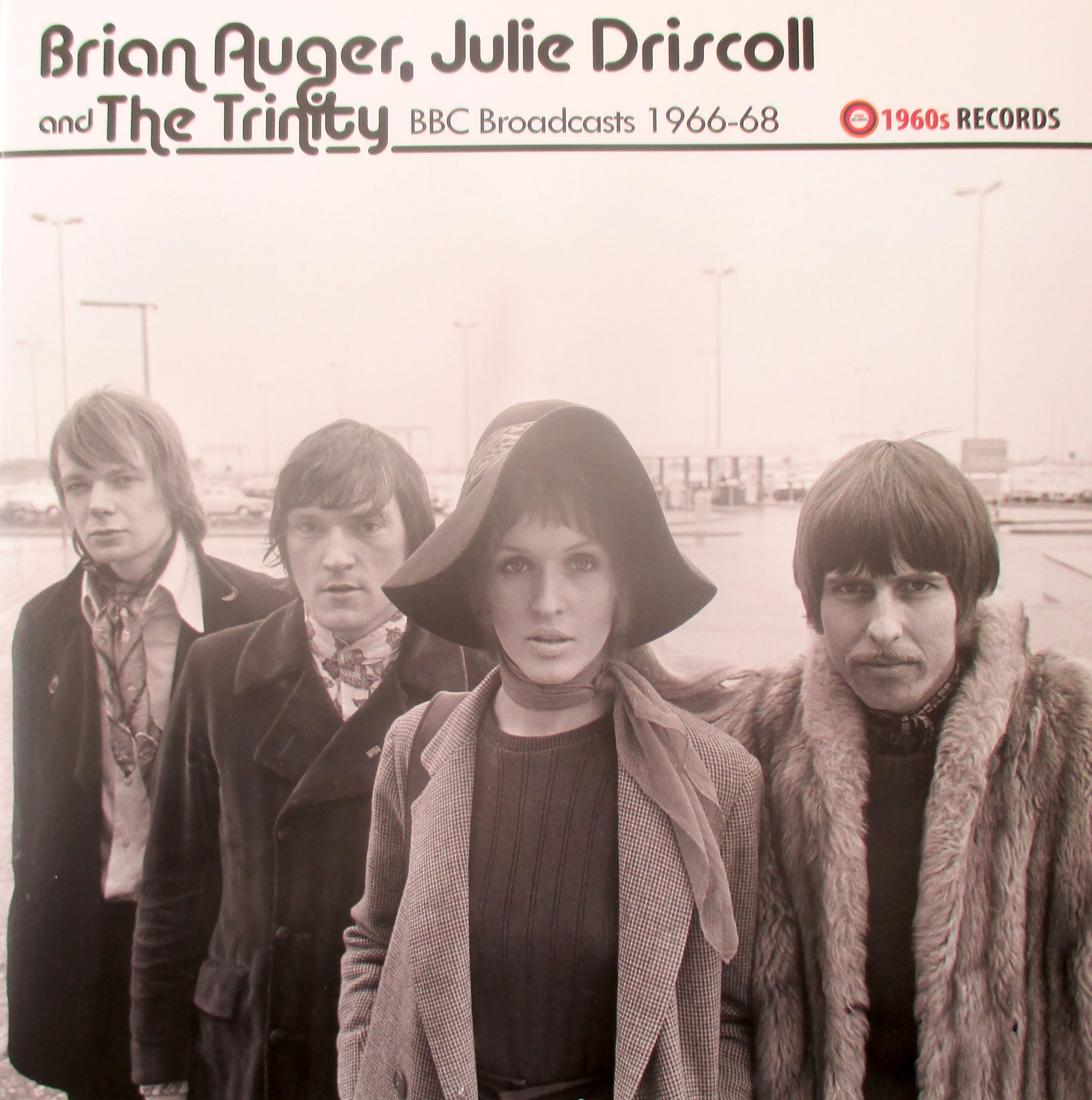
BBC Broadcasts 1966-68
Brian Auger, Julie Driscoll and The Trinity
Tracklisting
Side One
- This Wheel’s On Fire (Dylan, Danko)
- A Kind Of Love-In (Auger, Driscoll)
- Shadows Of You (Auger, Driscoll)
- Why (Am I Treated So Bad) (Staples)
- Don’t Let Me Be Misunderstood (Benjamin, Caldwell, Marcus)
- Interview
Side Two
- Season Of The Witch (Leitch)
- The Road To Cairo (Ackles)
- I Am A Lonesome Hobo (Dylan)
- Old Jim Crow (Alper, Simone, Groef)
- I’m Not Talkin’ (Allison)
- Shadows Of You (Auger, Driscoll)
Personnel
Brian Auger – keyboards, vocals
Rick Laird – bass
Dave Ambrose – bass
Phil Kinorra – drums
Clive Thacker – drums
Vic Briggs – guitar
Gary Boyle – guitar
Julie ‘Jools’ Driscoll – vocals
Recording Details
All tracks recorded specially for the BBC 1966-1968
Sound Quality
Excellent throughout
Sleevenotes
“The cleverest thing Julie Driscoll ever did was to get her Mum to perm her hair. Although it was one of those dreadful home permanents – Julie’s hair frizzed out as though each individual hair had been struck by lightning, a huge freaky halo of electricity around her head – it was the most miraculous transformation since Bob Dylan and Jimi Hendrix let their hair grow. She got one whole page in Vogue for her hair and another for her star eye make-up. As for Brian Auger and The Trinity they are always complaining about being upstaged by ‘Jools’. Maybe they should get their Mums to perm their hair too.”
Lillian Roxon’s Rock Encyclopaedia (1969)
Our previous release R&B122 documented how manager Georgio Gomelsky augumented jazz combo The Brian Auger Trinity with singers Rod Stewart, Long John Baldry and Julie Driscoll to form the R&B /soul revue Steampacket. Stewart, Baldry and Driscoll left Steampacket in Autumn 1966, leaving the band as Brian Auger and The Trinity. This line-up released two unsuccessful singles before Julie Driscoll returned for the November 1967 single Save Me (Parts 1 & 2), released under the rather unwieldy name of Brian Auger, Julie Driscoll and The Trinity. This was not a hit but the follow up, This Wheel’s On Fire (April 1968), reached number 5 in the UK charts, number 13 in Canada and charted throughout Europe. Originally written by Bob Dylan (lyrics) and The Band’s Rick Danko (music) Auger gave the song a completely new arrangement featuring a delicate piano introduction, phasing, Mellotron, Hammond organ and distortion to echo the apocalyptic lyric. The unconventional music was complemented by ‘Jools’ striking looks, her vivid dress-sense and mesmerising vocals. The result was one of the most enigmatic singles of the 1960s which retains an air of mystery even today. The version recorded for the BBC loses nothing in live performance. The song would reach new audiences when recorded by Siouxsie and the Banshees in 1987 and used as the theme tune for TV comedy Absolutely Fabulous in the early 1990’s. Auger is scathing about the latter. “They didn’t even use the original version. They were so cheap they paid Julie a miniscule fee to re-record the vocal with session musicians.”
A Kind Of Love-In and Shadows Of You were both Auger/Driscoll compositions, appearing on single B sides and featuring Auger’s Hammond extensively. Roebuck “Pop” Staples wrote Why (Am I Treated So Bad). Far from being a romantic complaint, the song is about The Little Rock Nine, the first black students to attend the segregated Little Rock Central High School. In 1957 it took three weeks and an escort of federal troops organised by President Eisenhower before The Little Rock Nine were allowed to enter the previously all-white school in Arkansas. Don’t Let Me Be Misunderstood is performed as a slow, soulful duet which pays respect to Nina Simone’s version. The interview that follows features Jools and Brian interrogated by the inevitable Brian Mathews.
Donovan’s Season Of The Witch was a single throughout Europe and pits an impassioned Driscoll vocal against Auger’s keyboards. The Road To Cairo was the follow-up to This Wheel’s On Fire and although it did not duplicate that record’s commercial success it showed the band’s ability to spot promising songwriters such as David Ackles. A further Dylan cover is I Am A Lonesome Hobo, here given an upbeat arrangement that would have got any ex-mods up and dancing. Auger provides a jazzy backing to Nina Simone’s Old Jim Crow, her attack on the state and local laws passed in the American South to enforce racial segregation. Another one of Gomelsky’s bands The Yardbirds had released a raunchy version of Mose Allison’s I’m Not Talkin’ in 1965 on their Five Yardbirds EP and the same year Auger had played the harpsichord on their hit single For Your Love. The Trinity version of I’m Not Talkin’ is sung by Auger and lacks the yobbo raunch of the Yardbirds version, putting more emphasis on the lyrics. Finally a second version of Shadows Of You, this one with a nimble-fingered guitar solo.
That’s all for now. Brian Auger, Julie Driscoll and The Trinity recorded even more tracks for the BBC so you know we shall meet again (if your memory serves you well).
Sleevenotes:
Ma ‘Mel’ Layed

 Only Rock 'n' Roll