
New vinyl LPs from Can, Kraftwerk and Taste out now!
Available now from http://www.1960s.london

Can – In Concert At The BBC 1973
Tracklisting
Side One
- I’m So Green
Side Two
- Pinch
Tracks written by Can ( Czukay / Karoli / Liebezeit / Schmidt / Suzuki )
Recording Details
Tracks recorded for BBC Radio In Concert live at The Paris Theatre, London on February 19th 1973, transmitted March 3rd
Recording Quality
Excellent throughout
Personnel
Holger Czukay – bass
Irmin Schmidt – keyboards
Michael Karoli – guitars
Jaki Liebezeit – drums
Damo Suzuki – vocals
Sleevenotes
“Music of nuance, endlessly listenable and performed with an ear for detail so finely developed that it makes the majority of top-flight Anglo-American outfits look about as sensitive as a bunch of Sumo wrestlers trying to waltz.” Ian McDonald, writing about Can in the NME (January 1974).
For a band that ceased to exist in 1979, Can continue to exert a significant influence over today’s music scene. Public Image Limited, The Fall, Primal Scream, Siouxsie and the Banshees, Pete Shelley, Brian Eno, Happy Mondays and Radiohead have all cited Can as an influence. Even LCD Soundsystem and Oasis have recorded Can-influenced material.
To understand Can’s continued popularity and significance we need to look at how and why the band formed. Keyboard player Irmin Schmidt was a classical musician, conducting orchestras by the early 1960s but also fascinated by Ligeti, La Monte Young and the Velvet Underground. Studying composition at the Stockhausen International Summer School for New Music he met music teacher and bass player Holger Czukay. Said Schmidt ”Jaki Liebezeit, our drummer, had been playing free jazz in the most advanced group in Europe, while Michael (Karoli) had been playing guitar for pure pop groups. Damo (Suzuki, vocalist) who joined us later, had just been singing in the streets. The group really came about by chance in ’68. We all came together because we were fed up with what we had been doing before. We just wanted to be with other people exploring different musical fields. The only thing we had in common was that we all wanted to play music that was spontaneous.”
This love of spontaneity and the band members ability to interact musically in real time meant that Can stood apart from their UK and US contemporaries. Whereas ‘progressive rock’ behemoths aimed in concert to recreate exact facsimiles of their increasingly lengthy and complex LPs, Can were more interested in catching something more fleeting and more vital. Schmidt was adamant that every Can performance would be unique. “When you’re inventing onstage that means you’re totally dependent on everything that surrounds you, from the first moment you come on the reaction of the public and feeling it gives you, the lights, sound, acoustics. Everything is influencing you and of course every time it’s different. The location is different, the public is different, so you immediately react to that.”
In 1971 the single Spoon became a top ten hit in Germany after being used as the theme song to the television mini-series Das Messer. The success of the single allowed Can to establish their own Inner Space studio in North Rhine-Westphalia. Here they recorded the rest of their third album for United Artists, Ege Bamyasi (November 1972). Promoting this LP during their second UK tour in February 1973, Can recorded expanded versions of the tracks I’m So Green and Pinch for In Concert. No attempt was made to recreate the original studio tracks. Instead, in the words of long-time Can watcher Kris Needs “familiar riffs, melodies or grooves appear fleetingly like passing scenery on a train.”
There are some constant elements. Schmidt’s keyboards veer from elegiac melody lines to violent rhythmic stabbing. Suzuki’s vocal improvisations use words for sound rather than meaning. Czukay’s precision bass lines hold the band together, underpinned by the relentless power and pace of Liebezeit’s motorik drumming. Karoli’s guitar glides melodically over the music before switching to scratchy funk.
This version of the band would only record one further LP (Future Days, 1973) before Suzuki left the band to marry his girlfriend and become a Jehovah’s Witness. A re-issue programme starting in 2021 has resulted in five live LPs covering the period 1973-1977. Leaving out this fine recording is inexplicable and we are happy to remedy the omission.
Sleevenotes: Ivan T Moore


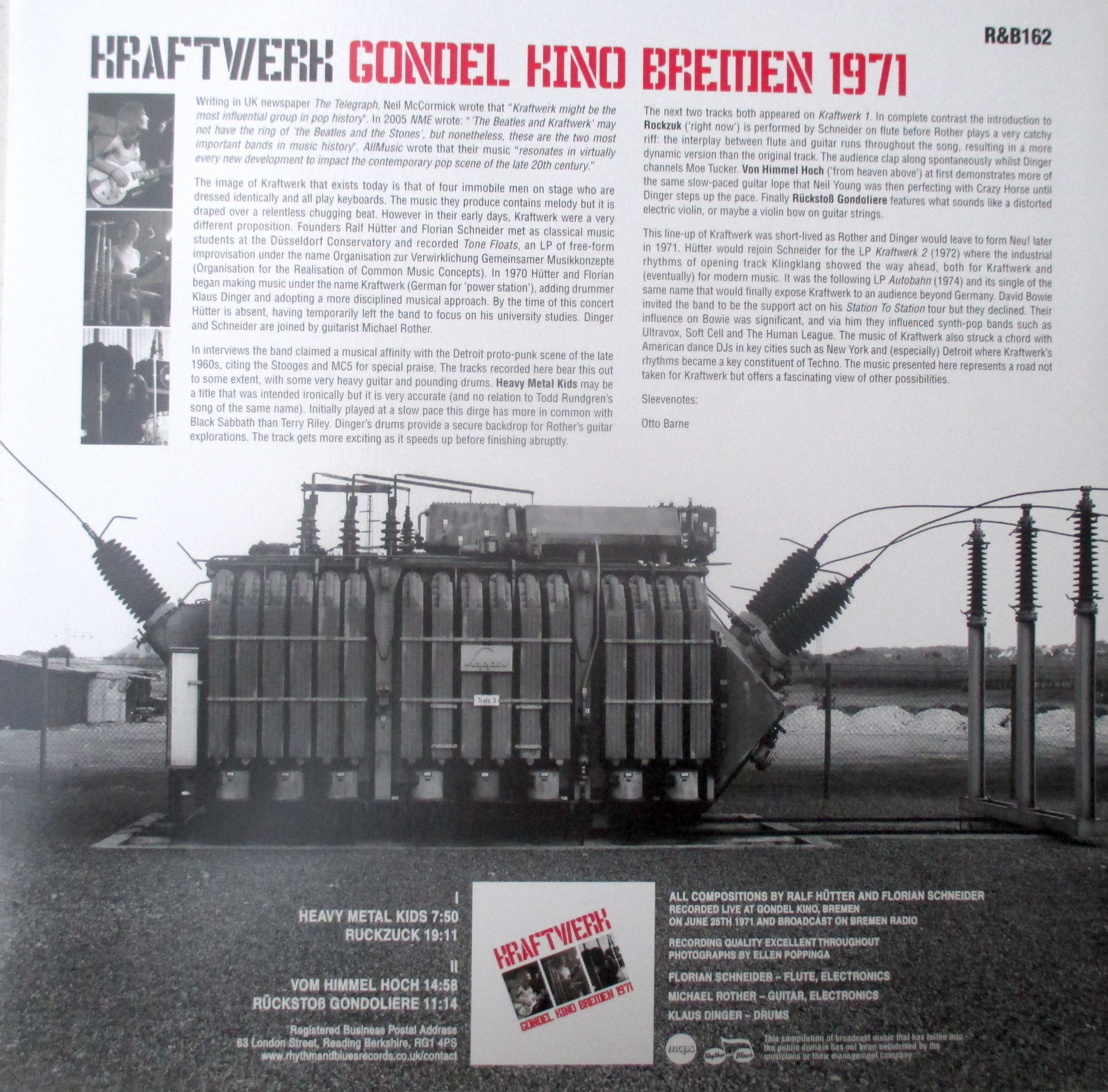
Kraftwerk – Gondel Kino Bremen 1971
Tracklisting
Side One
- Heavy Metal Kids
- Ruckzuck
Side Two
- Von Himmel Hoch
- Rückstoss Gondoliere
All tracks written by Ralf Hütter and Florian Schneider
Personnel
Florian Schneider – flute, electronics
Michael Rother – guitar, electronics
Klaus Dinger – drums
Recording details
All tracks recorded live at Gondel Kino, Bremen on June 25th 1971 and broadcast on Bremen Radio
Recording quality
Excellent throughout
Sleevenotes
Writing in UK newspaper The Telegraph, Neil McCormick wrote that “Kraftwerk might be the most influential group in pop history“. In 2005 NME wrote: “‘The Beatles and Kraftwerk’ may not have the ring of ‘the Beatles and the Stones’, but nonetheless, these are the two most important bands in music history“. AllMusic wrote that their music “resonates in virtually every new development to impact the contemporary pop scene of the late 20th century.”
The image of Kraftwerk that exists today is that of four immobile men on stage who are dressed identically and all play keyboards. The music they produce contains melody but it is draped over a relentless chugging beat. However in their early days, Kraftwerk were a very different proposition. Founders Ralf Hütter and Florian Schneider met as classical music students at the Düsseldorf Conservatory and recorded Tone Floats, an LP of free-form improvisation under the name Organisation zur Verwirklichung Gemeinsamer Musikkonzepte (Organisation for the Realisation of Common Music Concepts). In 1970 Hütter and Florian began making music under the name Kraftwerk (German for ‘power station’), adding drummer Klaus Dinger and adopting a more disciplined musical approach. By the time of this concert Hütter is absent, having temporarily left the band to focus on his university studies. Dinger and Schneider are joined by guitarist Michael Rother.
In interviews the band claimed a musical affinity with the Detroit proto-punk scene of the late 1960s, citing the Stooges and MC5 for special praise. The tracks recorded here bear this out to some extent, with some very heavy guitar and pounding drums. Heavy Metal Kids may be a title that was intended ironically but it is very accurate (and no relation to Todd Rundgren’s song of the same name). Initially played at a slow pace this dirge has more in common with Black Sabbath than Terry Riley. Dinger’s drums provide a secure backdrop for Rother’s guitar explorations. The track gets more exciting as it speeds up before finishing abruptly. The next two tracks appeared on Kraftwerk 1. In complete contrast the introduction to Ruckzuck (‘right now’) isperformed by Schneider on flute before Rother plays a very catchy riff: the interplay between flute and guitar runs right through the song, resulting in a more dynamic version than the original track.The audience clap along spontaneously whilst Dinger channels Moe Tucker. Von Himmel Hoch (‘from heaven above’) at first seems more of the same slow-paced guitar lope that Neil Young was then perfecting with Crazy Horse until Dinger steps up the pace. Finally Rückstoss Gondoliere features what sounds like a distorted electric violin, or maybe a violin bow on guitar strings.
This line-up of Kraftwerk was short-lived as Rother and Dinger would leave to form Neu! later in 1972. Hütter would rejoin Schneider for the LP Kraftwerk 2 (1972)where the industrial rhythms of opening track Klingklang showed the way ahead, both for Kraftwerk and (eventually) for modern music. It was the following LP Autobahn (1974) and its single of the same name that would finally expose Kraftwerk to an audience beyond Germany. An invitation from David Bowie to be the support act on his Station To Station tour followed: it was declined. Their affect on Bowie was significant (as was that of Neu!), and from him they influenced synth-pop bands such as Ultravox, Soft Cell and The Human League. The music of Kraftwerk also struck a chord with American dance DJs in key cities such as New York and (especially) Detroit where Kraftwerk’s rhythms became a key constituent of Techno. The music presented here represents a road not taken for Kraftwerk but offers a fascinating view of other possibilities.
Sleevenotes: Otto Barne
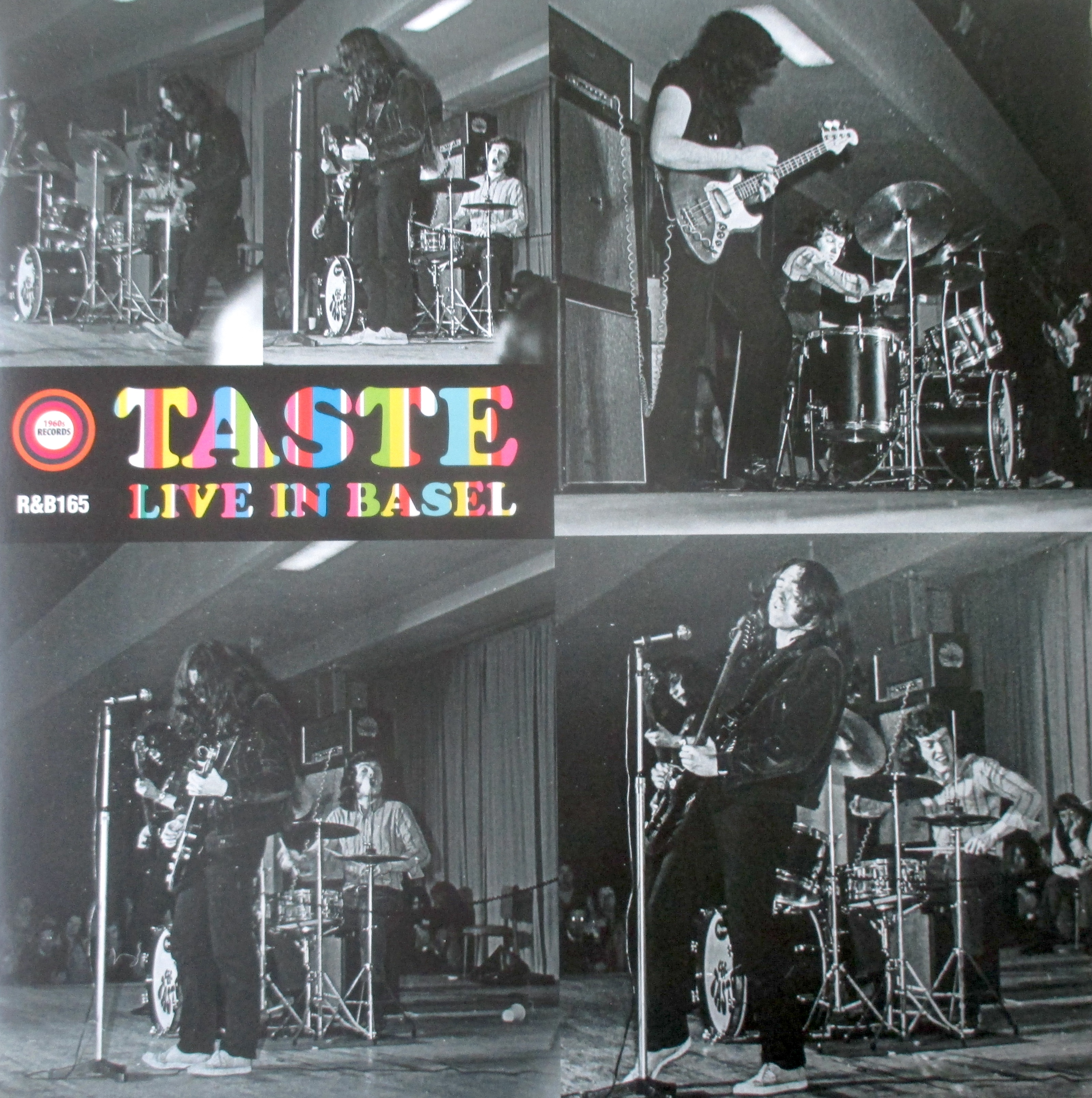
Taste – Live in Basel 1970
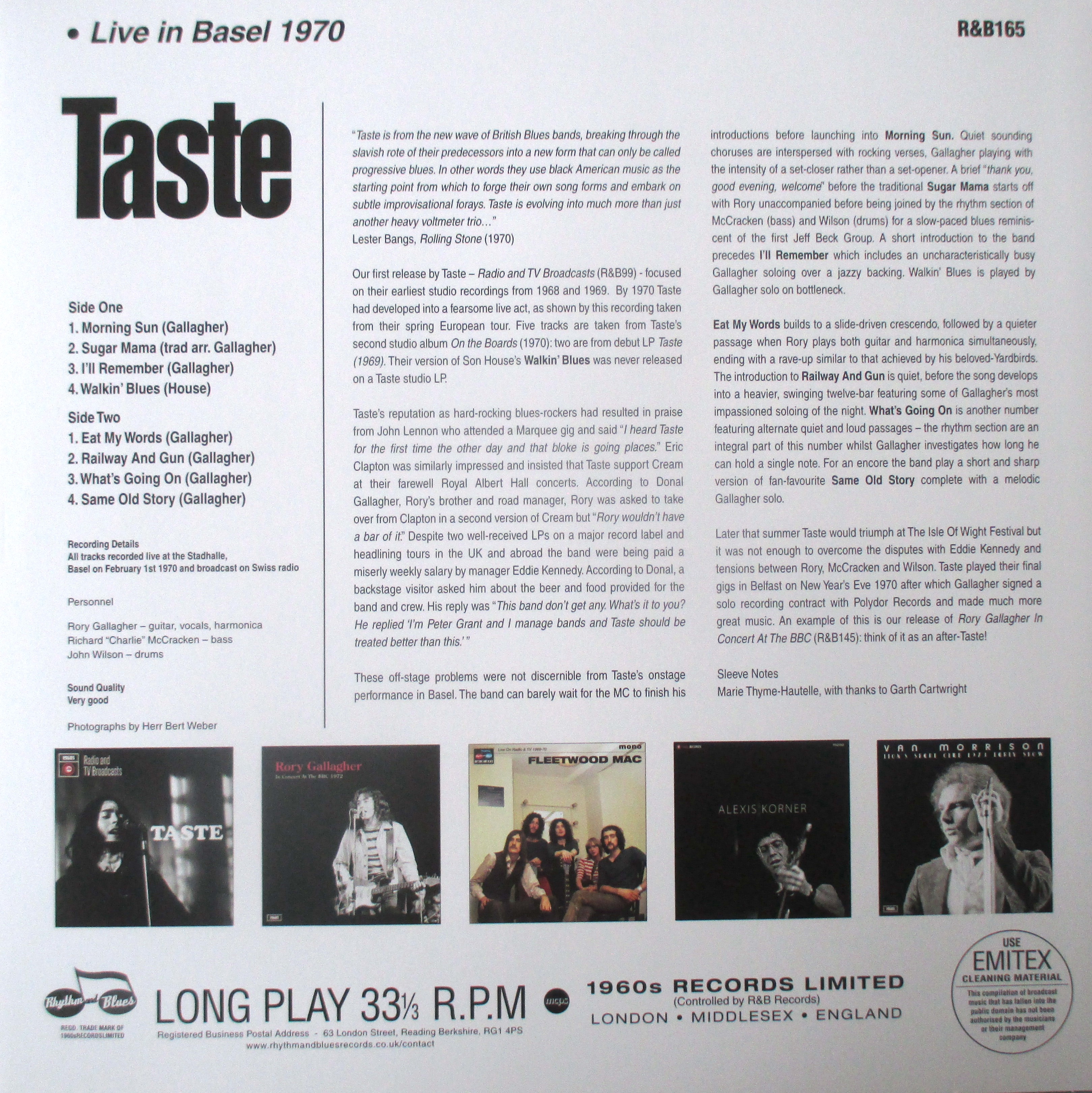
Side One
1. Morning Sun (Gallagher)
2. Sugar Mama (trad arr. Gallagher)
3. I’ll Remember (Gallagher)
4. Walkin’ Blues (House)
Side Two
1. Eat My Words (Gallagher)
2. Railway And Gun (Gallagher)
3. What’s Going On (Gallagher)
4. Same Old Story (Gallagher)
Recording Details
All tracks recorded live at the Stadhalle, Basel on February 1st 1970 and broadcast on Swiss radio
Personnel
Rory Gallagher – guitar, vocals, harmonica
Richard “Charlie” McCracken – bass
John Wilson – drums
Sound Quality
Excellent throughout
Sleevenotes
“Taste is from the new wave of British Blues bands, breaking through the slavish rote of their predecessors into a new form that can only be called progressive blues. In other words they use black American music as the starting point from which to forge their own song forms and embark on subtle improvisational forays. Taste is evolving into much more than just another heavy voltmeter trio…”
Lester Bangs, Rolling Stone (1970)
Our first release by Taste – Radio and TV Broadcasts (R&B99) – focused on their earliest studio recordings from 1968 and 1969. By 1970 Taste had developed into a fearsome live act, as shown by this recording taken from their spring European tour. Five tracks are taken from Taste’s second studio album On the Boards (1970): two are from debut LP Taste (1969). Their version of Son House’s Walkin’ Blues was never released on a Taste studio LP.
Taste’s reputation as hard-rocking blues-rockers had resulted in praise from John Lennon who attended a Marquee gig and said “I heard Taste for the first time the other day and that bloke is going places.” Eric Clapton was similarly impressed and insisted that Taste support Cream at their farewell Royal Albert Hall concerts. According to Donal Gallagher, Rory’s brother and road manager, Rory was asked to take over from Clapton in a second version of Cream but “Rory wouldn’t have a bar of it.” Despite two well-received LPs on a major record label and headlining tours in the UK and abroad the band were being paid a miserly weekly salary by manager Eddie Kennedy. According to Donal, a backstage visitor asked him about the beer and food provided for the band and crew. His reply was “This band don’t get any. What’s it to you? He replied ‘I’m Peter Grant and I manage bands and Taste should be treated better than this.’ ”
These off-stage problems were not discernible from Taste’s onstage performance in Basel. The band can barely wait for the MC to finish his introductions before launching into Morning Sun. Quiet sounding choruses are interspersed with rocking verses, Gallagher playing with the intensity of a set-closer rather than a set-opener. A brief “thank you, good evening, welcome” before the traditional Sugar Mama starts off with Rory unaccompanied before being joined by the rhythm section of McCracken (bass) and Wilson (drums) for a slow-paced blues reminiscent of the first Jeff Beck Group. A short introduction to the band precedes I’ll Remember which includes an uncharacteristically busy Gallagher soloing over a jazzy backing. Walkin’ Blues is played by Gallagher solo on bottleneck.
Eat My Words builds to a slide-driven crescendo, followed by a quieter passage when Rory plays both guitar and harmonica simultaneously, ending with a rave-up similar to that achieved by his beloved-Yardbirds. The introduction to Railway And Gun is quiet, before the song develops into a heavier, swinging twelve-bar featuring some of Gallagher’s most impassioned soloing of the night. What’s Going On is another number featuring alternate quiet and loud passages – the rhythm section are an integral part of this number whilst Gallagher investigates how long he can hold a single note. For an encore the band play a short and sharp version of fan-favourite Same Old Story complete with a melodic Gallagher solo.
Later that summer Taste would triumph at The Isle Of Wight Festival but it was not enough to overcome the disputes with Eddie Kennedy and tensions between Rory, McCracken and Wilson. Taste played their final gigs in Belfast on New Year’s Eve 1970 after which Gallagher signed a solo recording contract with Chrysalis Records and made much more great music. An example of this is our release of Rory Gallagher In Concert At The BBC (R&B145): think of it as an after-Taste!
Sleeve Notes
Marie Thyme-Hautelle, with thanks to Garth Cartwright
 Only Rock 'n' Roll