
New Vinyl LPs Out Now: Pink Fairies, Tomorrow and Simon Dupree & The Big Sound!
Order now from http://www.1960s.london

At The BBC 1970-72
The Pink Fairies
Side One
1.The Snake (Pink Fairies)
2. Lucille (Collins, Richard)
3. Johnny B. Goode (Berry)
4. Uncle Harry’s Last Freak-Out (Pink Fairies)
Side Two
1. Do It (Pink Fairies)
2. Tomorrow Never Knows (Lennon, McCartney)
3. 3/5 Mile In Ten Seconds (Balin)
4. I Saw Her Standing There (Lennon, McCartney)
5. Portobello Shuffle (Pink Fairies)
6. Walk Don’t Run (Smith)
Recording Details
All tracks recorded for BBC Radio as follows:
Side One
Tracks 1 & 2 recorded for Top Gear on 10 & 24/11/70, broadcast on 28/11/70
Tracks 3 & 4 recorded for In Concert on 14/10/71, broadcast on 16/11/71
Side Two
Tracks 1 – 3 recorded for Sounds Of The Seventies (Mike Harding) on 8/2/71, broadcast on 16/2/71
Tracks 4 – 6 recorded for Sounds Of The Seventies (Pete Drummond) on 29/3/72, broadcast 6/4/72
Personnel
Paul Rudolph – Guitar, vocals
Duncan ‘Sandy’ Sanderson – Bass
Russell Hunter – Drums
John ‘Twink’ Alder – Drums (Side One, Tracks 1 & 2 and Side Two Tracks 1-3)
Trevor Burton – Guitar (Side One, Tracks 3 & 4)
Recording Quality
Very Good throughout
Sleeve Notes
The first wave of UK punk bands were keen to namecheck US high energy rock’n’roll renegades such as The MC5, The Stooges and The New York Dolls as key influences on their sound. To this exclusive club can be added a single UK band: The Pink Fairies, of whom John Lydon was a fan.
The Pink Fairies evolved out of The (Social) Deviants, an underground band founded in 1967 by vocalist and journalist Mick Farren who was gradually joined by Hunter, Sandy and guitarist Paul Rudolph. A disastrous Canadian tour saw Farren parting company from the rest of the band who on returning to the UK added a second drummer in Twink and re-named themselves the Pink Fairies. In his autobiography Give The Anarchist A Cigarette Mick Farren explains the origins of the band’s name. “Back at the Speakeasy our particular clique formed ‘The Pink Fairies Motorcycle Gang and Drinking Club’, a hard core of Pretty Things and Deviants that would be augmented by the usual suspects: Viv Prince, Steve Took and occasionally “Legs” Larry Smith and Viv Stanshall. The fun began under the guise of ‘getting up to jam’ which in reality meant a mass stage invasion followed by about forty minutes of shrieking cacophony until all players declared themselves exhausted and retired to the bar, leaving a debris of bottles, glasses and distressed equipment. The name would ultimately be appropriated and truncated by Twink for a supposedly commercial rock band”.
Talking to Bucketfull of Brains magazine in 2011 Sandy ruminated on what made the Fairies special. “That we sounded different to other UK bands was an after-effect of the Deviants going to Vancouver and then proceeding down the West Coast of the States, that had a real influence on me. Even the covers bands were musically very talented and were very competent musicians. During our last month in the US we stayed in a house in San Francisco that had a music room so you got up, had something to eat and then made music as opposed to here where it was ‘let’s book a rehearsal room for next Tuesday.’ And of course Paul was from Vancouver and when he joined the Fairies we morphed into a different entity from the tail end of the beat boom.” Russell agreed “When we got back to London we tried to recreate that vibe and approach playing music in the way that other musicians played jazz. Not the complexity of jazz but we’d have a verse structure, and a bridge structure and an idea of how it was going to end and then nightly we’d launch into whatever and sometimes when that works it is absolutely magic.”
Some of that magic can be heard here, although the BBC Panel that passed their first Top Gear session as suitable for broadcast commented on “a most ugly, heavy noise” and “not for general use”. Debut single The Snake showcased the double drum line-up to great effect whilst a cover of Little Richard’s Lucille demonstrated the band’s ability to play effective no-frills rock’n’roll. Four tracks presented here never appeared on a Fairies studio album. Lucille is one, and another is the band’s version of Jefferson Airplane’s 3/5 Mile In Ten Seconds. Do It was the other side of the Fairies debut single and this version recorded for a 1971 Sounds Of The Seventies is thoroughly punky in both words and music. The Beatles Tomorrow Never Knows receives a complete overhaul, Rudolph playing backwards guitar forwards whilst drums and bass duplicate the lurching rhythms of the original.
John Peel was a supporter of the band, and he introduced their 1971 In Concert appearance.Tensions within the band had seen Twink ejectedbut the band were joined on this occasion by ex-Move bassist Trevor Burton, here playing guitar.
An ebullient Johnny B.Goode opened the broadcast: the closing number was mistakenly claimed by Peel to be Uncle Wally’s Last Freak-Out (sic). This track from debut LP Never Never Land was a collection of old Deviants riffs designed to be open-ended in live performance. The relatively compact version here still allows for a drum solo and gives Paul Rudolph space to solo. A second Sounds Of The Seventies session drew on second LP What A Bunch Of Sweeties (1972). I Saw Her Standing There got a tough update, Portobello Shuffle described the band’s Ladbroke Grove neighbourhood and a lengthy exploration of The Venture’s instrumental Walk Don’t Run added a novel vocal section.
Paul Rudolph left the band immediately after the release of …Sweeties and was replaced by Mick Wayne (briefly) and then by Larry Wallis (permanently). Larry added more melody and structure to the band’s music in time for third LP Kings Of Oblivion (1973), a prophetic title which ended the first era of Fairydom. There were subsequent sporadic reunions and collaborations as documented in Rich Deakin’s book Keep It Together! (2008, new edition in preparation). Sadly Mick Farren, Larry, Russell and Sandy are no longer with us, although their spirit remains with us via this fine LP.
“Up The Pinks!”
With thanks to the late Tim Rundall
Sleeve Notes: C.T. Keeds


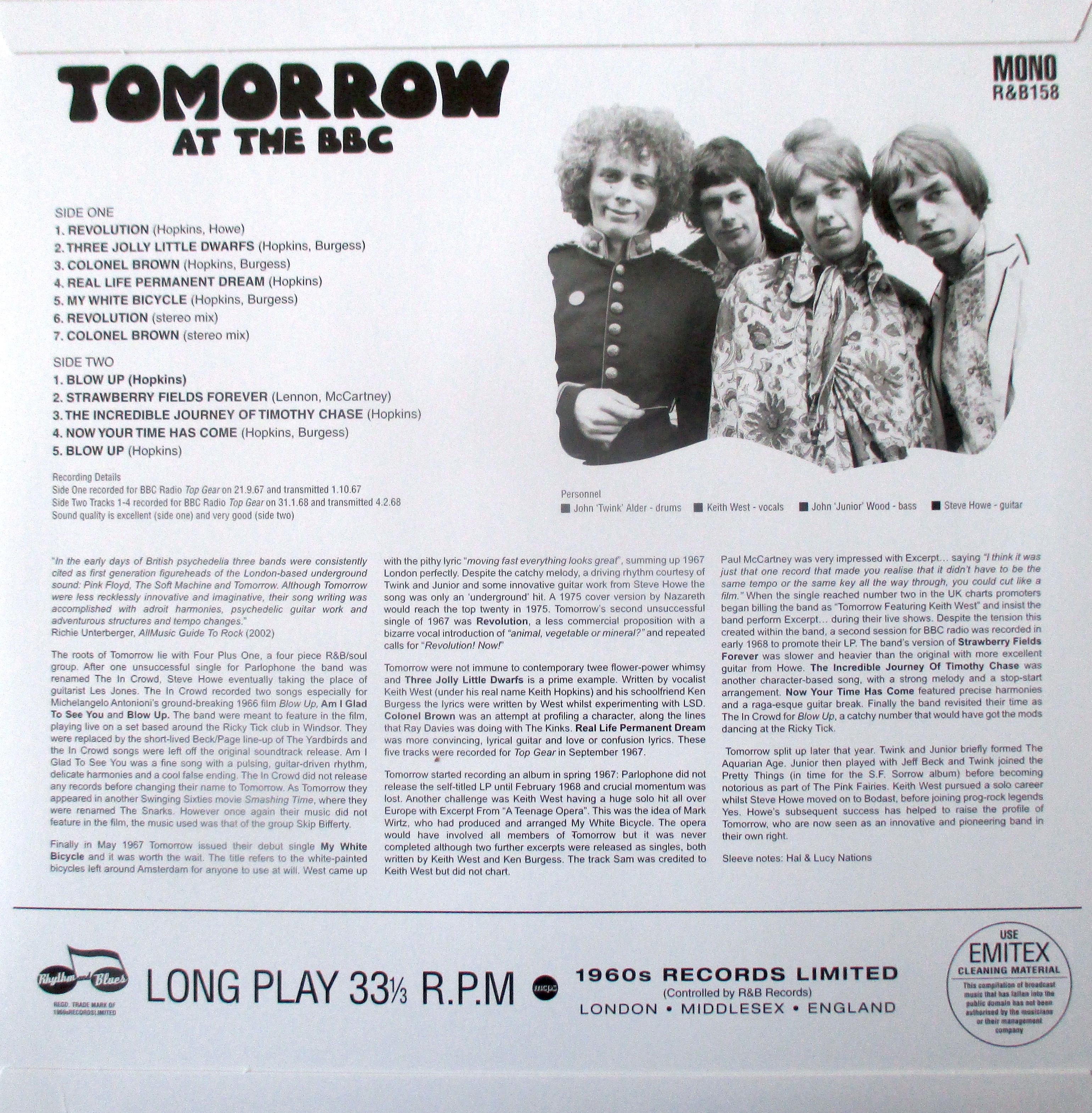
At The BBC 1967-68
Tomorrow
Tracklisting
Side One
- Revolution (Hopkins, Howe)
- Three Jolly Little Dwarfs (Hopkins, Burgess)
- Colonel Brown (Hopkins, Burgess)
- Real Life Permanent Dream (Hopkins)
- My White Bicycle (Hopkins, Burgess)
- Revolution (stereo mix)
- Colonel Brown (stereo mix)
Side Two
- Strawberry Fields Forever (Lennon, McCartney)
- The Incredible Journey Of Timothy Chase (Hopkins)
- Now Your Time Has Come (Hopkins, Burgess)
- Blow Up (West)
- Am I Glad To See You (West)
Sound Quality
Excellent Throughout
Recording Details
Side One Recorded for BBC Radio Top Gear on 21.9.67 and transmitted 1.10.67
Side Side Two Tracks 1-4 recorded for BBC Radio Top Gear on 31.1.68 and transmitted 4.2.68
Side Two Track 5 recorded for the soundtrack of the film Blow Up (1966) but not included on the original soundtrack
Personnel
Keith West – vocals
Steve Howe – guitar
John ‘Junior’ Wood – bass
John ‘Twink’ Alder – drums
Except Side One, Track 6 – Kippington Lodge
Sleevenotes
“In the early days of British psychedelia three bands were consistently cited as first generation figureheads of the London-based underground sound: Pink Floyd, The Soft Machine and Tomorrow. Although Tomorrow were less recklessly innovative and imaginative, their song writing was accomplished with adroit harmonies, psychedelic guitar work and adventurous structures and tempo changes.” Richie Unterberger, AllMusic Guide To Rock (2002)
The roots of Tomorrow lie with Four Plus One, a four piece R&B/soul group. After one unsuccessful single for Parlophone the band was renamed The In Crowd, Steve Howe eventually taking the place of guitarist Les Jones. The In Crowd recorded two songs especially for Michelangelo Antonioni’s ground-breaking 1966 film Blow Up, Am I Glad To See You and Blow Up. The band were meant to feature in the film, playing live on a set based around the Ricky Tick club in Windsor. They were replaced by the short-lived Beck/Page line-up of The Yardbirds and the In Crowd songs were let off the original soundtrack release. Am I Glad To See You was a fine song with a pulsing, guitar-driven rhythm, delicate harmonies and a cool false ending. The In Crowd did not release any records before changing their name to Tomorrow. As Tomorrow they appeared in another Swinging Sixties movie Smashing Time, where they were renamed The Snarks. However once again their music did not feature in the film, the music used was that of the group Skip Bifferty.
Finally in May 1967 Tomorrow issued their debut single My White Bicycle and it was worth the wait. The title refers to the white-painted bicycles left around Amsterdam for anyone to use at will, a forerunner of today’s Lime bikes. West came up with the pithy lyric “moving fast everything looks great”, summing up 1967 London perfectly. Despite the catchy melody, a driving rhythm courtesy of Twink and Junior and some innovative guitar work from Steve Howe the song was only an ‘underground’ hit. A 1975 cover version by Nazareth would reach the top twenty in 1975. Tomorrow’s second unsuccessful single of 1967 was Revolution, a less commercial proposition with a bizarre vocal introduction of “animal, vegetable or mineral?” and repeated calls for “Revolution! Now!”
Tomorrow were not immune to contemporary twee flower-power whimsy and Three Jolly Little Dwarfs is a prime example. Written by vocalist Keith West (under his real name Keith Hopkins) and his schoolfriend Ken Burgess the lyrics were written by West whilst experimenting with LSD. Colonel Brown was an attempt at profiling a character, along the lines that Ray Davies was doing with The Kinks. Real Life Permanent Dream was more convincing, lyrical guitar and love or confusion lyrics. These five tracks were recorded for Top Gear in September 1967.
Tomorrow started recording an album in spring 1967: Parlophone did not release the self-titled LP until February 1968 and crucial momentum was lost. Another challenge was Keith West having a huge solo hit all over Europe with Excerpt From “A Teenage Opera”. This was the idea of Mark Wirtz, who had produced and arranged My White Bicycle. The opera would have involved all members of Tomorrow but it was never completed although two further excerpts were released as singles, both written by Keith West and Ken Burgess. The track Sam was credited to Keith West but did not chart.
Paul McCartney was very impressed with Excerpt… saying “I think it was just that one record that made you realise that it didn’t have to be the same tempo or the same key all the way through, you could cut like a film.” When the single reached number two in the UK charts promoters began billing the band as “Tomorrow Featuring Keith West” and insist the band perform Excerpt… during their live shows.
Despite the tension this created within the band, a second session for BBC radio was recorded in early 1968 to promote their LP. The band’s version of Strawberry Fields Forever was slower and heavier than the original with more excellent guitar from Howe. The Incredible Journey Of Timothy Chase was another character-based song, with a strong melody and a stop-start arrangement. Now Your Time Has Come featured precise harmonies and a raga-esque guitar break.Finallythe band revisited their time as The In Crowd for Blow Up,a catchy number that would have got the mods dancing at the Ricky Tick.
Tomorrow split up later that year. Twink and Junior briefly formed The Aquarian Age. Junior then played with Jeff Beck and Twink joined the Pretty Things (in time for the S.F. Sorrow album) before becoming notorious as part of The Pink Fairies. Keith West pursued a solo career whilst Steve Howe moved on to Bodast, before joining prog-rock legends Yes. Howe’s subsequent success has helped to raise the profile of Tomorrow, who are now seen as an innovative and pioneering band in their own right.
Sleeve notes: Hal & Lucy Nations

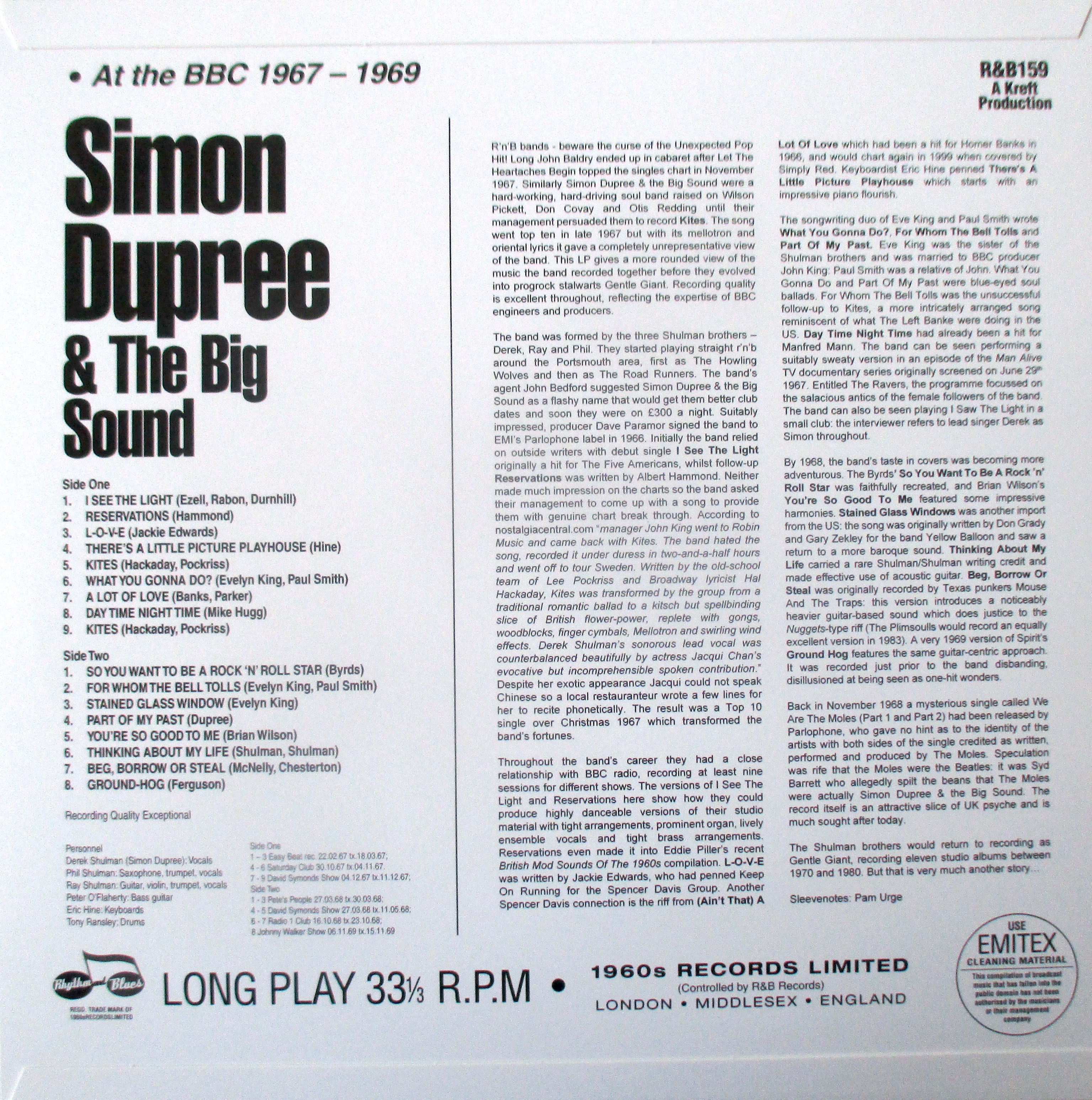
Simon Dupree & the Big Sound
Live at the BBC 1967 – 1969
Tracklisting
Side One
1. I See The Light (Ezell, Rabon, Durrill)
2. Reservations (Hammond)
3. L-O-V-E (Jackie Edwards)
4. There’s A Little Picture Playhouse (Hine)
5. Kites (Hackaday, Pockriss)
6. What You Gonna Do? (King, Smith)
7. A Lot Of Love (Banks, Parker)
8. Day Time Night Time (Hugg)
9. Kites (Hackaday, Pockriss)
Side Two
1. So You Want To Be A Rock ‘n’ Roll Star (McGuinn, Hillman)
2. For Whom The Bell Tolls (King, Smith)
3. Stained Glass Window (Grady, Zekley)
4. Part Of My Past (King, Smith)
5. You’re So Good To Me (Wilson)
6. Thinking About My Life (Shulman, Shulman)
7. Beg, Borrow Or Steal (Ronnie Weiss)
8. Ground-Hog (Traditional)
Recording Details
Side One
Tracks 1 – 3 recorded for Easy Beat on 22.02.67, transmitted 18.03.67
Tracks 4 – 5 recorded for Saturday Club on 30.10.67, transmitted 4.11.67
Tracks 7 – 9 recorded for The David Symonds Show on 04.12.67, transmitted 11.12.67
Side Two
Tracks 1 – 3 recorded for Pete’s People on 27.03.68, transmitted 30.03.68
Tracks 4 – 5 recorded for David Symonds Show on 27.03.68, transmitted 11.05.68
Tracks 6 – 7 recorded for Radio 1 Club on 16.10.68, transmitted 23.10.68
Track 8 recorded for The Johnny Walker Show on 06.11.69, transmitted on 15.11.69
Recording Quality
Excellent throughout
Personnel
Derek Shulman: Vocals
Phil Shulman: Saxophone, trumpet, vocals
Ray Shulman: Guitar, violin, trumpet, vocals
Peter O’Flaherty: Bass guitar
Eric Hine: Keyboards
Tony Ransley; Drums
Sleevenotes
R’n’B bands – beware the curse of the Unexpected Pop Hit! Long John Baldry ended up in cabaret after Let The Heartaches Begin topped the singles chart in November 1967. Similarly Simon Dupree & the Big Sound were a hard-working, hard-driving soul band raised on Wilson Pickett, Don Covay and Otis Redding until their management persuaded them to record Kites. The song went top ten in late 1967 but with its mellotron and oriental lyrics it gave a completely unrepresentative view of the band. This LP gives a more rounded view of the music the band recorded together before they evolved into progrock stalwarts Gentle Giant. Recording quality is excellent throughout, reflecting the expertise of BBC engineers and producers.
The band was formed by the three Shulman brothers – Derek, Ray and Phil. They started playing straight r’n’b around the Portsmouth area, first as The Howling Wolves and then as The Road Runners. The band’s agent John Bedford suggested Simon Dupree & the Big Sound as a flashy name that would get them better club dates and soon they were on £300 a night. Suitably impressed, producer Dave Paramor signed the band to EMI’s Parlophone label in 1966. Initially the band relied on outside writers with debut single I See The Light originally a hit for The Five Americans, whilst follow-up Reservations was written by Albert Hammond. Neither made much impression on the charts so the band asked their management to come up with a song to provide them with genuine chart break through. According to nostalgiacentral.com “manager John King went to Robin Music and came back with Kites. The band hated the song, recorded it under duress in two-and-a-half hours and went off to tour Sweden. Written by the old-school team of Lee Pockriss and Broadway lyricist Hal Hackaday, Kites was transformed by the group from a traditional romantic ballad to a kitsch but spellbinding slice of British flower-power, replete with gongs, woodblocks, finger cymbals, Mellotron and swirling wind effects. Derek Shulman’s sonorous lead vocal was counterbalanced beautifully by actress Jacqui Chan’s evocative but incomprehensible spoken contribution.” Despite her exotic appearance Jacqui could not speak Chinese so a local restauranteur wrote a few lines for her to recite phonetically. The result was a Top 10 single over Christmas 1967 which transformed the band’s fortunes.
Throughout the band’s career they had a close relationship with BBC radio, recording at least nine sessions for different shows. The versions of I See The Light and Reservations here show how they could produce highly danceable versions of their studio material with tight arrangements, prominent organ, lively ensemble vocals and tight brass arrangements. Reservations even made it into Eddie Piller’s recent British Mod Sounds Of The 1960s compilation. L-O-V-E was written by Jackie Edwards, who had penned Keep On Running for the Spencer Davis Group. Another Spencer Davis connection is the riff from (Ain’t That) A Lot Of Love which had been a hit for Homer Banks in 1966, and would chart again in 1999 when covered by Simply Red. Keyboardist Eric Hine penned There’s A Little Picture Playhouse which starts with an impressive piano flourish.
The songwriting duo of Eve King and Paul Smith wrote What You Gonna Do?, For Whom The Bell Tolls and Part Of My Past. Eve King was the sister of the Shulman brothers and was married to BBC producer John King: Paul Smith was a relative of John. What You Gonna Do and Part Of My Past were blue-eyed soul ballads. For Whom The Bell Tolls was the unsuccessful follow-up to Kites, a more intricately arranged song reminiscent of what The Left Banke were doing in the US. Day Time Night Time had already been a hit for Manfred Mann. The band can be seen performing a suitably sweaty version in an episode of the Man Alive TV documentary series originally screened on June 29th 1967. Entitled The Ravers, the programme focussed on the salacious antics of the female followers of the band. The band can also be seen playing I Saw The Light in a small club: the interviewer refers to lead singer Derek as Simon throughout.
By 1968 the band’s taste in covers was becoming more adventurous. The Byrds’ So You Want To Be A Rock’n’Roll Star was faithfully recreated, and Brian Wilson’s You’re So Good To Me featured some impressive harmonies. Stained Glass Windows was another import from the US: the song was originally written by Don Grady and Gary Zekley for the band Yellow Balloon and saw a return to a more baroque sound. Thinking About My Life carried a rare Shulman/Shulman writing credit and made effective use of acoustic guitar. Beg, Borrow Or Steal was originally recorded by Texas punkers Mouse And The Traps: this version introduces a noticeably heavier guitar-based sound which does justice to the Nuggets-type riff (The Plimsoulls would record an equally excellent version in 1983). A very 1969 version of the traditional Ground-Hog features the same guitar-centric approach. It was recorded just prior to the band disbanding, disillusioned at being seen as one-hit wonders.
Back in November 1968 a mysterious single called We Are The Moles (Part 1 and Part 2) had been released by Parlophone, who gave no hint as to the identity of the artists with both sides of the single credited as written, performed and produced by The Moles. Speculation was rife that the Moles were the Beatles: it was Syd Barrett who allegedly spilt the beans that The Moles were actually Simon Dupree & the Big Sound. The record itself is an attractive slice of UK psyche and is much sought after today.
The Shulman brothers would return to recording as Gentle Giant, recording eleven studio albums between 1970 and 1980. But that is very much another story…
Sleevenotes: Pam Urge
Special thanks to Syd Kreft
 Only Rock 'n' Roll