
New vinyl LPs from The Faces, Small Faces and The Beach Boys
Available now from http://www.1960s.london

(Ronnie’s Last Stand)
The Faces Live at Edmonton Sundown June 4th 1973
Tracklisting
Side One
- Cindy Incidentally (Stewart, Wood, McLagan)
- Angel (Hendrix)
- True Blue (Stewart, Wood)
- I’d Rather Go Blind (Foster, Jordan)
- Borstal Boys (McLagan, Wood, Stewart)
Side Two
- Jealous Guy (Lennon)
- You Wear It Well (Stewart, Quittenton) /
- Maggie May (Stewart, Quittenton)
- Twistin’ The Night Away (Cooke)
- Memphis, Tennessee (Berry)
- We’ll Meet Again (Parker, Charles)
Personnel
Rod Stewart – vocals
Ronnie Wood – guitar, vocals
Ronnie Lane – bass, vocals
Ian McLagan – keyboards
Kenney Jones – drums
Recording Details
All tracks recorded live at the Edmonton Sundown on June 4th 1973 and broadcast as the Mike Mansfield Television special Ooh La La
Recording Quality
Excellent throughout
Sleevenotes
With the March 1973 release of studio album number four Ooh La La The Faces were at the height of their popularity and the LP went straight to number one in the UK charts. However the even greater solo success of singer Rod Stewart had caused tensions within the band. Speaking to Melody Maker Stewart ill-advisedly criticised the new LP as “a bloody mess…a disgrace”. Keyboards player Ian McLagan responded that “he could have contributed more to it but he didn’t so he had even less of a reason to criticise.” Bass player Ronne Lane was feeling disillusioned with the music industry in general and with Rod Stewart in particular. and decided that he would leave the band he had co-founded. The May 19th edition of Sounds magazine announced that The Faces were to headline three gigs at the 3,500 capacity Edmonton Sundown in North London on June 1st, 3rd and 4th. When, the following week, the same magazine announced that “Plonk Quits Faces” and that these gigs would be his last, demand went through the roof with fans queuing for over seven hours for tickets.
The Faces manager Billy Gaff was keen to commemorate Lane’s final appearance and commissioned director/producer Mike Mansfield to film the last night. A lavish set featured lush potted palms and a silver candlestick on Mac’s Steinway piano. Kenny Jones’ drums were white, black and pink striped, like liquorice allsorts. The band were preceded by a troupe of twelve can-can girls, prancing and cartwheeling in a very non-PC way. Crowd shots show the Faces faithful fans at their most fervent – as many girls as boys, tartan scarves everywhere and a few home-made “Farewell Ronnie We Love You” signs.
A perusal of the setlist shows a further source of unease: six songs are from Rod Stewart’s solo albums whilst a mere three were recorded as The Faces. Mansfield omits the first numbers – possibly Miss Judy’s Farm and Silicone Grown – and we join the band for Cindy Incidentally. The song is based on a McLagan piano riff (“Memphis played backwards”) and reached number two when released as a Faces single. Stewart is looking restrained in a sparkly vest and white satin strides, Lane is wearing a green three-piece tonic suit whilst guitarist Ronnie Wood favours an extraordinary, toreador-inspired two piece. Even the roadies are formally dressed and appropriately look like old-school bar tenders. Scarves are held aloft for Angel, the Hendrix ballad that Stewart had made his own but here sung extensively by the audience. Whilst True Blue had appeared on Stewart’s solo album Never A Dull Moment (1972) it was a Wood/Stewart composition and the studio backing had been provided by The Faces. The song fits into the Faces live set beautifully and its presence would have improved Ooh La La, fuelling the suspicion that Stewart was keeping the best material for his solo career. Lane, Wood and Stewart all harmonise around a single microphone and Wood blasts off on his trademark black and silver Tony Zemaitis guitar as the tempo of the song picks up. I’d Rather Go Blind had been associated with Etta James and Chicken Shack: here it is a tour de force for Stewart’s vocal prowess and a tasteful Ronnie Wood coda, underpinned by McLagan’s organ. The opening riff to Borstal Boys gets a great crowd response with Kenney Jones driving the song and Stewart opting for a lie-down halfway through. Mac honky-tonks, Ronnie Wood plays a short slide guitar solo that distils what he used to do every night on Plynth and Rod does his impersonation of a drum majorette using his special lightweight mic stand.
Side Two opens with a version of John Lennon’s Jealous Guy, based on Donny Hathaway’s live arrangement: inexplicably it was never included on a Faces studio LP. During a medley of You Wear It Well and Maggie May Rod gives up singing the opening lines and lets the crowd do it for him. All night Ronnie Lane had been pacing the stage playing his melodic bass lines and singing the occasional backing vocal but very much keeping himself to himself. Now Stewart addresses him as “Old Pal” and asks “Shall we do Twistin’ The Night Away before they close?”. To which Ronnie looks at his watch and says ruefully “Too late. They closed”. Twistin’ The Night Away makes for a thunderous set-closer, with Kenny’s rat-a-tat drums and the crowd going nuts whilst the band are deluged in confetti. For an encore Rod asks the audience to chose between Memphis and Losing You. He adjudges that Memphis has the greater vocal support. Introduced by McLagan’s barrelhouse piano, the song builds in momentum as it speeds up. Finally the band gather at the front of the stage with their arms around each other for a slightly ironic rendition of We’ll Meet Again
“That last night at Edmonton was absolutely fucking fantastic. I was up in the balcony and it was moving. I was shitting meself because I thought it was all going to collapse. Ronnie left there that night and he came with me in the motor and we went to Tramp. He sees Marc Bolan, goes up to him and says, ‘You haven’t got a job for an out of work bass player, have ya?’”. Stan Lane, from Had Me A Real Good Time (Andy Neil)
Sleevenotes: Mathias Rosey

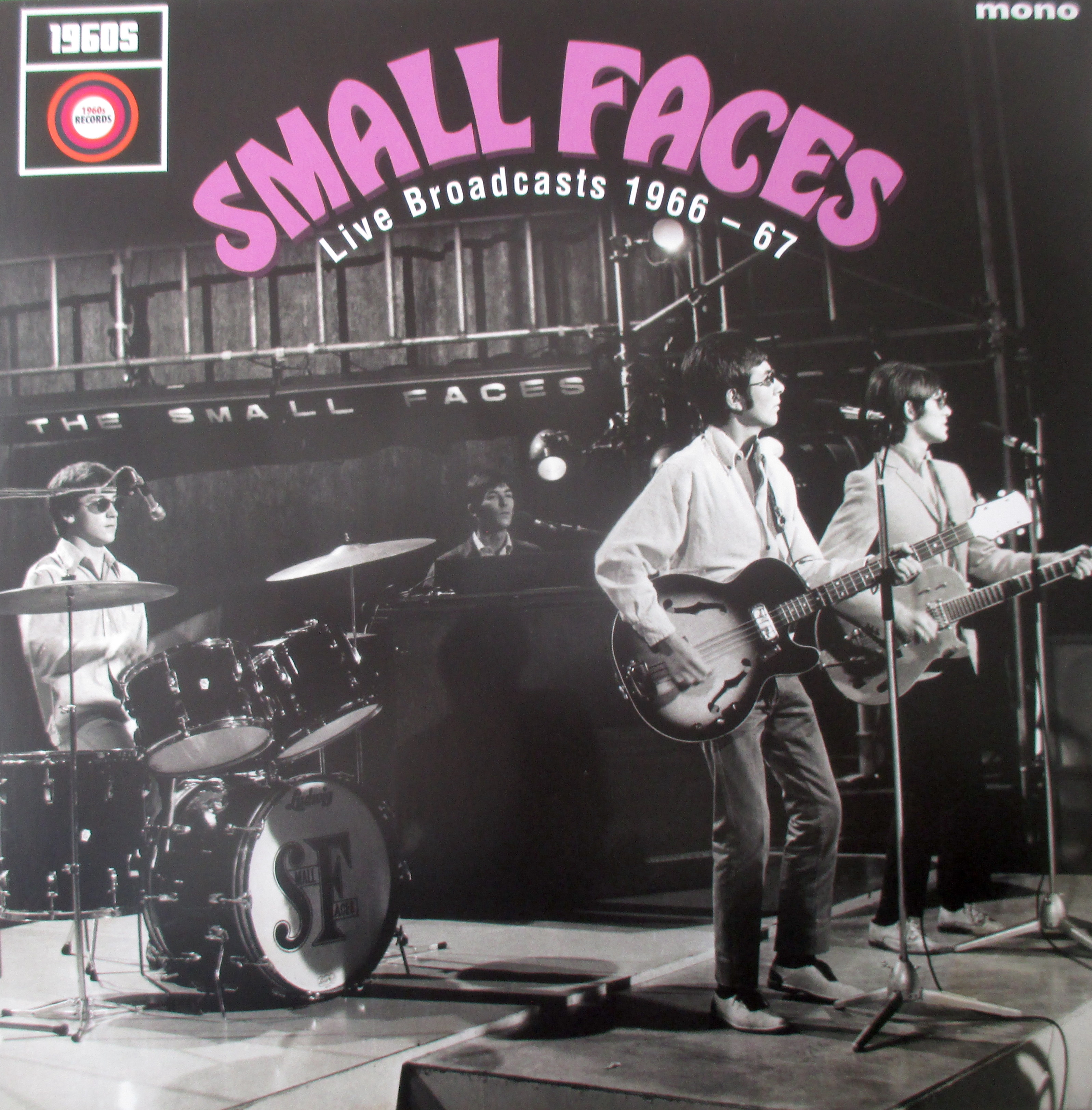
Broadcasts 1996 – 67
The Small Faces
Tracklisting
Side One
- Hey Girl (Marriott, Lane)
- All Or Nothing (Marriott, Lane)
- What’cha Gonna Do About It (Potter, Samwell)
- Sha-La-La-La-Lee (Lynch, Shulman)
- You Really Got A Hold On Me (Robinson)
- All Or Nothing (Marriott, Lane)
- Sha-La-La-La-Lee (Lynch, Shulman)
- I Can’t Make It (Marriott, Lane)
- All Or Nothing (Marriott, Lane)
Side Two
- Sha-La-La-La-Lee (Lynch, Shulman)
- What’cha Gonna Do About It (Potter, Samwell)
- Comin’ Home Baby (Dorough, Tucker)
- You Need Loving (Marriott, Lane)
- Shake (Cooke)
- You Really Got A Hold On Me (Robinson)
- Plum Nellie (Booker T & The M.G.’s) /
- You Need Loving (Marriott, Lane) /
- Baby Please Don’t Go (Williams)
Recording Details
Side One
Tracks 1 – 4 recorded at the Offenbach Stadhalle for HT TV Beat Beat Beat on September 28th 1966
Track 5 recorded for the BBC The Joe Loss Radio Show on March 11th 1966
and transmitted live
Track 6 recorded for BBC Top Of The Pops ’66 Part 2 on December 14th 1966, transmitted on December 27th
Track 7 recorded for BBC TV Top Of The Pops ’66 Part 1 on December 13th 1966, transmitted on December 26th
Tracks 8 & 9 recorded for Associated TV The Morecambe & Wise Show at Elstree Studio Centre, Hertfordshire on April 18th 1967 and broadcast on October 22nd.
Side Two
Tracks 1- 4 recorded for the BBC The Joe Loss Radio Show on January 14th 1966 and transmitted live
Track 5 recorded for the BBC The Joe Loss Radio Show on March 11th 1966
and transmitted live
Track 6 recorded for BBC Saturday Club on March 14th and transmitted on March 19th
Tracks 7 – 9 recorded at The Marquee, London by the Canadian Broadcasting Corporation (CBCTV) on March 22nd 1966
Personnel
Steve Marriott – Guitar, vocals
Ronnie Lane – Bass, vocals
Ian McLagan – Keyboards, vocals
Kenney Jones – Drums
Recording Quality
Very good throughout
Sleevenotes
“In many ways the Small Faces have been the group that sums up all groups: they have that classic group gift for self-delusion. They’ve thought themselves artists when they’ve only been loons, they’ve talked endlessly about getting themselves together and making masterpieces, but somehow they wound up in the discotheques instead. Finally none of the crap mattered: they’ve meant fun and they’ve lasted. Little and fierce and pantomime, they’ve come to be one of my most favourite acts.”
Nik Cohn (1970) WopBopaLooBopLopBamBoom
Was there ever a better pop group than the Small Faces? Brilliant songwriting, great musicianship, innovative recordings, fashionable gear, on-stage dynamism – they had it all, as this compilation shows.
The opening four tracks on Side One come from an early German TV appearance, filmed in front of a youthful, clean-cut crowd of dancers. Hey Girl was the first successful single to be written by Steve Marriott and Ronnie Lane. Marriott is in perpetual motion whilst the gruff backing vocals are shared between a dapper Lane and Ian McLagan. All Or Nothing was the band’s only number one single, displacing the Beatles’ Yellow Submarine. The alternating quiet and loud passages showed a new sophistication and showcased the controlled power in Marriott’s lead vocal. Debut single What’cha Gonna Do About is delivered with a punky intensity: no surprise that the song featured at early Sex Pistols gigs. Sha-La-La-La-Lee benefits from a live performance with Marriott yelling “One more!” to rally the troops. The impact that the Small Faces had in 1966 was illustrated by the BBC asking them to play both Sha-La-La-La-Lee and All Or Nothing on their summary of the year’s top hits. Top Of The Pops ’66 aired on BBC TV over successive nights at the end of December, one song per night.
The Morecambe & Wise Show was primetime UK Saturday night television in 1967, so a guest spot was great exposure. After a tortuous introduction from Eric Morecambe the band play I Can’t Make It. The hair is longer, there are cravats and extended shirt collars. The version of All Or Nothing highlights Kenney’s explosive drumming, he now has Small Faces writ large on his bass drum. There is even a little bow from Steve and Ronnie at the end.
The Joe Loss Radio Show is a rich source of live recordings from 1966. A typical session would start with a rehearsal at 10:00, with the session itself transmitted live between 13:00 and 14:00. The session from January featured perennials Sha-La-La-La-Lee and What’cha Gonna Do About It. More unusual was the band’s version of Comin’ Home Baby. Originally a hit for Mel Torme, the song was originally a jazz instrumental written by bassist Ben Tucker of The Dave Bailey Quintet. Ben subsequently persuaded his friend Bob Dorough to write a lyric but the Small Faces’ version is performed as a lively instrumental. The final song is Willie Dixon’s You Need Love, later to be retitled You Need Loving on the Small Faces debut LP and given a cheeky Marriott/Lane writing credit. The final “woman…you need…love” vocal may sound familiar to Led Zeppelin, who were equally cavalier with songwriting credits.
The band were back in the Joe Loss radio studio in March to record a further two tracks, both covers of American r’n’b artists: the band grew up listening to Stax and Motown and it shows. This recording of Smokey Robinson’s You Really Got A Hold On Me was inexplicably omitted from the official BBC Sessions release. Taking the song at a slower pace than the Miracles original allows Marriott to testify. For Sam Cooke’s Shake McLagan’s organ is to the fore, interspersed with Kenney Jones’ drum breaks. At the same session a further version of You Really Got A Hold On Me was recorded and transmitted live.
Also in March the Small Faces made their debut at the legendary London club The Marquee, at its original location in the basement of the Academy Cinema on Oxford Street. Part of their performance was filmed for a Canadian TV documentary. After a brief snippet of Booker T & The M.G.’s instrumental Plum Nellie the bandpower through You Need Loving. Big Joe Williams’ Baby Please Don’t Go was best known from the version recorded by Them. Here Marriott cuts loose on lead guitar, ably supported by McLagan’s organ and the peerless Lane/Jones rhythm section.
“The best mod-rockers? Maybe. The Small Faces somehow made all their originality safe underneath perfect pop singles.” Brian Hogg, Bam Balam magazine (1977)
Sleevenotes: Rolan Over


Live at Fillmore East
The Beach Boys
Tracklisting
Side One
- Heroes And Villains (B Wilson, Parks)
- Do It Again (B Wilson, Love)
- Cotton Fields (Ledbetter)
- Help Me, Rhonda (B Wilson, Love)
- Wouldn’t It Be Nice? (B Wilson, Love, Asher)
- Your Song (John, Taupin)
Side Two
- Student Demonstration Time (Leiber, Stoller, Love)
- Good Vibrations (B Wilson, Love)
- California Girls (B Wilson, Love)
- I Get Around (B Wilson, Love)
- It’s About Time (D Wilson, Jardine, Burchman)
- Wouldn’t It Be Nice? (B Wilson, Love, Asher)
- Cool, Cool Water (B Wilson, Love)
Recording Details
Side One and Side Two tracks 1-5 recorded during the closing week of the Fillmore East, New York on June 27th 1971 and broadcast live on FM radio stations WNEW and WPLJ.
Side Two tracks 6 & 7 recorded live in New York and broadcast on The David Frost Show on May 7th 1971
Personnel
Carl Wilson – guitar, vocals
Alan Jardine – guitar, vocals
Bruce Johnston – bass, keyboards, vocals
Dennis Wilson – vocals, drums
Mike Love – vocals, percussion
Daryl Dragon – keyboards, synthesizer
Dennis Dragon – percussion
Mike Kowalski – drums
Sleevenotes
“You know, they’re pretty fucking good.” That was Bob Dylan’s verdict on watching the Beach Boys perform as special guests of the Grateful Dead during their April 1971 residency at Bill Graham’s Fillmore East. Having signed to Reprise in 1970 the band’s first LP for their new label was Sunflower, a strong selection of songs written by the whole group. New manager Jack Rieley ended the wearing of matching attire onstage and promoted Carl Wilson to band leader. He also encouraged the band to write more ecological and socially aware lyrics, a process that would culminate with the release of Surf’s Up in August 1971.
The final night at the Fillmore was an invitation-only event. The scheduled acts – the Allman Brothers, Albert King and the J.Geils Band – were joined by special guests Edgar Winter’s White Trash, Mountain, Country Joe and the Beach Boys. This concert came towards the end of the Surf’s Up recording sessions: the only track included is Student Demonstration Time, the band’s rewrite of the Robins’ Riot In Cell Block #9. Brian Wilson was on hiatus from touring and Dennis Wilson was unable to drum, having accidentally punched his hand through a plate glass window. Bolstered by replacement musicians the band are on fine form both vocally and instrumentally, as demonstrated by set-opener Heroes And Villains. Do It Again benefits from an extended introduction and the use of a horn section. The groups peerless vocal harmonies are showcased on Cotton Fields, supported by some groovy organ and the horns again. Carl Wilson’s lead vocal drives a mid-paced version of Help Me Rhonda. An exuberant Wouldn’t It Be Nice? is warmly received. The next song is a real rarity – Bruce Johnston singing Elton John’s Your Song, a US hit the previous year. Student Demonstration Time turns out to be a rollicking live number, with sirens and honky-tonk piano and some effective saxophone honking. Set closer is a remarkable Good Vibrations that captures much of the complexity of the recorded version, right down to the flute, whilst still rocking out.
The enthusiastic audience response brings the band back for a three number encore. A double whammy of California Girls and I Get Around provides a heady dose of nostalgia: the performances are vibrant and enthusiastic. The final song is the only selection from Sunflower. It’s About Time brings the Beach Boys up to date, some incisive rhythm guitar providing a gritty base for their trademark harmonies.
As a bonus we include two live tracks from The David Frost Show. Theversion of Wouldn’t It Be Nice sticks to the studio arrangement, although there are some changes to the lyrics. More unusual is the performance of Cool, Cool Water. Although released on Sunflower the track evolved from the song Love To Say Dada recorded for Smile. The track had been released as a single in March 1971. Bruce Johnstone moves from bass to keyboards as he helps with the intricate harmonies.
Introducing the band at the Fillmore Bill Graham described the Beach Boys as “one of the great, great, great sounds”. The release of Surf’s Up would result in a critical re-appraisal of the band, but this fine quality recording demonstrates that all the necessary components were already in place for their artistic renaissance.
Sleevenotes
Carol Lynne-Noh

 Only Rock 'n' Roll