
New Vinyl: Spooky Tooth, Blodwyn Pig, Humble Pie and Van Morrison
All available now from http://www.1960s.london
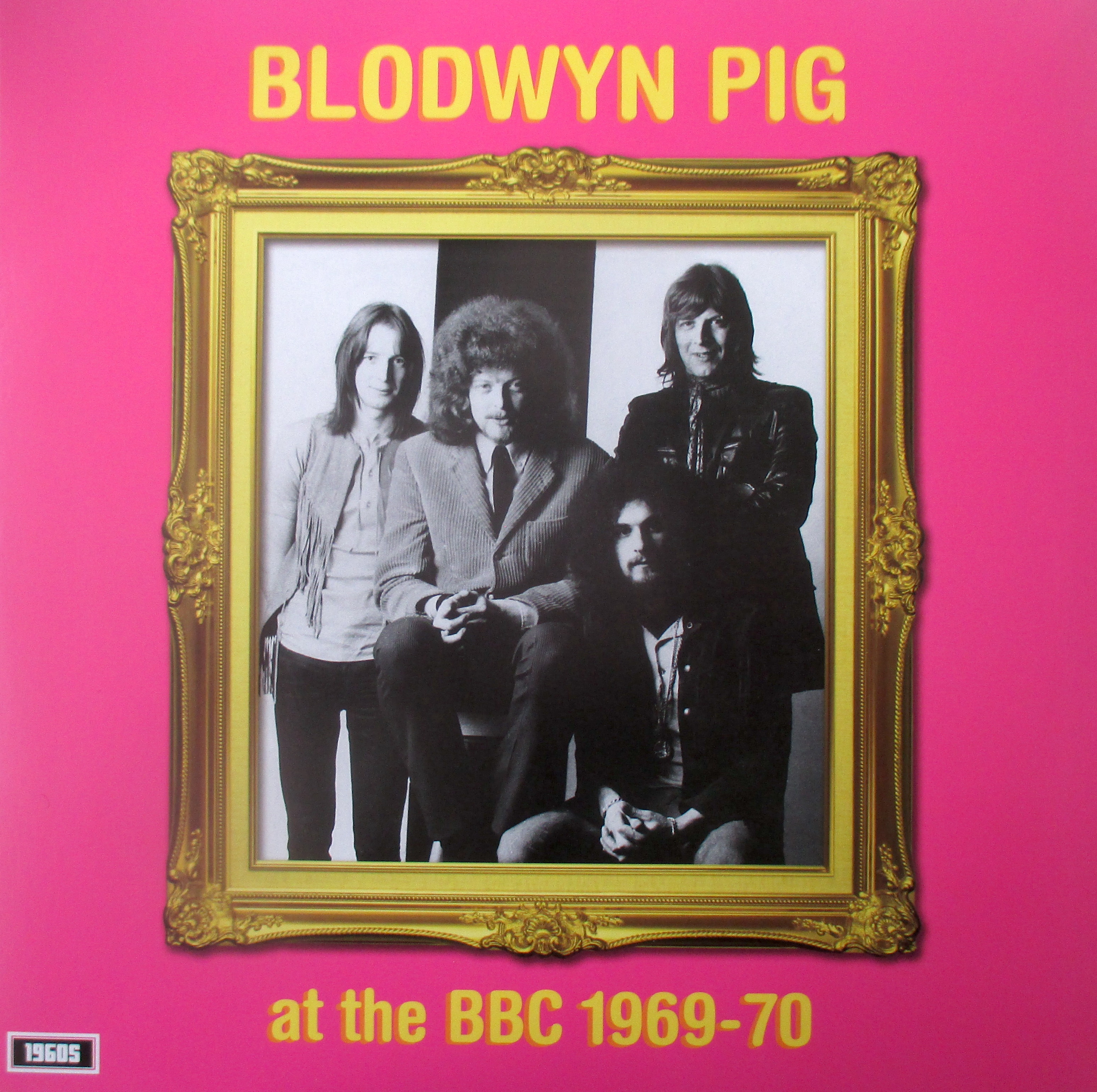
Blodwyn Pig At The BBC 1969 -70
Tracklisting
Side One
- Ain’t Ya Coming Home, Babe? (Abrahams, Lancaster, Pyle)
- The Change Song (Abrahams)
- It’s Only Love (Abrahams)
- The Modern Alchemist (Lancaster)
- Mr. Green’s Blues (Lancaster, Abrahams, Berg)
- It’s Only Love (Abrahams)
Side Two
- Worry (Pyle)
- Somebody Like Me (Abrahams, Fensome)
- See My Way (Abrahams)
- Meanie Mornay (Abrahams)
- Rock Me Baby (Josea, King)
- Same Ol’ Story (Abrahams)
Recording Details
Side One was recorded for BBC radio as follows:
Tracks 1 & 5 recorded on March 24th 1969 for Top Gear, transmitted on 13th April
Track 2 recorded on 24th February 1969 for Symonds on Sunday, transmitted on 2nd March
Track 3, 4 and 6 recorded for Top Gear, transmitted on 18th May 1969
Side Two
Track 1 recorded for BBC radio Top Gear on 29th May 1970 and transmitted on 10th July
Track 2 recorded for BBC World Service Rhythm & Blues, recorded and transmitted 1970
Track 3 & 4 recorded on 30th March 1970 for BBC radio Sounds Of The Seventies, transmitted on April 14th
Track 5 recorded for BBC radio Top Gear on 29th May 1970 and transmitted on 10th July
Track 6 recorded for BBC TV Top Of The Pops and transmitted on January 29th 1970
Personnel
Mick Abrahams – guitar, vocals
Andy Pyle – bass
Jack Lancaster – soprano saxophone, tenor saxophone, bass flute, violin
Ron Berg – drums
Sleevenotes
Many music fans only know Blodwyn Pig as the band that guitarist Mick Abrahams formed after he left Jethro Tull, but they were successful in their own right with two top ten LPs and a reputation as an exciting live band. Abrahams joined his first band The Crusaders in 1964. Next came a stint with Alexis Korner in Blues Incorporated where he met drummer Clive Bunker. This was followed by The Toggery Five and then McGregory’s Engine. McGregory’s Engine then merged with the group John Evan’s Smash, whose members included Ian Anderson and Glen Cornick, to form Jethro Tull. Abrahams blues guitar was a strong feature of debut album This Was (1968) and second single A Song For Jeffrey but his stay in Jethro Tull was short-lived. “ I got very pissed off with Ian, who saw Tull as his band, and wasn’t prepared to let anyone else voice their opinion on what was going on,” Mick explained in 2024 to Malcolm Dome of Prog magazine. “So I left. But I told them that I’d stay on until they found a replacement for me, because there was no way I wanted to leave them in the shit. A short while later, I was called to a meeting at the office of Terry Ellis, the band’s manager, who said ‘Ian and the boys don’t want you in the band any more so you’ve been fired.’ I just replied to Terry, ‘How can you fire me when I quit three weeks ago?’”
Mick had strong views of what he wanted his next band to be. They were named Blodwyn Pig by Mick’s friend Graham Waller, ‘Blodwyn’ being Welsh for ‘love’. “I’ve always thought of myself as a blues player, but with a little country, jazz and other styles thrown in for good measure. I never wanted us to be seen as performing one type of music or another. Some called us blues while there were those who insisted we were progressive. And when we did Top Of The Pops, the band were introduced as being ‘avant-garde’. It would have been closer to the point to call us ‘aven’t a fucking clue’!”. Rhythm section Andy Pyle and Ron Berg plus multi-instrumentalist Jack Lancaster were all strong musicians. However their ability to operate across a wide range of styles made it more difficult for the band to forge a coherent musical identity, as we can hear in the recordings made for the BBC through the support of John Peel and the other late-night DJs.
Taken from debut LP Ahead Rings Out (1969) Ain’t Ya Coming Home, Babe? illustrates this well. After a spoken-word introduction, Lancaster wails on sax and an extended guitar-solo from Abrahams follows, all over the top of a distinctly non 4/4 beat. The Change Song is more thoughtful, based around acoustic guitar and violin and with Abrahams’ country influences coming through. Two versions of It’s Only Love showcase an uptempo rocker where the brass helps drive the song. Lancaster wrote The Modern Alchemist and his jazz influence is to the fore with Abrahams guitar responding in the same idiom. Mr Green’s Blues never made it on to either studio LP: the lyric “he got the blues cos he got the greens!” refers to Peel’s vegetarian eating habits. Here Abrahams’ guitar combines well with Lancaster’s flute in a more recognisable twelve-bar blues.
Abrahams wrote Worry but gifted the songwriting to Andy Pyle who was complaining about his lack of credits on the second studio album LP, Getting To This (1970). See My Way also came from the second LP and sounds more ‘progressive’ with Abrahams demonstrating his speed and fluidity. Somebody Like Me is unavailable elsewhere and features Lancaster on violin. Meanie Mornay was another song not included on either studio LP and highlights Abrahams’ slide guitar. A cover of B.B. King’s Rock Me Baby enables Mick Abrahams to demonstrate his considerable ability to play a straight blues. At a time when groups such as Deep Purple and Black Sabbath were starting to have hit singles, Blodwyn Pig were invited to play Same Ol’ Story on Top Of The Pops. A stand-alone single and a catchy number, Same Ol’ Story was not a hit, despite the band looking suitably ‘heavy’ with lots of hair and fringed jerkins. Lancaster demonstrated his ability to play two saxes at once, a homage to key influence Rahsaan Roland Kirk.
Sadly in 1970 inter-band tensions resulted in Abrahams effectively being sacked from the group he had formed. Since then Aerosmith has cited Blodwyn Pig as an influence, Joey Ramone has covered See My Way and Cameron Crowe selected album track Dear Jill for the soundtrack of Almost Famous (2000). Regrets? Mick Abrahams has a few. “I do feel that had we stayed together this band would have been huge. There was a lot of potential we never got to explore, and we had a unique magic which you can hear on our albums.” And on the twelve tracks included here.
Sleevenotes: Jethro Toe


Spooky Tooth Broadcasts 1966 – 1969
Tracklisting
Side One
- Tobacco Road (Loudermilk)
- Yesterday (Lennon, McCartney)
- Sunshine Help Me (Wright)
- I Can’t Quit Her (Kooper, Levine)
- Evil Woman (Weiss)
- Love Really Changed Me (Wright, Miller, Grosvenor)
- Better By You, Better Than Me (Wright)
Side Two
- Tobacco Road (Loudermilk)
- Oh, Pretty Woman (Williams)
- Feelin’ Bad (Wright, Kellie)
- Better By You, Better Than Me (Wright)
- That Was Only Yesterday (Wright)
- My Babe (Medley, Hatfield)
- I Wanna Be Free (Tex)
- Stagger Lee (Lopez)
Recording Details
Side One
Tracks 1-3 recorded at Gala du MIDEM, Cannes 24.01.68 and broadcast on French TV
Tracks 4 – 6 recorded for BBC Radio Top Gear on 17.06.68
broadcast on 23.06.68
Track 7 recorded for Forum Musiques and broadcast on 24.05.69
Side Two
Track 1 recorded for BBC Radio Top Gear on 21.02.68, broadcast 17.03.68
Tracks 2 & 3 recorded 23.04.69 for BBC Radio Johnnie Walker and broadcast 26.04.69
Tracks 4 & 5 recorded for BBC Radio Top Gear on 03.02.69, broadcast 23.02.69
Track 6 recorded at the First International Festival Of Pop Music, Palais Des Sports, Paris on 14.04.67 and broadcast on French TV
Tracks 7 & 8 recorded for Reveillon Sur Les Deux Chaines 31.12.66 and broadcast on French TV
Sound Quality
The tracks recorded for the BBC are Excellent sound quality, the remaining tracks are Very Good
Personnel
Mike Harrison – keyboards, electric harpsichord, vocals
Luther Grosvenor – guitar
Mike Kellie – drums
Greg Ridley – bass
Gary Wright – keyboards, vocals (except Side Two, tracks 6-8)
Sleevenotes
“Spooky Tooth made a wonderful noise, creating a rushing hybrid of hard white soul and bluesy prog, with a rich inflection of gospel and psychedelia. The twin vocals of Harrison and Wright rang through the air like a hipper, more muscular version of the Righteous Brothers. At other times with Wright singing falsetto against Harrison’s bullish lead and the band blazing behind them they sounded as unbound as anything that West Coast acid rock could offer” Rob Hughes.
Before Spooky Tooth there was The V.I.P.’s, a tough R & B band from Carlisle formed in 1963 by lead singer Mike Harrison and bassist Greg Ridley. The band were eventually signed to Island by A&R extraordinaire Guy Stevens. They became popular in France and Germany but had no success in the UK. Keith Emerson was briefly a member en route to The Nice. After he left the remaining foursome – by now including guitarist Luther Grosvenor and drummer Mike Kellie – morphed into Art at the suggestion of Guy Stevens, who produced their sole LP Supernatural Fairy Tales (1967). Art were also the backing group for fashionable design collective Hapshash And The Coloured Coat on their LP Featuring the Human Host and the Heavy Metal Kids (1967). Neither LP was commercially successful.
The breakthrough came when Island producer Jimmy Miller recommended his New Jersey friend Gary Wright to the band. Wright played keyboards and was a strong vocalist with good songwriting skills. Anglo-American, twin keyboards, twin vocalists: Spooky Tooth was born. The band auditioned for the BBC. They were passed by the panel but comments ranged from “I like the group, loads of attack and screaming feeling” to “loud and pretentious psychedelic rubbish”.
The BBC tracks presented here demonstrate Spooky Tooth’s ability to remodel outside material to fit their distinctive sound. The soulful I Can’t Quit Her was written by Al Kooper and Irwin Levine for the first Blood, Sweat & Tears album. Larry Weiss’s Evil Woman was first released by Guy Darrell in 1967 and subsequently covered by Canned Heat and The Troggs. Here it builds from a delicate keyboard introduction to full-on raver. The catchy Love Really Changed Me was a band original from their first LP It’s All About (1968) but did not chart when released as a single. Tobacco Road had been a pop hit for The Nashville Teens in 1964 but this version is much slower and heavier. Oh, Pretty Woman was an A.C. Williams composition that came to prominence when covered by Albert King in 1966, Grosvenor taking the solo here. Feelin’ Bad was a rare co-write between Gary Wright and Mike Kellie. Wright’s Better By You, Better Than Me appeared on second album Spooky Two(1969). The track is built around an insidious guitar riff and remains Spooky Tooth’s best-known number thanks to a cover version by Judas Priest. That Was Only Yesterday shows a more sensitive side of the band with a subtle keyboard motif complementing the dual vocals of Wright and Harrison.
Spooky Tooth appeared regularly on French television throughout their career. A performance of Tobacco Road from Cannes in 1968 was performed to a seated and bow-tied audience but this did not inhibit the band with Wright’s falsetto particularly impressive. The same session saw the band perform a slow-paced orchestral Yesterday followed by their debut single Sunshine Help Me. A catchy pop song written by Gary Wright, its chart failure took everyone by surprise. The promotional film for Better By You, Better Than Me appears to be recorded live in a barn, preceded by the obligatory shot of the band running round a lake
The V.I.Ps were also filmed performing live for French TV. The band’s 1967 appearance at the First International Festival Of Pop Music in Paris (predating Monterey) saw them covering the Righteous Brothers’ My Babe. Even at this early stage the band’s distinctive sound was in place with Grosvenor’s guitar particularly prominent. The versions of Joe Tex’s I Wanna Be Free and the traditional Stagger Lee demonstrate why they went down so well with continental audiences and makes their lack of success in the UK inexplicable.
In 1969 Ridley left Spooky Tooth to form Humble Pie with Steve Marriott and Peter Frampton. Wright then quit the band after Island MD Chris Blackwell had arranged for Spooky Tooth to record some sessions backing French avant-garde musician Pierre Henry. To the horror of the band the resulting tracks were released under the Spooky Tooth name as Ceremony (1969). According to Harrison, Blackwell later told him “that was the biggest mistake I ever made.”
Spooky Tooth’s career never recovered from this setback and although various incarnations would tour and record until 2009, they lacked the cohesion and focus of the band in their prime. Band members would reappear in a variety of more successful groups including Foreigner, Humble Pie, Mott The Hoople and The Only Ones. Why did Spooky Tooth never achieve the success that was predicted for them? Wright reckons “the recordings peaked when we did our second album Spooky Two, but then we got sidetracked.” Mike Kellie is more direct: “I can’t tell you why we didn’t have hits. But I think we were our own worst enemies. Sometimes we needed a good slap.”
Sleevenotes: Pinque LaBelle


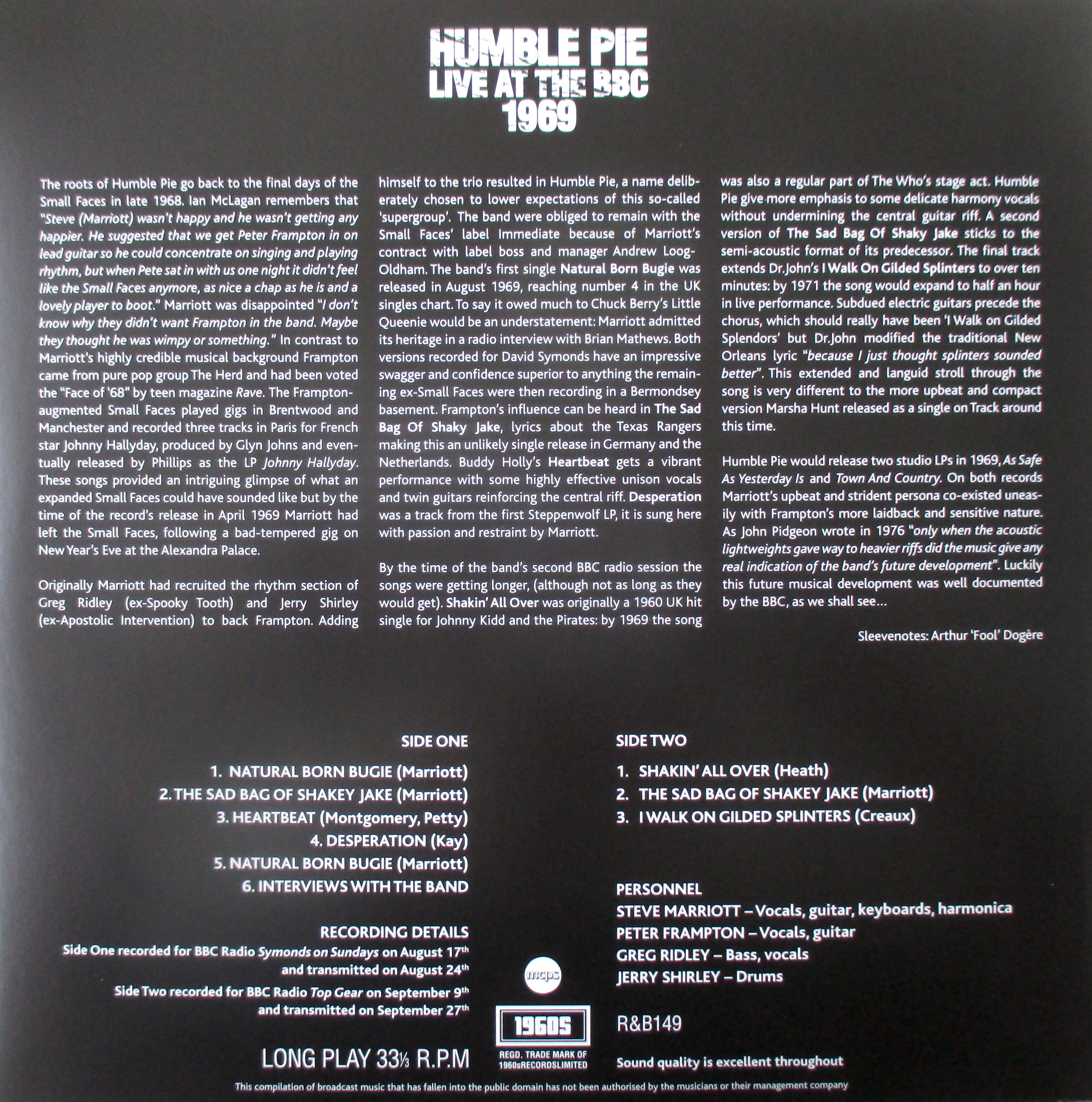
Humble Pie – Live At The BBC 1969
Tracklisting
Side One
- Natural Born Bugie (Marriott)
- The Sad Bag Of Shakey Jake (Marriott)
- Heartbeat (Montgomery, Petty)
- Desperation (Kay)
- Natural Born Bugie – Alternate (Marriott)
Side Two
- Shakin’ All Over (Heath)
- The Sad Bag Of Shakey Jake (Marriott)
- I Walk On Gilded Splinters (Creaux)
Recording Details
Side One recorded for BBC Radio Symonds on Sundays on August 17th and transmitted on August 24th
Side Two recorded for BBC Radio Top Gear on September 9th and transmitted on September 27th
Sound Quality
Sound us Excellent throughout
Personnel
Steve Marriott – Vocals, guitar, keyboards, harmonica
Peter Frampton – Vocals, guitar
Greg Ridley – Bass, vocals
Jerry Shirley – Drums
Sleevenotes
The roots of Humble Pie go back to the final days of the Small Faces in late 1968. Ian McLagan remembers that “Steve (Marriott) wasn’t happy and he wasn’t getting any happier. He suggested that we get Peter Frampton in on lead guitar so he could concentrate on singing and playing rhythm, but when Pete sat in with us one night it didn’t feel like the Small Faces anymore, as nice a chap as he is and a lovely player to boot.” Marriott was disappointed “I don’t know why they didn’t want Frampton in the band. Maybe they thought he was wimpy or something.” In contrast to Marriott’s highly credible musical background Frampton came from pure pop group The Herd and had been voted the “Face of ‘68” by teen magazine Rave. The Frampton-augmented Small Faces played gigs in Brentwood and Manchester and recorded three tracks in Paris for French star Johnny Halliday, produced by Glyn Johns and eventually released by Phillips as the LP Johnny Hallyday. These songs provided an intriguing glimpse of what an expanded Small Faces could have sounded like but by the time of the record’s release in April 1969 Marriott had left the Small Faces, following a bad-tempered gig on News Year’s Eve at the Alexandra Palace.
Originally Marriott had recruited the rhythm section of Greg Ridley (ex-Spooky Tooth) and Jerry Shirley (ex-Apostolic Intervention) to back Frampton. Adding himself to the trio resulted in Humble Pie, a name deliberately chosen to lower expectations of this so-called ‘supergroup’. The band were obliged to remain with the Small Faces’ label Immediate because of Marriott’s contract with label boss and manager Andrew Loog-Oldham. The band’s first single Natural Born Bugie wasreleased in August 1969, reaching number 4 in the UK singles chart. To say it owed much to Chuck Berry’s Little Queenie would be an understatement: Marriott admitted its heritage in a radio interview with Brian Mathews. Both versions recorded for David Symonds have an impressive swagger and confidence superior to anything the remaining ex-Small Faces were then recording in a Bermondsey basement. Frampton’s influence can be heard in the The Sad Bag Of Shaky Jake, lyrics about the Texas Rangers making this an unlikely single release in Germany and the Netherlands. Buddy Holly’s Heartbeat gets a vibrant performance with some highly effective unison vocals and twin guitars reinforcing the central riff. Desperation was a track from the first Steppenwolf LP, it is sung here with passion and restraint by Marriott.
By the time of the band’s second BBC radio session the songs were getting longer, (although not as long as they would get). Shakin’ All Over was originally a 1960 UK hit single for Johnny Kidd and the Pirates: by 1969 the song was also a regular part of The Who’s stage act. Humble Pie give more emphasis to some delicate harmony vocals without undermining the central guitar riff. A second version of The Sad Bag Of Shaky Jake sticks to the semi-acoustic format of its predecessor. The final track extends Dr.John’s I Walk On Gilded Splinters to over ten minutes: by 1971 the song would expand to half an hour in live performance. Subdued electric guitars precede the chorus, which should really have been ‘I Walk on Gilded Splendors’ but Dr.John modified the traditional New Orleans lyric “because I just thought splinters sounded better”. This extended and languid stroll through the song is very different to the more upbeat and compact version Marsha Hunt released as a single on Track around this time.
Humble Pie would release two studio LPs in 1969, As Safe As Yesterday Is and Town And Country. On both records Marriott’s upbeat and strident persona co-existed uneasily with Frampton’s more laidback and sensitive nature. As John Pidgeon wrote in 1976 “only when the acoustic lightweights gave way to heavier riffs did the music give any real indication of the band’s future development”. Luckily this future musical development was well documented by the BBC, as we shall see…
Sleevenotes: Arthur ‘Fool’ Dogère

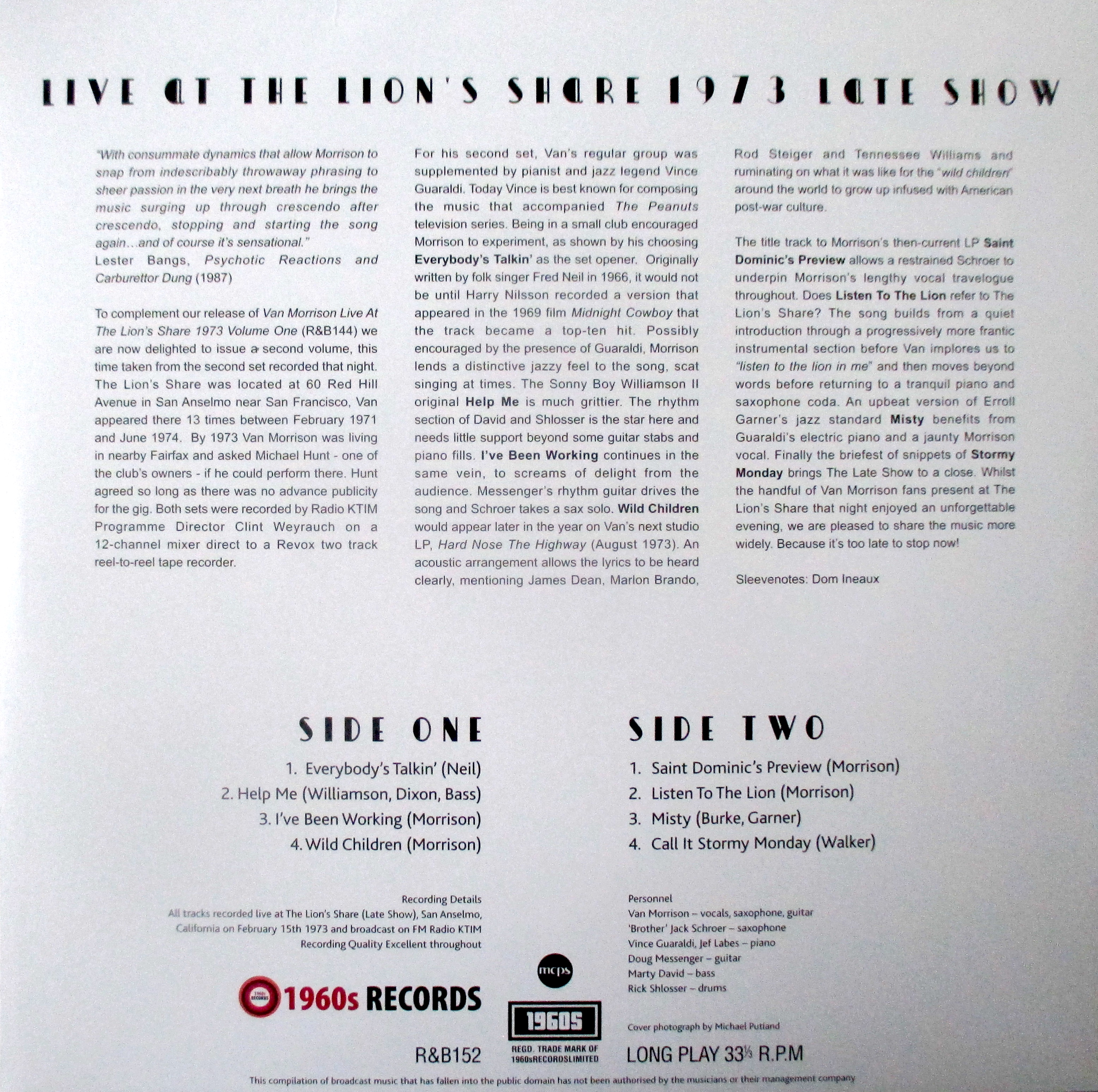
Van Morrison Live At The Lion’s Share 1973 L:ate Show
Tracklisting
Side One
- Everybody’s Talkin’ (Neil)
- Help Me (Williamson, Dixon, Bass)
- I’ve Been Working (Morrison)
- Wild Children (Morrison)
Side Two
- Saint Dominic’s Preview (Morrison)
- Listen To The Lion (Morrison)
- Misty (Burke, Garner)
- Call It Stormy Monday (But Tuesday Is Just As Bad) (Walker)
Personnel
Van Morrison – vocals, saxophone, guitar
‘Brother’ Jack Schroer – saxophone
Jef Labes – piano
Doug Messenger – guitar
Marty David – bass
Rick Shlosser – drums
Vince Guaraldi – piano
Recording Details
All tracks recorded live at The Lion’s Share, San Anselmo, California on February 15th 1973 and broadcast on FM Radio KTIM. All songs are from the Late Show.
Recording Quality
Excellent throughout
Sleevenotes
“With consummate dynamics that allow Morrison to snap from indescribably throwaway phrasing to sheer passion in the very next breath he brings the music surging up through crescendo after crescendo, stopping and starting the song again…and of course it’s sensational.”
Lester Bangs, Psychotic Reactions and Carburettor Dung (1987)
To complement our release of Van Morrison Live At The Lion’s Share 1973 Volume One (R&B??) we are now delighted to issue a second volume, this time taken from the second set recorded that night. The Lion’s Share was located at 60 Red Hill Avenue in San Anselmo near San Francisco, Van appeared there 13 times between February 1971 and June 1974. By 1973 Van Morrison was living in nearby Fairfax and asked Michael Hunt – one of the club’s owners – if he could perform there. Hunt agreed so long as there was no advance publicity for the gig. Both sets were recorded by Radio KTIM Programme Director Clint Weyrauch on a 12-channel mixer direct to a Revox two track reel-to-reel tape recorder.
For his second set, Van’s regular group was supplemented by pianist and jazz legend Vince Guaraldi. Today Vince is best known for composing the music that accompanied The Peanuts television series. Being in a small club encouraged Morrison to experiment, as shown by his choosing Everybody’s Talkin’ as the set opener. Originally written by legendary US folk singer Fred Neil in 1966, it would not be until Harry Nilsson recorded a version that appeared in the 1969 film Midnight Cowboy that the track became a top-ten hit. Possibly encouraged by the presence of Guaraldi, Morrison lends a distinctive jazzy feel to the song, scat singing at times. Help Me is much grittier. Originally sung by Sonny Boy Williamson II the song shares much of its DNA with Green Onions (Booker T. & the M.G.’s). The rhythm section of David and Shlosser is the star here and needs little support beyond some guitar stabs and piano fills. I’ve Been Working continues in the same vein, to screams of delight from the audience. Messenger’s rhythm guitar drives the song and Schroer takes a sax solo. Wild Children would appear later in the year on Van’s next studio LP, Hard Nose The Highway (August 1973). An acoustic arrangement allows the lyrics to be heard clearly, mentioning James Dean, Marlon Brando, Rod Steiger and Tennessee Williams and ruminating on what it was like for the “wild children” around the world to grow up infused with American post-war culture.
The title track to Morrison’s then-current LP Saint Dominic’s Preview allows a restrained Schroer to underpin Morrison’s lengthy vocal travelogue throughout. Does Listen To The Lion refer to The Lion’s Share? The song builds from a quiet introduction through a progressively more frantic instrumental section before Van implores us to “listen to the lion in me” and then moves beyond words before returning to a tranquil piano and saxophone coda. An upbeat version of Erroll Garner’s jazz standard Misty benefits from Guaraldi’s electric piano and a jaunty Morrison vocal. Finally the briefest of snippets of Stormy Monday brings The Late Show to a close. Whilst the handful of Van Morrison fans present at The Lion’s Share that night enjoyed an unforgettable evening, we are pleased to share the music more widely. Because it’s too late to stop now!
Sleevenotes: Dom Ineaux
 Only Rock 'n' Roll