
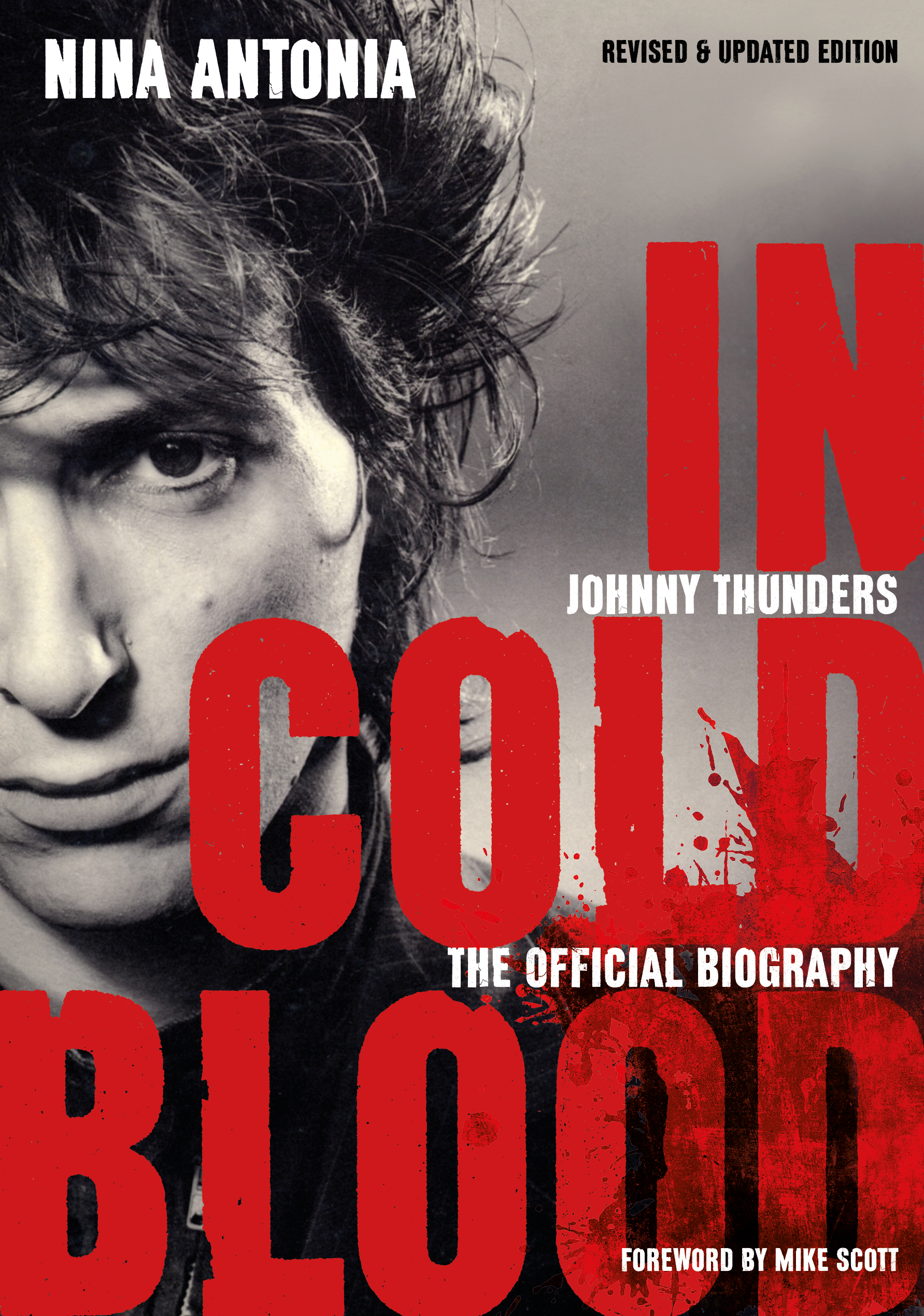
Johnny Thunders – In Cold Blood
Nina Antonia
Jawbone Press (2023)
ISBN 978-1-911036-11-1
When Nina Antonia published the first edition of In Cold Blood in 1987 books about musicians who were not commercially successful were rare. Nina was perceptive enough to realise that whilst Thunders would never be commercially significant, in artistic terms he was already very influential. And so it has proved with the best of Thunders music still revered today, whilst his image has launched a thousand “dangerous “rock bands.
A second edition of In Cold Blood followed in 2000. The later part of Thunders career had not lived up to his early promise. All you really need to hear are his two albums with The New York Dolls, the Heartbreakers sole studio album LAMF and his glorious first solo LP So Alone: the recording of this crucial music is well documented here. Thunders carried on recording and touring until his death in 1991 but never again achieved the same high levels of quality in his studio recordings or in his live shows.
The reason for this? Drugs. Nina rightfully calls out the unhealthy dynamic of an audience coming to latter day Thunders gigs to see what state he’d be in, a ritual that Thunders was not beyond playing up to. Unfortunately the day-to-day demands of a major heroin habit caused Thunders to make poor artistic and commercial decisions which sapped his creativity and gave him a reputation for unreliability.
An antidote to such concerns is to crank up the stereo and put on Thunders in his prime. Listening to Jet Boy, Subway Train, Pirate Love, You Can’t Put Your Arms Around A Memory and so many more tracks recorded from 1973 to 1978 is to be immersed in how rock’n’roll should sound. The combination of an increasingly battered Les Paul Junior and Johnny’s nasal but impassioned vocals cuts through all the bullshit.
This third and final edition of In Cold Blood is the best looking yet. Mike Scott provides a pithy introduction whilst Chrissie Hynde and Bobbie Gillespie eulogise on the back cover. In a newly written final chapter Nina ruminates that “Johnny – like myself – was of a generation that believed in music as if it were a religion, with drugs as it’s unholy sacraments.” Nina became very close to Thunders whilst writing In Cold Blood and whilst that gave her great access it has also resulted in the occasional loss of objectivity.
Thunders’ traumatic early family issues as depicted here were undoubtedly a factor in his reckless behaviour and extensive self-medication. Early intervention and mental-health support of the type that is common today might have made Thunders a less unhappy human being. Would he still have created the vibrant, dangerous musical legacy that Nina celebrates? An uncomfortable question to ask and to answer. In Cold Blood explains how it all happened and successfully makes the case for Thunders continued relevance.

 Only Rock 'n' Roll
Trackbacks & Pingbacks